










By Dr. Gurakuc Kuci
Professor at Universum College in Kosovo and External Associate at the Institute for Hybrid Warfare Studies “OCTOPUS”, specializing in hybrid warfare, geopolitics, and international relations.
Rewriting Antiquity and Constructing the “Latecomer”
For several decades, Serbia has been constructing a narrative architecture aimed at disconnecting Albanians from antiquity, relativizing Albanian historical and national figures, dividing them along religious lines and, ultimately, portraying them as latecomers.
Taken individually, each may appear to be merely a historical debate, but when brought together, they reveal a mechanism. In Serbian historical and nationalist discourse, the thesis that Albanians are not descendants of the Illyrians, but that the Serbs are the descendants of the latter, is being promoted increasingly.
At a gathering held on 21 June 2007 at the premises of the Serbian Academy of Sciences and Arts – SANU, Mihailo Marković called the Illyrian origin of Albanians a “historical falsification”, Mihailo Stanišić linked Albanians to the Caucasus, while Jovan Deretić claimed that Albanians had arrived in the Balkans in the 11th century and that “Illyrians are a synonym for Serbs”. This narrative continues to be pushed increasingly even today.
Stripping Albanians of their antiquity means portraying them as usurpers and occupiers of someone else’s lands. In this way, pseudo-history creates the moral substrate for territorial revisionism, after which expansion is no longer presented as expansion, but as the “reclamation” of land.
Appropriation of Historical Figures and Identity Engineering
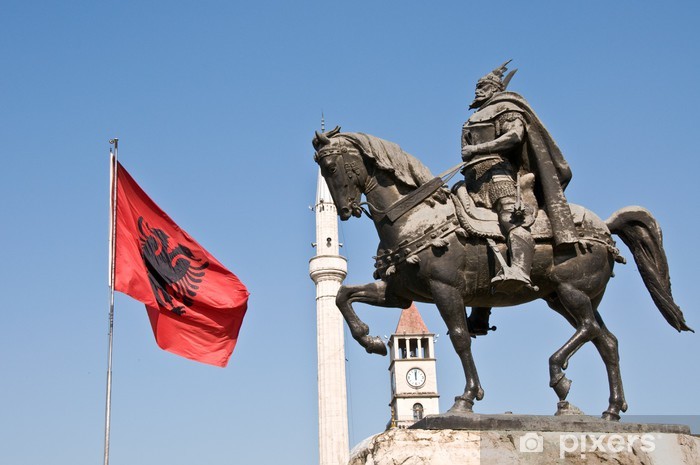
The same logic can also be found in the case of Skanderbeg, where, beyond the debate over the origin of his mother, Voisava, the Serbian narrative has gone much further. Serbian historian Olivera Milosavljević, one of the best-known critics of Serbian nationalist historiography, documents in the study “Skenderbeg je Srbin” that Serbian authors have portrayed Skanderbeg as a Serb, a “half-Serb”, or a “great Serbian hero”.
Vladan Đorđević, in 1913, even claimed that Skanderbeg’s fighters were not Albanians, but Serbs.
Here, the mechanism consists of contesting the Albanians’ historical capacity for state-building, while appropriating any figure who might undermine this thesis. Moreover, to blur the picture even further, narratives are produced claiming that Vladimir Putin has Albanian genes. At first glance, this may appear to be a compliment, but in narrative warfare it can serve to blur identities, relativize them and render them interchangeable, until the boundaries between historical identities begin to disappear. In other words, this is a form of identity engineering.
A similar mechanism can also be observed in relation to Montenegro. Serbia recognized Montenegro as an independent state, but Serbian nationalist discourse has continued to contest the distinct Montenegrin identity and to seek to incorporate it into the Serbian national corpus.
Identity engineering can also materialize in physical space. When religious buildings appear in places where there is no functional community, or no clearly documented functional community, that seeks them, such a building may acquire a function that extends beyond religion: symbolic, identity-related and territorial. In this way, physical space begins to be used to produce memory, presence and a sense of identity-based belonging, as will also become clear from the argument below.
This mixing blurs historical and identity boundaries until the public loses the ability to distinguish between history and propaganda.
Religion, Identity Fragmentation and Hybrid Warfare
The religious dimension is equally important. Skanderbeg was constructed in Albanian collective memory by the figures of the National Awakening as a national symbol transcending religious divisions. Reducing him to an exclusively Christian figure opens the way to reading history through Muslim–Catholic–Orthodox divisions rather than through a shared national identity.
Equally problematic is the reverse process: presenting Albanian Muslim identity as something foreign, Ottoman, or opposed to Albanian identity. In this way, religion is no longer treated as one layer of Albanian identity, but is instead used to create categories of “more authentic” and “less authentic” Albanians. It is precisely here that identity fragmentation begins.
This is particularly dangerous when it coincides with old Serbian nationalist narratives that portray Muslim Albanians as a product of Ottomanization and their presence in certain territories as the result of Islamization, migration, or Ottoman expansion. If a Muslim Albanian is portrayed as less autochthonous because he is Muslim, then a religious debate gradually becomes a historical and territorial argument.
There is also a precedent from the most recent war in Kosovo. The OSCE/ODIHR report “Kosovo/Kosova As Seen, As Told”, based on materials from the OSCE Kosovo Verification Mission – OSCE-KVM, documents that Catholic Albanians were detained, mistreated and expelled in accordance with the general pattern of violence against Albanians.
However, the report also records something else: a very limited number of testimonies indicated that some members of the Yugoslav and Serbian forces distinguished between Catholic and Muslim Albanians and, in certain cases, treated Catholics more favourably.
The OSCE does not characterize this as a general policy of Belgrade. Nevertheless, such differentiated treatment can produce precisely the effect of division and mistrust among Albanians along religious lines.
It is precisely here that a fundamental distinction must be made between intent and effect. It is not necessary for every individual who contributes to religious division to be part of an organized operation or to receive instructions from outside. In hybrid warfare, the convergence of effects also matters. A narrative produced within a society can objectively serve the same strategic objective that an external actor is attempting to achieve.
If the trust and unity that Albanians had managed to strengthen, including through historical processes such as the Blood Feud Reconciliation Movement, are undermined, then shared identity and social cohesion become more vulnerable.
Even today, the risk remains the same: relativizing the elements that keep Albanian identity distinct – origin, language, historical memory, and the way religious identities coexist within it – creates space for identity engineering. Thus, this is where history, identity and security converge.
The problem does not begin with the construction of a church or mosque, or with criticism of a religion; the problem begins when religion is used to determine who is an “authentic” Albanian, who has a historical right to a particular space, and who should be considered a latecomer to it.
When you deprive a people of its antiquity, appropriate its national figures, fragment its identity along religious lines, and then declare it a latecomer in its own territory, you have not merely altered its history; you have also constructed a narrative that may one day be used to legitimize historical claims and territorial expansion.
The most successful phase of such an operation is reached when this narrative is no longer transmitted only from Belgrade, but when Albanians themselves begin to reproduce it.
© 2026 Argumentum