







• SHQIPËRI
  • KOSOVË
  • MAQEDONIA E VERIUT
  • MALI I ZI
  • Revista në PDF
1 September, 2026
 
  • Home
  • OP/ED

    The Reconfiguration of Maritime Governance: Structural Hegemonic Decline and the Arctic Pivot

    Between Political Calculation and Retreat: Croatian Communists at the End of an Era

    The West is buying time, but to whom is it giving it?

    27 July 1941 – A Site of Memory Between War, Revolution and Europe

    The cult of Saint Veneranda / Saint Pren(d)a / Saint Premte / Saint Paraskeva among Albanians

    The Self-Inflicted Decoupling: How U.S. Immigration Policy Is Ceding the Tech Edge to China

    The Blueprint Does Not Stop at the Drina

    The Underlying Logic behind China’s Economic Success

    Do Not Misuse the U.S. Declaration of Independence to Justify the Narrative of Insurrection in Albania

  • Interview

    Exclusive Interview with Oleksandr Tyshchenko: A 40-Year Legacy of Chernobyl, Nuclear Risks, and Global Responsibility

    INTERVIEW: ZLATKO KRAMARIĆ – THOUGHTS ON THE OLD CONTINENT

    EXCLUSIVE / Ukrainian Ambassador to Albania, Volodymyr Shkurov: “Ukraine wants peace, but not at the expense of its freedom and independence”

    EXCLUSIVE| Ambassador Tayyar Kagan Atay: Türkiye and Albania, a Strategic Partnership Rooted in Shared Heritage and a Common Vision for the Future

    “Diplomacy, Not War”: Palestinian Ambassador to Albania Calls for Justice, Peace, and Global Action for Gaza

    Exclusive: “Even After Tito – Tito”/ Ambassador Zlatko Kramarić on Authoritarian Legacies and Democracy’s Future in the Balkans

    The Conclusion of the Diplomatic Mission / Ambassador Dancho Markovski: Strengthening Albania-North Macedonia Relations for a Shared European Future

    A Century of Diplomatic Relations Between Albania and Russia: Exclusive Interview with the Russian Ambassador to Albania, H.E. Alexey Zaytsev

    Exclusive/ The chairman of the Freedom Party, Ilir Meta: “The will of the citizens will triumph in Albania, as it did in North Macedonia”

  • Realpolitik

    Belgrade, Zelensky and the Consulates! The European Pact takes water! Drone in Leipzig and hybrid war! Why a  ceasefire is needed in September

    The Summit of Unity! Think of peace and prepare for war! It’s only the start to the end! Just a pause between two wars!

    Peace with war diplomacy! The protest,  image and tourism! Why this silence from the EU Commission and Council? A deal or a pause?

    Just kind words  in Tivat! Where is the peace!? A deal yes, peace No!What is happening with USA and  EU?  5 elections but no solution!

    IBAR? ”Sufficiently! Much ado about nothing! Shart contrasts in Beijing! Where is the exit?!

    Neither peace nor war! Peace with bombs?! IBAR in autumn?! Not another Hormuz in Taivan! 

    IBAR – a springing board or an obstacle? Can we catch the EU Negotiation train 2027? When the dress makes the news!  EU electoral April  ends in a draw 1:1!  

    The European Parliament building in Strasbourg, France with flags waving calmly celebrating peace of the Europe. July 12, 2020.

    EU 2027 or 2037! Even half membership failed! No exit strategy!     

    What next?

  • Current Events

    Albanian Opposition Leader Sali Berisha to Return to U.S. Five Years After Entry Ban

    Bekim Sejdiu Named Consensus Candidate for Kosovo Presidency

    President Begaj Receives New Dutch Ambassador Marleen Monster

    Albania on Alert: Bomb Threats Target Several Institutions

    Belgium Opens First-Ever Embassy in Tirana, Strengthening Bilateral Ties

    MEFA: Albania Successfully Repatriates Five Citizens, Including Women and Children, from Syria

    Hoxha: A Modern Diplomacy for a European Albania

    The Delayed Awakening: Realpolitik and the Structural Causes of European Stagnation

    Democracy Cannot Be Governed by Noise

  • Top News

    Albania Plans Distribution of 17,000 Textbooks to Albanian Diaspora for 2026–2027 School Year

    Belgium Opens First-Ever Embassy in Tirana, Strengthening Bilateral Ties

    US Launches Economic Offensive Against Iran, Bessent Warns Countries to Cut Tehran’s Lifelines

    Rama, Vučić, Zelensky: Where Is Albania’s National Interest?

    Council of Albanian Ambassadors Raises Concern Over Serbian Plan to Alter the Ibër River

    Rama: Foreign Information Manipulation Has Become One of the Greatest Threats to Democracy and European Security

    The Council of Albanian Ambassadors condemns chauvinistic rhetoric by Serbian officials and calls for diplomatic action

    NATO at Ankara 2026: Strategic Rebalancing Between Russia Deterrence, Turkey’s Rise, and National Interests

    Daniel Serwer: A Bad War Ending Badly May Still Be Good News

  • YOUR VOICE
  • ARGUMENTUM MAGAZINE
  • Shqip
No Result
View All Result
Argumentum
  • Home
  • OP/ED

    The Reconfiguration of Maritime Governance: Structural Hegemonic Decline and the Arctic Pivot

    Between Political Calculation and Retreat: Croatian Communists at the End of an Era

    The West is buying time, but to whom is it giving it?

    27 July 1941 – A Site of Memory Between War, Revolution and Europe

    The cult of Saint Veneranda / Saint Pren(d)a / Saint Premte / Saint Paraskeva among Albanians

    The Self-Inflicted Decoupling: How U.S. Immigration Policy Is Ceding the Tech Edge to China

    The Blueprint Does Not Stop at the Drina

    The Underlying Logic behind China’s Economic Success

    Do Not Misuse the U.S. Declaration of Independence to Justify the Narrative of Insurrection in Albania

  • Interview

    Exclusive Interview with Oleksandr Tyshchenko: A 40-Year Legacy of Chernobyl, Nuclear Risks, and Global Responsibility

    INTERVIEW: ZLATKO KRAMARIĆ – THOUGHTS ON THE OLD CONTINENT

    EXCLUSIVE / Ukrainian Ambassador to Albania, Volodymyr Shkurov: “Ukraine wants peace, but not at the expense of its freedom and independence”

    EXCLUSIVE| Ambassador Tayyar Kagan Atay: Türkiye and Albania, a Strategic Partnership Rooted in Shared Heritage and a Common Vision for the Future

    “Diplomacy, Not War”: Palestinian Ambassador to Albania Calls for Justice, Peace, and Global Action for Gaza

    Exclusive: “Even After Tito – Tito”/ Ambassador Zlatko Kramarić on Authoritarian Legacies and Democracy’s Future in the Balkans

    The Conclusion of the Diplomatic Mission / Ambassador Dancho Markovski: Strengthening Albania-North Macedonia Relations for a Shared European Future

    A Century of Diplomatic Relations Between Albania and Russia: Exclusive Interview with the Russian Ambassador to Albania, H.E. Alexey Zaytsev

    Exclusive/ The chairman of the Freedom Party, Ilir Meta: “The will of the citizens will triumph in Albania, as it did in North Macedonia”

  • Realpolitik

    Belgrade, Zelensky and the Consulates! The European Pact takes water! Drone in Leipzig and hybrid war! Why a  ceasefire is needed in September

    The Summit of Unity! Think of peace and prepare for war! It’s only the start to the end! Just a pause between two wars!

    Peace with war diplomacy! The protest,  image and tourism! Why this silence from the EU Commission and Council? A deal or a pause?

    Just kind words  in Tivat! Where is the peace!? A deal yes, peace No!What is happening with USA and  EU?  5 elections but no solution!

    IBAR? ”Sufficiently! Much ado about nothing! Shart contrasts in Beijing! Where is the exit?!

    Neither peace nor war! Peace with bombs?! IBAR in autumn?! Not another Hormuz in Taivan! 

    IBAR – a springing board or an obstacle? Can we catch the EU Negotiation train 2027? When the dress makes the news!  EU electoral April  ends in a draw 1:1!  

    The European Parliament building in Strasbourg, France with flags waving calmly celebrating peace of the Europe. July 12, 2020.

    EU 2027 or 2037! Even half membership failed! No exit strategy!     

    What next?

  • Current Events

    Albanian Opposition Leader Sali Berisha to Return to U.S. Five Years After Entry Ban

    Bekim Sejdiu Named Consensus Candidate for Kosovo Presidency

    President Begaj Receives New Dutch Ambassador Marleen Monster

    Albania on Alert: Bomb Threats Target Several Institutions

    Belgium Opens First-Ever Embassy in Tirana, Strengthening Bilateral Ties

    MEFA: Albania Successfully Repatriates Five Citizens, Including Women and Children, from Syria

    Hoxha: A Modern Diplomacy for a European Albania

    The Delayed Awakening: Realpolitik and the Structural Causes of European Stagnation

    Democracy Cannot Be Governed by Noise

  • Top News

    Albania Plans Distribution of 17,000 Textbooks to Albanian Diaspora for 2026–2027 School Year

    Belgium Opens First-Ever Embassy in Tirana, Strengthening Bilateral Ties

    US Launches Economic Offensive Against Iran, Bessent Warns Countries to Cut Tehran’s Lifelines

    Rama, Vučić, Zelensky: Where Is Albania’s National Interest?

    Council of Albanian Ambassadors Raises Concern Over Serbian Plan to Alter the Ibër River

    Rama: Foreign Information Manipulation Has Become One of the Greatest Threats to Democracy and European Security

    The Council of Albanian Ambassadors condemns chauvinistic rhetoric by Serbian officials and calls for diplomatic action

    NATO at Ankara 2026: Strategic Rebalancing Between Russia Deterrence, Turkey’s Rise, and National Interests

    Daniel Serwer: A Bad War Ending Badly May Still Be Good News

  • YOUR VOICE
  • ARGUMENTUM MAGAZINE
  • Shqip
No Result
View All Result
Argumentum
No Result
View All Result
Home ENGLISH

The Illyrians, Skanderbeg and Religion: Anatomy of an Identity War

1 September, 2026
in ENGLISH, In Focus
A A
Share on FacebookShare on Twitter

By Dr. Gurakuc Kuci

Professor at Universum College in Kosovo and External Associate at the Institute for Hybrid Warfare Studies “OCTOPUS”, specializing in hybrid warfare, geopolitics, and international relations.

Rewriting Antiquity and Constructing the “Latecomer”

For several decades, Serbia has been constructing a narrative architecture aimed at disconnecting Albanians from antiquity, relativizing Albanian historical and national figures, dividing them along religious lines and, ultimately, portraying them as latecomers.

Taken individually, each may appear to be merely a historical debate, but when brought together, they reveal a mechanism. In Serbian historical and nationalist discourse, the thesis that Albanians are not descendants of the Illyrians, but that the Serbs are the descendants of the latter, is being promoted increasingly.

At a gathering held on 21 June 2007 at the premises of the Serbian Academy of Sciences and Arts – SANU, Mihailo Marković called the Illyrian origin of Albanians a “historical falsification”, Mihailo Stanišić linked Albanians to the Caucasus, while Jovan Deretić claimed that Albanians had arrived in the Balkans in the 11th century and that “Illyrians are a synonym for Serbs”. This narrative continues to be pushed increasingly even today.

Stripping Albanians of their antiquity means portraying them as usurpers and occupiers of someone else’s lands. In this way, pseudo-history creates the moral substrate for territorial revisionism, after which expansion is no longer presented as expansion, but as the “reclamation” of land.

Appropriation of Historical Figures and Identity Engineering

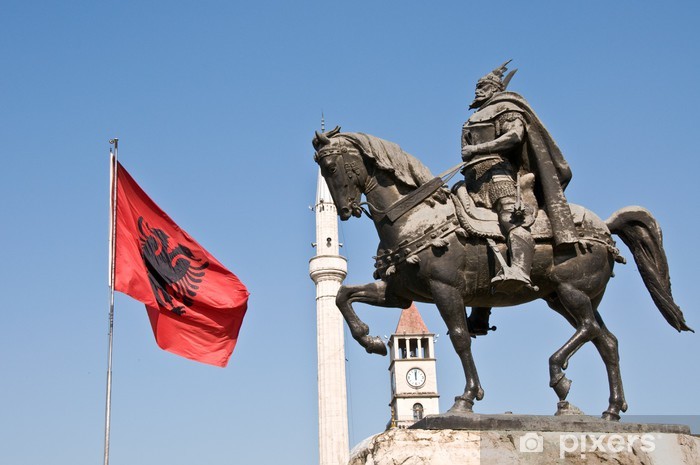
The same logic can also be found in the case of Skanderbeg, where, beyond the debate over the origin of his mother, Voisava, the Serbian narrative has gone much further. Serbian historian Olivera Milosavljević, one of the best-known critics of Serbian nationalist historiography, documents in the study “Skenderbeg je Srbin” that Serbian authors have portrayed Skanderbeg as a Serb, a “half-Serb”, or a “great Serbian hero”.

Vladan Đorđević, in 1913, even claimed that Skanderbeg’s fighters were not Albanians, but Serbs.

Here, the mechanism consists of contesting the Albanians’ historical capacity for state-building, while appropriating any figure who might undermine this thesis. Moreover, to blur the picture even further, narratives are produced claiming that Vladimir Putin has Albanian genes. At first glance, this may appear to be a compliment, but in narrative warfare it can serve to blur identities, relativize them and render them interchangeable, until the boundaries between historical identities begin to disappear. In other words, this is a form of identity engineering.

A similar mechanism can also be observed in relation to Montenegro. Serbia recognized Montenegro as an independent state, but Serbian nationalist discourse has continued to contest the distinct Montenegrin identity and to seek to incorporate it into the Serbian national corpus.

Identity engineering can also materialize in physical space. When religious buildings appear in places where there is no functional community, or no clearly documented functional community, that seeks them, such a building may acquire a function that extends beyond religion: symbolic, identity-related and territorial. In this way, physical space begins to be used to produce memory, presence and a sense of identity-based belonging, as will also become clear from the argument below.

This mixing blurs historical and identity boundaries until the public loses the ability to distinguish between history and propaganda.

Religion, Identity Fragmentation and Hybrid Warfare

The religious dimension is equally important. Skanderbeg was constructed in Albanian collective memory by the figures of the National Awakening as a national symbol transcending religious divisions. Reducing him to an exclusively Christian figure opens the way to reading history through Muslim–Catholic–Orthodox divisions rather than through a shared national identity.

Equally problematic is the reverse process: presenting Albanian Muslim identity as something foreign, Ottoman, or opposed to Albanian identity. In this way, religion is no longer treated as one layer of Albanian identity, but is instead used to create categories of “more authentic” and “less authentic” Albanians. It is precisely here that identity fragmentation begins.

This is particularly dangerous when it coincides with old Serbian nationalist narratives that portray Muslim Albanians as a product of Ottomanization and their presence in certain territories as the result of Islamization, migration, or Ottoman expansion. If a Muslim Albanian is portrayed as less autochthonous because he is Muslim, then a religious debate gradually becomes a historical and territorial argument.

There is also a precedent from the most recent war in Kosovo. The OSCE/ODIHR report “Kosovo/Kosova As Seen, As Told”, based on materials from the OSCE Kosovo Verification Mission – OSCE-KVM, documents that Catholic Albanians were detained, mistreated and expelled in accordance with the general pattern of violence against Albanians.

However, the report also records something else: a very limited number of testimonies indicated that some members of the Yugoslav and Serbian forces distinguished between Catholic and Muslim Albanians and, in certain cases, treated Catholics more favourably.

The OSCE does not characterize this as a general policy of Belgrade. Nevertheless, such differentiated treatment can produce precisely the effect of division and mistrust among Albanians along religious lines.

It is precisely here that a fundamental distinction must be made between intent and effect. It is not necessary for every individual who contributes to religious division to be part of an organized operation or to receive instructions from outside. In hybrid warfare, the convergence of effects also matters. A narrative produced within a society can objectively serve the same strategic objective that an external actor is attempting to achieve.

If the trust and unity that Albanians had managed to strengthen, including through historical processes such as the Blood Feud Reconciliation Movement, are undermined, then shared identity and social cohesion become more vulnerable.

Even today, the risk remains the same: relativizing the elements that keep Albanian identity distinct – origin, language, historical memory, and the way religious identities coexist within it – creates space for identity engineering. Thus, this is where history, identity and security converge.

The problem does not begin with the construction of a church or mosque, or with criticism of a religion; the problem begins when religion is used to determine who is an “authentic” Albanian, who has a historical right to a particular space, and who should be considered a latecomer to it.

When you deprive a people of its antiquity, appropriate its national figures, fragment its identity along religious lines, and then declare it a latecomer in its own territory, you have not merely altered its history; you have also constructed a narrative that may one day be used to legitimize historical claims and territorial expansion.

The most successful phase of such an operation is reached when this narrative is no longer transmitted only from Belgrade, but when Albanians themselves begin to reproduce it.

/Argumentum.al

© 2026 Argumentum

Related Posts

Current Events

Albanian Opposition Leader Sali Berisha to Return to U.S. Five Years After Entry Ban

1 September, 2026
ENGLISH

Council of Albanian Ambassadors, supports the candidacy of Ambassador Bekim Sejdiu for President of the Republic of Kosova.

31 August, 2026
Balkan Overview

Bekim Sejdiu Named Consensus Candidate for Kosovo Presidency

31 August, 2026

Follow US

Subscribe

Receive Argumentum Magazine by Email

Last Posts

Albanian Opposition Leader Sali Berisha to Return to U.S. Five Years After Entry Ban

1 September, 2026

The Illyrians, Skanderbeg and Religion: Anatomy of an Identity War

1 September, 2026

Council of Albanian Ambassadors, supports the candidacy of Ambassador Bekim Sejdiu for President of the Republic of Kosova.

31 August, 2026

Bekim Sejdiu Named Consensus Candidate for Kosovo Presidency

31 August, 2026

Germany Reacts to Iceland’s Rejection of EU Talks: “The EU Must Become More Attractive”

31 August, 2026
Argumentum

“Argumentum”, një proces intelektual …

Contact Us

[email protected]
[email protected]
[email protected]

Follow Us

Media Partner

Register

Receive Argumentum Magazine by Email
  • Home
  • Privacy Policy
  • About Us
  • Contact

© 2022 Argumentum. All Rights Reserved. | NUIS: L91415033Q

Welcome Back!

Login to your account below

Forgotten Password?

Retrieve your password

Please enter your username or email address to reset your password.

Log In

Add New Playlist

No Result
View All Result
  • Home
  • OP/ED
  • Interview
  • Realpolitik
  • Current Events
  • Top News
  • YOUR VOICE
  • ARGUMENTUM MAGAZINE
  • Shqip

© 2022 Argumentum. All Rights Reserved. | NUIS: L91415033Q

This website uses cookies. By continuing to use this website you are giving consent to cookies being used. Visit our Privacy and Cookie Policy.