










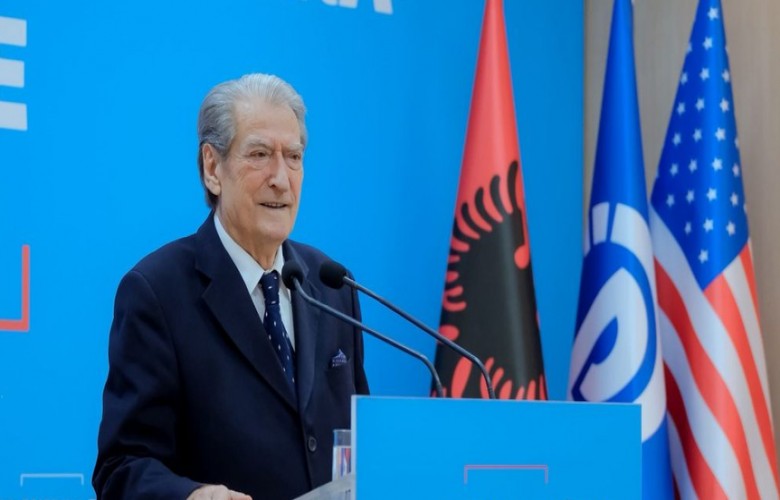
Berisha to meet with Albanian-Americans in New Jersey on September 6
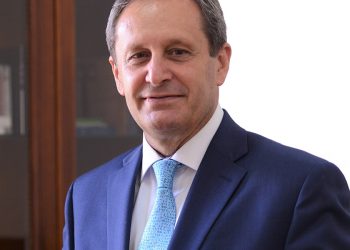
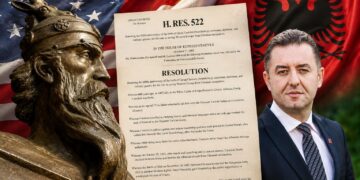
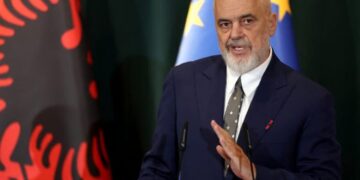
Five years after the U.S. Department of State designated him “non grata,” former Prime Minister and Democratic Party leader Sali Berisha is set to return to the United States.
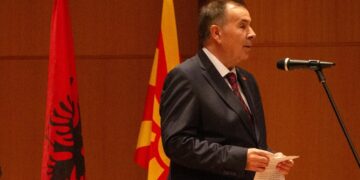
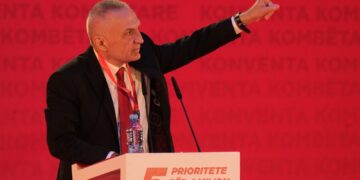
Berisha has announced that on September 6 he will hold a meeting with Albanian-Americans in New Jersey, as part of an event titled “Freedom Works.”
The meeting will take place on Sunday at 11:00 a.m. at the Bergen Performing Arts Center in Englewood, New Jersey.
The announcement comes more than five years after, in May 2021, then-U.S. Secretary of State Antony Blinken designated Berisha as ineligible to enter the United States, accusing him of involvement in significant corruption. In its statement at the time, the U.S. Department of State accused Berisha of involvement in corrupt acts during his tenure as prime minister, including the misappropriation of public funds and the use of political power for personal, political and family interests.
The 2021 decision marked one of the strongest political confrontations between Washington and one of the central figures of Albania’s post-communist political landscape. Berisha has repeatedly rejected the U.S. allegations, describing the decision as politically motivated and calling for its reversal.
For five years, the U.S. “non grata” designation became one of the central issues in Albania’s political debate. For Berisha’s opponents, the Washington decision was a powerful argument against his return to the leadership of the opposition; for Berisha and his supporters, it became a political and legal battle that had to be overturned.
But this year, the relationship appears to have entered a different phase.
In June, Berisha said that the United States had lifted the entry restriction against him and his family members. The U.S. Department of State, however, used more technical language, confirming that it had granted waivers to certain individuals affected by measures imposed under Section 7031(c), on the grounds that such action served a “compelling national interest” of the United States.
For Berisha, this is a moment of particular political significance. His return to the United States gives him an opportunity to present a new chapter in his relationship with Washington and to recover part of the political capital he lost following the 2021 decision. At the same time, the meeting with the Albanian-American community will also serve as a test of the support he continues to enjoy among Albanians in the United States.
But the significance of this visit goes beyond Berisha himself.
The United States has for decades been a decisive factor in Albanian politics, and Washington’s position toward Albanian political leaders has had a direct impact on political developments in Tirana. In Berisha’s case, the “non grata” designation had a particularly significant effect on the struggle over the control and direction of the opposition, placing his relationship with the United States at the center of Albania’s political debate.
In this context, Berisha’s return to the United States is not simply a visit or a meeting with the diaspora. It is a development indicating that the relationship between Berisha and Washington has entered a new phase.
Yet this should not automatically be interpreted as a full political rehabilitation by the United States. Washington has not publicly stated that it has changed its assessment of the allegations made in 2021. What has changed is the practical effect of the entry restriction and, along with it, Berisha’s political space to communicate directly with the Albanian-American community.
The choice of New Jersey is also significant. The New York–New Jersey area is one of the most important centers of the Albanian-American community and has traditionally been an important arena for the political and social activities of the Albanian diaspora.
For this reason, the “Freedom Works” event is likely to be more than a community gathering. It will also provide Berisha with an opportunity to convey his political message after five years of confrontation with Washington.
For Albania, Berisha’s return to the United States carries significance beyond a meeting with the diaspora. For five years, Washington’s position toward him directly influenced political battles within the opposition and shaped the way his political figure was perceived on the Albanian scene.
Now, his presence in the United States opens a new chapter. For Berisha, it is an opportunity to demonstrate that the “non grata” chapter has been overcome; for Albanian politics, however, it remains to be seen whether this return will also be followed by a new relationship with Washington.
The September 6 meeting in New Jersey is likely to provide the first signal.
© 2026 Argumentum