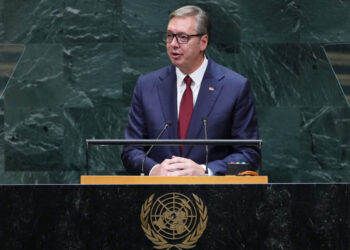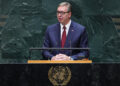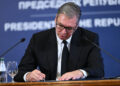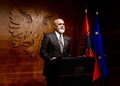



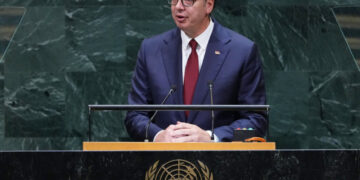





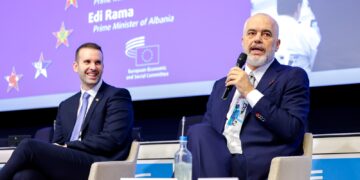
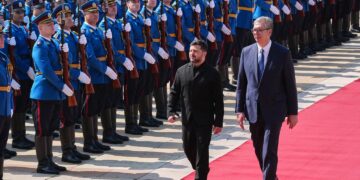
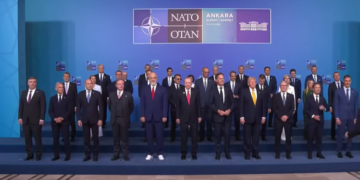

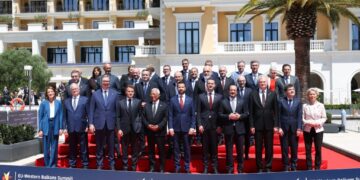
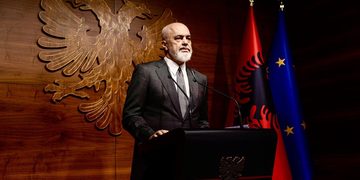
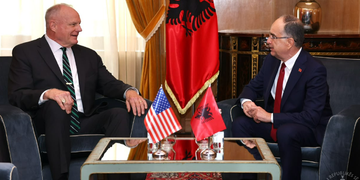
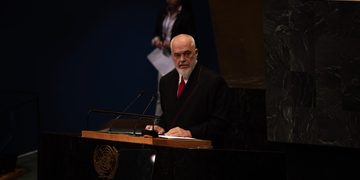








On 9 October 2019, President of Serbia Aleksandar Vučić (SNS), Prime Minister of North Macedonia Zoran Zaev (SDSM) and Prime Minister of Albania Edi Rama (PS) signed the declaration of intent to establish the so-called “mini-Schengen” between the three states. The deal envisages the abolition of border control and other barriers with the aim to facilitate free movement in the region by 2021, which will enable the citizens to travel with ID cards only, or to get work permits and recognition of qualifications without additional procedures. It also provides for better cooperation in combating organised crime as well as mutual assistance in case of natural disasters.
The aim of the declaration is to enable the whole Western Balkan region to start implementing the four key freedoms of the European Union – the free movement of people, goods, capital and services. The initiative is also open for Bosnia and Herzegovina, Montenegro and Kosovo. Nevertheless, it was noted that the initiative does not represent compensation or alternative for EU membership of states in the region.
Beneluxization of the region
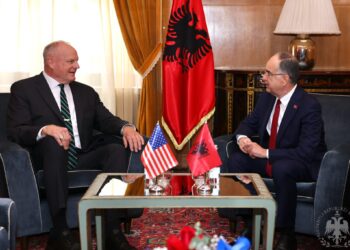
On 10 November 2019 President Aleksandar Vučić and Prime Ministers Zoran Zaev and Edi Rama met again, for the second time, to discuss the concrete terms of the initiative and their declaration. Representatives of Bosnia and Herzegovina, Montenegro and Kosovo were also invited to the meeting.
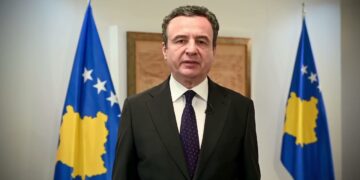
Kosovo President Hashim Thaçi (PDK) rejected participation at the meeting, explaining that the vision of Kosovo is its accession to EU and NATO. Certain Kosovo officials including the most likely new Prime Minister Albin Kurti (LVV) even stated that the initiative represents an attempt to establish the fourth Yugoslavia and the so-called Greater Serbia. The most experienced Albanian politician and incumbent President Ilir Meta (LSI) recently stated that “the project for Greater Albania is not possible, and the one for Greater Serbia has failed”.
Montenegro sent its Minister of Economy Dragica Sekulić (DPS) to the summit, which was highly inappropriate, bearing in mind that it was a high-level meeting of heads of states and governments. As justification for its reserved attitude towards the initiative Montenegro reminded it was a NATO member and had already opened 32 chapters in negotiations with the EU, which puts it far ahead of other Balkan states when it comes to EU accession process. However, this is only partly true, as it only shows nominal indicators. Montenegro could be the furthest away from EU membership due to its internal political situation that may cause instability and escalate to the point where it may pose a threat to regional peace.
Bosnia and Herzegovina was represented at the summit by Chairman of the Council of Ministers Denis Zvizdić (SDA) who stated that Bosnia and Herzegovina is strategically oriented towards EU and NATO membership and that it would need further information regarding the initiative in order to take its position.
Analysts believe that the initiative to boost regional cooperation between six West Balkan states (Serbia, Albania, North Macedonia, Bosnia and Herzegovina, Montenegro and Kosovo) nicknamed “mini-Schengen” does not represent an alternative to or withdrawal from EU membership for those countries but rather accelerates the process of their EU accession. The initiative represents a form of “Beneluxization” of the region following the model of the 1944 London Customs Convention that established the Benelux customs union between Belgium, the Netherlands and Luxemburg, which was implemented in 1947 and replaced in 1960 by the Benelux Economic Union. Its establishment had a great impact on the formation of the European Union.
The Treaty establishing the Benelux Economic Union was signed in 1958 to ensure free movement of persons, goods and services among the three countries. The Benelux General Secretariat is located in Brussels. Though their legal systems are largely harmonised, the three states may not interfere into each other’s internal affairs, thus retaining their right to sovereignty.
Analysts have noted that the freedom of movement would have several positive effects on the West Balkan countries, increasing their competitiveness on the market with 20 million inhabitants, which represents an important factor of economies of scale – it is not the same to have a market potential of two or 20 million consumers. According to World Bank (WB) and International Monetary Fund (IMF) estimations, regional integration would lead to economic development, which would result in at least 3-4% growth already next year. To illustrate, 26 million hours are wasted every year as waiting time at border crossings in the region. Regional co-operation will ease political relations and accelerate the resolving of open issues. Great pressure is therefore felt from the business community and citizens in the region, who expect their states to join the initiative and ensure its soon implementation.
At the Ohrid Summit it was agreed to introduce a system that would enable the citizens to travel with ID cards only, and to get work permits and recognition of qualifications in any of the three countries without additional procedures.
This would directly increase workforce accessibility, thus making the whole region more attractive for new investments. Companies coming to any of these countries will not have to worry about the workforce, as they will be able to recruit qualified workers from all the countries in the region without additional procedures.
The free and smooth movement of goods will be facilitated with the introduction of round-the-clock working time for all inspection services, especially the phytosanitary (plant health) and veterinary inspectorates.
Introduction of a common transit document package is also envisaged for the movement of goods between the member states of the initiative, with an emphasis on introducing the paperless system in line with the digital development strategy of these countries.
The initiative also places emphasis on mutual recognition of qualifications, exchange of students and joint research and development projects.
Analysts believe that the initiative should also include the free movement of sportsmen from the member states, which would further ease and strengthen relations in the region.
Once the mini-Schengen area is established, foreigners arriving in Skopje, Belgrade or Tirana could travel to other member states of the initiative without any additional visa.
Serbia and Albania are planning to enable their citizens to travel with ID documents only by the end of 2019.
Serbia, Albania and North Macedonia are also planning to increase their cross-border cooperation in combating transnational crime and terrorism, and to provide mutual assistance in the field of migration and emergency situations. The declaration provides for the formation of special clusters enabling up to ten times faster trans-border traffic.
Although it falls within the joint initiative, free movement of capital implies a complicated implementation procedure and requires significant changes to the legislation on capital markets, taxation and financial systems.
The three states will regulate many fields with new rules in order to create a more attractive business environment and promote cooperation. Thus their initiative may become the most important political initiative of the 21st century in the West Balkan region.
The next, third meeting will be held on 21 December 2019 in Durrës where heads of West Balkan states will continue talks on their concrete future actions.
North Macedonia to reap most benefit, Vučić most criticised
The US strongly supports the initiative for close cooperation in the region that is open to all West Balkan countries. The EU has also upheld the idea to promote cooperation in the region through this initiative.
Despite being aware that it will not be easy to implement the idea of free movement of capital, its promoters believe they will be able to improve this aspect through cooperation in the next years.
Analysts have recalled that the EU was formed after the end of WW2 as a peace project initiated by six countries with the aim to ensure lasting peace and long-term stability in Europe. During its recent tragic history the Western Balkan region has seen several bloody wars. The visionary initiative put forward by three West Balkan states – Serbia, North Macedonia and Albania – is vital for the whole region, therefore other countries are expected to join it soon.
According to analysts North Macedonia will reap most benefits from the initiative at the beginning, followed by Albania and Serbia, despite harsh criticism of Serbian President Aleksandar Vučić. There are serious reasons for concern: large amounts of money and a well-paid media network have been deployed to discredit the initiative by presenting it as Vučić’s idea to realise the Greater Serbia project. Certain government-related intelligence and criminal structures in Montenegro, Albania and Kosovo as well as some parts of the international community from the East and the West will spare no effort to stop the formation of mini-Schengen area and to create instability and crises, especially in Serbia, in order to illegally change the government in that country. Moreover, significant funds are pumped in through a part of public media in Serbia to create new affairs, with the aim to present Serbia as an unstable and insecure country that would be an unreliable partner to the EU and the US. The regimes in Podgorica (Montenegro) and Pristina (Kosovo) symbolized by Milo Đukanović (DPS) and Hashim Thaci (LDK) benefit from the rising tensions and conflicts rather than from cooperation, since the crisis situation enables them to remain in power.
Analysts believe that one of the first measures in the framework of the mini-Schengen initiative should be to abolish the visa regime between Bosnia and Herzegovina and Kosovo, which would send a strong symbolical message to accelerate the implementation of the initiative and improve the relations in the region.
Is Vučić introducing new practice into regional and international relations?
The visit by Serbia’s President Aleksandar Vučić to France and his meeting with President Emmanuel Macron on 12 November 2019 represents an important event not only for Serbia but for the whole West Balkan region.
During the meeting Vučić presented the “mini-Schengen” initiative to boost regional cooperation to Macron who expressed his support. Moreover, President Vučić discussed the postponement of the date to start EU accession negotiations with Macedonia and Albania, and the situation in the West Balkan region.
Analysts have noted that Serbian President Aleksandar Vučić has started to introduce new practice into regional and international relations by not only representing the interests of his country but also advocating the interests of other countries in the region (with their prior agreement) – in this case North Macedonia and Albania – at meetings with high officials from other countries. Albanian Prime Minister stated at Ohrid that Serbian President Vučić has excellent relations with the key actors from across the world, which should be exploited to the benefit of the region. If such model of behaviour in regional and international relations becomes established as positive practice, it can motivate other leaders in the region to behave like that. Therefore it is crucial for the West Balkan countries to be united in their relations with the EU and/or other foreign-political initiatives, where they cannot achieve success individually. The so-called Visegrad Group (Hungary, Poland, Slovakia and the Czech Republic) may serve as an example of an alliance that acts unitedly within the EU with clearly expressed demands and positions. The Visegrad Group was formed with the purpose of furthering integration of the four countries in the EU and NATO, which they eventually achieved.
Ljubljana/Tirana/Belgrade/Skopje, 25 November 2019