









• SHQIPËRI
  • KOSOVË
  • MAQEDONIA E VERIUT
  • MALI I ZI
  • Revista në PDF
4 June, 2026
  • Home
  • OP/ED

    Cyber Attribution, Corruption, and the False-Flag Question in Albania’s 2022 Alleged Iranian Cyberattack

    Between Russia, Iran and Europe: Azerbaijan as a balancing power in the South Caucasus

    The Zero-Tariff Gate: Sovereignty as a Service in the Sino-African Corridor

    Albania vs. the Sea/ Marginal Notes on A. Leka’s Novel The Hidden Side of the Albanian Socialist Garden

    May 9 and the long shadow of a Letter: Is Europe still Schuman’s Project?

    The Arbnesh of Zadar: A living memory of Albanian identity on the Adriatic coast

    Science Diplomacy and Academic Freedom: A strategic nexus for contemporary diplomacy

    Serbia and Kosovo between new regional alliances and old geopolitical patterns

    Hungarian Writers and the European Spirit: Between Central Europe, Auschwitz, and Inner Exile

  • Interview

    Exclusive Interview with Oleksandr Tyshchenko: A 40-Year Legacy of Chernobyl, Nuclear Risks, and Global Responsibility

    INTERVIEW: ZLATKO KRAMARIĆ – THOUGHTS ON THE OLD CONTINENT

    EXCLUSIVE / Ukrainian Ambassador to Albania, Volodymyr Shkurov: “Ukraine wants peace, but not at the expense of its freedom and independence”

    EXCLUSIVE| Ambassador Tayyar Kagan Atay: Türkiye and Albania, a Strategic Partnership Rooted in Shared Heritage and a Common Vision for the Future

    “Diplomacy, Not War”: Palestinian Ambassador to Albania Calls for Justice, Peace, and Global Action for Gaza

    Exclusive: “Even After Tito – Tito”/ Ambassador Zlatko Kramarić on Authoritarian Legacies and Democracy’s Future in the Balkans

    The Conclusion of the Diplomatic Mission / Ambassador Dancho Markovski: Strengthening Albania-North Macedonia Relations for a Shared European Future

    A Century of Diplomatic Relations Between Albania and Russia: Exclusive Interview with the Russian Ambassador to Albania, H.E. Alexey Zaytsev

    Exclusive/ The chairman of the Freedom Party, Ilir Meta: “The will of the citizens will triumph in Albania, as it did in North Macedonia”

  • Realpolitik

    IBAR? ”Sufficiently! Much ado about nothing! Shart contrasts in Beijing! Where is the exit?!

    Neither peace nor war! Peace with bombs?! IBAR in autumn?! Not another Hormuz in Taivan! 

    IBAR – a springing board or an obstacle? Can we catch the EU Negotiation train 2027? When the dress makes the news!  EU electoral April  ends in a draw 1:1!  

    The European Parliament building in Strasbourg, France with flags waving calmly celebrating peace of the Europe. July 12, 2020.

    EU 2027 or 2037! Even half membership failed! No exit strategy!     

    What next?

    “With diplomatic velvet“! Major question marks! In Washington yes, but  in the White House NO! A strange dinner in Brussels!

    From a great ‘apple of disaccord’ to a  point of  cooperation! A bad start! The strange absence in Davos!

    5 lessons from the American 3 January! Don’t count the chicken before they are hatched! Will NATO freeze in Greenland? Wrong diplomatic messages!

    German Chancellor Friedrich Merz, European Commission President Ursula von der Leyen, Ukraine's President Volodymyr Zelenskiy, U.S. Special Envoy Steve Witkoff and Jared Kushner, son-in-law of U.S. President Donald Trump line up for a family photo opportunity at the Chancellery in Berlin, Germany, December 15, 2025.    REUTERS/Lisi Niesner/Pool

    A Strategy that could change the world! Europe in Berlin! Why an historic compromise? Only charm diplomacy in Athens!

  • Current Events

    Serbia – China 2026: Technological partnership, geopolitical positioning and a new phase of the Chinese presence in the Western Balkans

    The Digital Protectorate: How the EU AI Act Codified Silicon Valley’s Monopoly

    The 28th MFC Annual Conference in Durrës / Sulaj: Microfinance remains a key instrument for financial inclusion

    Serbia at the Crossroads of EU Integration and Geopolitical Balancing: IFIMES Analysis

    Tirana – €20 Million EU–Banking Agreement Boosts Albanian SMEs

    The Myth of Independence: How Chinese Efficiency is Rewriting the Constitution of Modern Geopolitics!

    Europe Yesterday and Today: Why 9 May Still Matters

    “EU4Municipalities II” Project, a Strategic Investment for Strengthening Municipalities and Accelerating Albania’s Path towards the EU

    Eight Years in the Service of Identity: The Journey of the Montenegrin Community in Albania

  • Top News

    No End in Sight: Trump, Netanyahu and the Expanding Middle East War

    Tirana – €20 Million EU–Banking Agreement Boosts Albanian SMEs

    “EU4Municipalities II” Project, a Strategic Investment for Strengthening Municipalities and Accelerating Albania’s Path towards the EU

    Albania, Italy deepen defence ties with naval shipbuilding deal

    U.S. Embassy: Iran-Linked Groups May Target Americans and Iranian Opposition in Albania

    The Council of Albanian Ambassadors disappointed with the voting of the draft law on the foreign service in the parliamentary committees.

    Prime Minister Edi Rama Addresses Israel’s Knesset in Historic Special Session

    Kazakhstan’s Strategic Reform Agenda: Stability, Modern Governance, and Responsible Diplomacy

    Trump Invites Rama to Peace Board, Prime Minister: Proud of Albania

  • YOUR VOICE
  • Shqip
No Result
View All Result
Argumentum
  • Home
  • OP/ED

    Cyber Attribution, Corruption, and the False-Flag Question in Albania’s 2022 Alleged Iranian Cyberattack

    Between Russia, Iran and Europe: Azerbaijan as a balancing power in the South Caucasus

    The Zero-Tariff Gate: Sovereignty as a Service in the Sino-African Corridor

    Albania vs. the Sea/ Marginal Notes on A. Leka’s Novel The Hidden Side of the Albanian Socialist Garden

    May 9 and the long shadow of a Letter: Is Europe still Schuman’s Project?

    The Arbnesh of Zadar: A living memory of Albanian identity on the Adriatic coast

    Science Diplomacy and Academic Freedom: A strategic nexus for contemporary diplomacy

    Serbia and Kosovo between new regional alliances and old geopolitical patterns

    Hungarian Writers and the European Spirit: Between Central Europe, Auschwitz, and Inner Exile

  • Interview

    Exclusive Interview with Oleksandr Tyshchenko: A 40-Year Legacy of Chernobyl, Nuclear Risks, and Global Responsibility

    INTERVIEW: ZLATKO KRAMARIĆ – THOUGHTS ON THE OLD CONTINENT

    EXCLUSIVE / Ukrainian Ambassador to Albania, Volodymyr Shkurov: “Ukraine wants peace, but not at the expense of its freedom and independence”

    EXCLUSIVE| Ambassador Tayyar Kagan Atay: Türkiye and Albania, a Strategic Partnership Rooted in Shared Heritage and a Common Vision for the Future

    “Diplomacy, Not War”: Palestinian Ambassador to Albania Calls for Justice, Peace, and Global Action for Gaza

    Exclusive: “Even After Tito – Tito”/ Ambassador Zlatko Kramarić on Authoritarian Legacies and Democracy’s Future in the Balkans

    The Conclusion of the Diplomatic Mission / Ambassador Dancho Markovski: Strengthening Albania-North Macedonia Relations for a Shared European Future

    A Century of Diplomatic Relations Between Albania and Russia: Exclusive Interview with the Russian Ambassador to Albania, H.E. Alexey Zaytsev

    Exclusive/ The chairman of the Freedom Party, Ilir Meta: “The will of the citizens will triumph in Albania, as it did in North Macedonia”

  • Realpolitik

    IBAR? ”Sufficiently! Much ado about nothing! Shart contrasts in Beijing! Where is the exit?!

    Neither peace nor war! Peace with bombs?! IBAR in autumn?! Not another Hormuz in Taivan! 

    IBAR – a springing board or an obstacle? Can we catch the EU Negotiation train 2027? When the dress makes the news!  EU electoral April  ends in a draw 1:1!  

    The European Parliament building in Strasbourg, France with flags waving calmly celebrating peace of the Europe. July 12, 2020.

    EU 2027 or 2037! Even half membership failed! No exit strategy!     

    What next?

    “With diplomatic velvet“! Major question marks! In Washington yes, but  in the White House NO! A strange dinner in Brussels!

    From a great ‘apple of disaccord’ to a  point of  cooperation! A bad start! The strange absence in Davos!

    5 lessons from the American 3 January! Don’t count the chicken before they are hatched! Will NATO freeze in Greenland? Wrong diplomatic messages!

    German Chancellor Friedrich Merz, European Commission President Ursula von der Leyen, Ukraine's President Volodymyr Zelenskiy, U.S. Special Envoy Steve Witkoff and Jared Kushner, son-in-law of U.S. President Donald Trump line up for a family photo opportunity at the Chancellery in Berlin, Germany, December 15, 2025.    REUTERS/Lisi Niesner/Pool

    A Strategy that could change the world! Europe in Berlin! Why an historic compromise? Only charm diplomacy in Athens!

  • Current Events

    Serbia – China 2026: Technological partnership, geopolitical positioning and a new phase of the Chinese presence in the Western Balkans

    The Digital Protectorate: How the EU AI Act Codified Silicon Valley’s Monopoly

    The 28th MFC Annual Conference in Durrës / Sulaj: Microfinance remains a key instrument for financial inclusion

    Serbia at the Crossroads of EU Integration and Geopolitical Balancing: IFIMES Analysis

    Tirana – €20 Million EU–Banking Agreement Boosts Albanian SMEs

    The Myth of Independence: How Chinese Efficiency is Rewriting the Constitution of Modern Geopolitics!

    Europe Yesterday and Today: Why 9 May Still Matters

    “EU4Municipalities II” Project, a Strategic Investment for Strengthening Municipalities and Accelerating Albania’s Path towards the EU

    Eight Years in the Service of Identity: The Journey of the Montenegrin Community in Albania

  • Top News

    No End in Sight: Trump, Netanyahu and the Expanding Middle East War

    Tirana – €20 Million EU–Banking Agreement Boosts Albanian SMEs

    “EU4Municipalities II” Project, a Strategic Investment for Strengthening Municipalities and Accelerating Albania’s Path towards the EU

    Albania, Italy deepen defence ties with naval shipbuilding deal

    U.S. Embassy: Iran-Linked Groups May Target Americans and Iranian Opposition in Albania

    The Council of Albanian Ambassadors disappointed with the voting of the draft law on the foreign service in the parliamentary committees.

    Prime Minister Edi Rama Addresses Israel’s Knesset in Historic Special Session

    Kazakhstan’s Strategic Reform Agenda: Stability, Modern Governance, and Responsible Diplomacy

    Trump Invites Rama to Peace Board, Prime Minister: Proud of Albania

  • YOUR VOICE
  • Shqip
No Result
View All Result
Argumentum
No Result
View All Result
Home ENGLISH

EU and the Western Balkans in 2020: The Year of Decisions

6 January, 2020
in ENGLISH, English OP/ED
A A
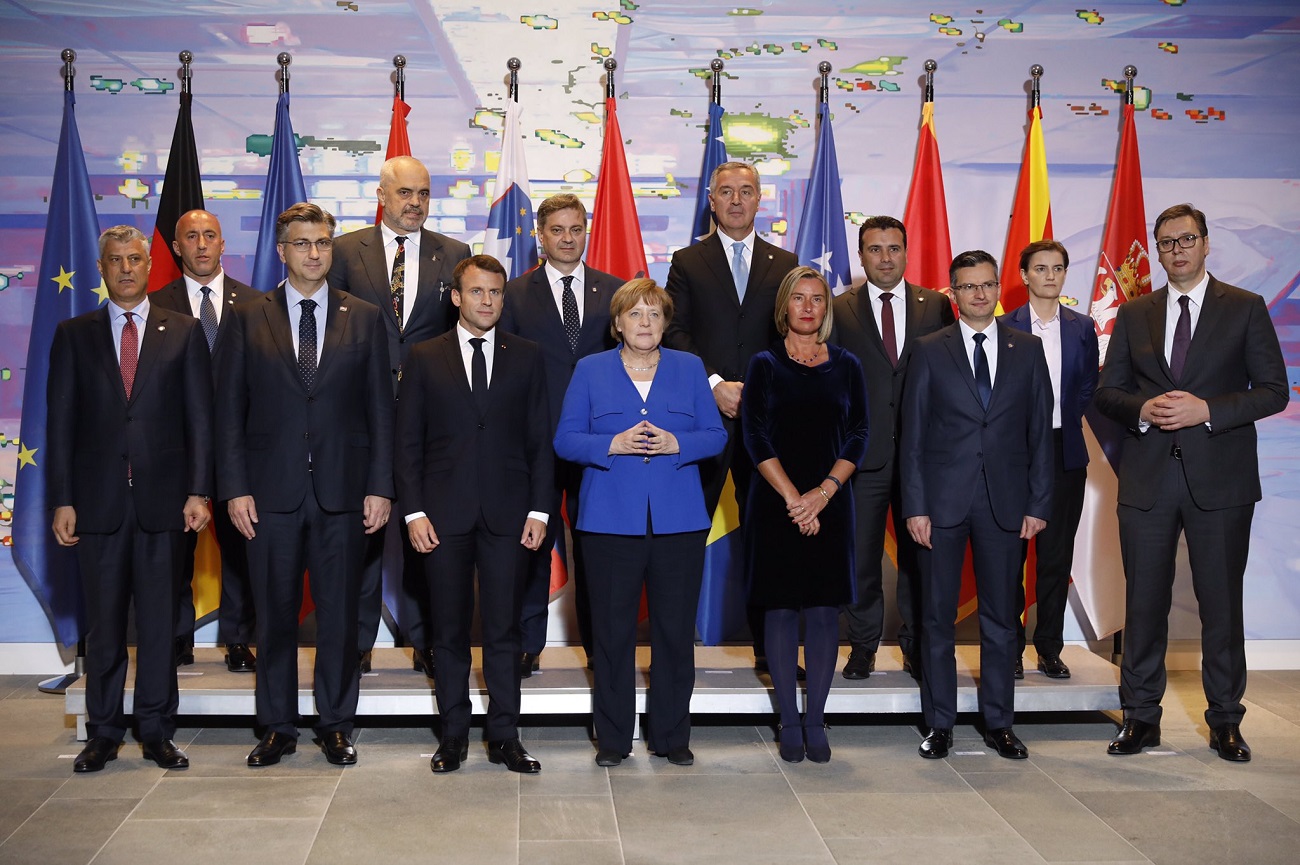
Berlin, 29. aprila 2019 - Samit o Zapadnom Balkanu u Berlinu nastavljen je veceras radnom vecerom, koju su za lidere iz regiona priredili domacini sastanka, nemacka kancelarka Angela Merkel i francuski predsednik Emanuel Makron. FOTO TANJUG / MARINA MAKSIMOVIC / bb *** Local Caption ***

Berlin, 29. aprila 2019 - Samit o Zapadnom Balkanu u Berlinu nastavljen je veceras radnom vecerom, koju su za lidere iz regiona priredili domacini sastanka, nemacka kancelarka Angela Merkel i francuski predsednik Emanuel Makron. FOTO TANJUG / MARINA MAKSIMOVIC / bb *** Local Caption ***

Share on FacebookShare on Twitter

There were very few positive milestones in 2019 when it comes to the EU perspective of the Western Balkans. Despite expectations, North Macedonia and Albania did not open EU accession negotiations, Bosnia and Herzegovina was not granted candidate status and Kosovo did not get the much-anticipated visa liberalization. Moreover, reform processes continued to stall in both frontrunners, Serbia and Montenegro, and the Serbia-Kosovo normalization process did not resume after tariffs were introduced in late 2018.

However, things were in motion. The new European Commission led by Ursula Von der Leyen took office after the 2019 European parliament elections in which fears of an emergent far right did not materialise. North Macedonia is soon expected to join NATO, and the controversial decision not to open EU accession negotiations with Albania and North Macedonia gave birth to a much-needed discussion about the future of the enlargement process.

With 2020 under way, we take a take a look at some of the expected highlights of the year at hand. Some items on this list represent material facts, while others represent predictions of our editorial board.

1. New enlargement toolkit

Oliver Varhelyi in AFET; Photo: European Union

The lack of decision to open accession talks with North Macedonia and Albania in October perhaps represented the most negative news regarding EU enlargement in 2019. The French objections to this move demonstrated that there is lack of consensus among member states about enlargement, and that the promises given by the European Commission to these two Western Balkans countries have barely any weight.

However, the French veto was partially justified by the claim that the enlargement process needs to be reformed, and France soon submitted its proposal about how this should be done. The French non-paper was soon followed by another non-paper about reforming the enlargement process, submitted by 9 other member states. The European Commissioner for Enlargement Olivér Várhelyi later said that the European Commission will present its own proposals in January 2020.

While it is not yet clear how exactly will be the enlargement process be reformed, will the reforms also apply to countries already negotiating – Serbia and Montenegro, and whether it will actually improve or slow down the process, the creation of the enlargement toolkit undoubtedly represents one of the expected highlights of 2020.

2. Croatian Presidency and the EU-WB Zagreb Summit

Andrej Plenković at EPP Congress 2019; Photo: Flickr / European People’s Party

Croatia began its first EU presidency on 1 January 2020 under the motto “A strong Europe in a world of challenges”. The presidency of the most recent EU member state will focus on four pillars: A Europe that develops, A Europe that connects, A Europe that protects, and An influential Europe.

Croatia neighbours three Western Balkan countries and is one of the EU member states most directly affected by EU enlargement in the region. Despite turbulences regarding bilateral disputes with these countries, Croatia declaratively supports EU enlargement further east, and Prime Minister Anrej Plenković appears interested in playing an important role in resolving the enlargement deadlock triggered by France last October.

Perhaps the most important event within Croatia’s EU presidency when it comes to enlargement will be the Zagreb EU – Western Balkans Summit, scheduled for May 2020. First announced at the previous EU – Western Balkans Summit in May 2018 in Sofia by the Croatian Prime Minister Andrej Plenković, the Zagreb 2020 EU – Western Balkans Summit eventually found itself in the programme of Croatia’s EU Presidency.

Just like the previous EU-WB Sofia Summit, the event will bring together leaders of EU members states and Western Balkan countries, and is expected to provide a boost for the EU enlargement process in the Western Balkans. Whether that will be the case depends partially on Croatia’s and prime minister Plenković’s efforts, but mostly on the ability of EU member states and institutions to reach a consensus about the future of the enlargement process in the months prior to the Summit.

3. Opening accession negotiations with North Macedonia and Albania

Zoran Zaev and Edi Rama; PHOTO: Flickr

Despite the lack of opening of accession negotiations in October and the beginning of the debate on enlargement reform, North Macedonia and Albania are nevertheless anticipating a different decision to be made during the first half of 2020.

Immediately after it was decided that the two countries will not open accession negotiations last October, many EU officials quite strongly condemned this decision and labelled it as a “historic mistake”, and the European Parliament even adopted a resolution supporting opening negotiations.

Even though the prospects for opening negotiations with North Macedonia and Albania most probably depend on the possibility of reaching a consensus on reform of the enlargement process, it seems likely that such a scenario will in fact occur in 2020 with or without a significant overhaul. Everything else could be a disaster for what remains of the credibility of the enlargement process.

4. North Macedonia joins NATO

Radmila Šekerinska and Jens Stoltenberg; Photo: Government of North Macedonia

North Macedonia was officially invited to join NATO after reaching the 2018 Prespa Agreement with Greece, and after the agreement was ratified in both North Macedonia’s and Greek parliament in early 2019, the country now officially named North Macedonia was set to join the Alliance by the end of the year. The protocol on accession of North Macedonia to NATO was signed on February 2019, after which the process of ratification of the protocol in national parliaments of member states began.

North Macedonia will almost certainly become a 30th member of the North Atlantic Treaty Alliance in early 2020, as the accession protocol was ratified in 28 out of 29 member countries in 2019, with Spain being the last one remaining. As the lack of ratification in Spain is a consequence of the political crisis in the country, and not of any objection to North Macedonia’s membership, full accession of North Macedonia to NATO is expected soon.

5. Parliamentary elections in Serbia, Montenegro and North Macedonia

Aleksandar Vučić; Photo: Tanjug / Sava Radovanović

Three Western Balkan countries – Serbia, North Macedonia and Montenegro – are expected to hold parliamentary elections in 2020. These represent rather important events, as they could either resolve or lead to the deepening of the political crises in each of the countries, and will undoubtedly have an impact on the entire region.

During 2019 Serbia entered into a major political crisis, as a large part of the opposition started boycotting the parliament and announced their decision to boycott the upcoming 2020 parliamentary elections as well. The European Parliament sent its delegation to act as mediator between the parliamentary parties, but a majority of the opposition boycotted these discussions as well.

After three rounds of talks were concluded in December and elections scheduled for late April or early May 2020, there is still a major question mark over whether the elections will be held as planned and what is going to be the reaction of both the government and the EU mediators to the parliamentary boycott by a large part of the opposition.

The 2020 parliamentary elections in Montenegro are likely to be a controversial affair, as political polarisation appears to be on the rise. Previous parliamentary elections in 2016 were marked by an alleged Russian-backed coup attempt on election day, which a part of the opposition considered to be affecting the results of the elections. The latest tensions surrounding the recently adopted controversial Law on freedom of religion are likely to lead to further tensions as the year goes by. Boycott of the elections by a part of the opposition also remains as a possibility.

Extraordinary parliamentary elections in North Macedonia, which will be held in April 2020, come as a consequence of the decision of prime minister Zoran Zaev to resign in January after the European Council did not open EU accession negotiations with the country. Having in mind that Zaev’s government changed the name of Macedonia primarily for the sake of EU membership against strong opposition, the French “no” and the possible failure to get accession talks opened in 2020 ahead of the elections might lead to a government change with unforeseen consequences.

Croatia also held the second round of presidential elections on 5 January 2020, and will also hold parliamentary elections by the end of the year. Having in mind the victory of the opposition presidential candidate Zoran Milanović, we might be in for some interesting political developments in the former Western Balkan country in 2020.

6. New phase in the Belgrade Pristina dialogue

Richard Grenell and Hashim Thaci; Photo: President of the Republic of Kosovo

The Belgrade-Pristina dialogue, which was already marked by a questionable implementation record in recent years, came to a complete halt after Kosovo introduced 100% tariffs on goods from Serbia and Bosnia and Herzegovina in November 2018.

With the new government expected to be formed in Kosovo soon and the new EU High Representative Josep Borell in office, there is likely going to be a major push for continuing the dialogue in 2020. The United States already appointed its presidential envoy for the normalization process, and the EU is likely to follow suit with its own special representative for either the Western Balkans in general or Belgrade-Pristina dialogue specifically.

The continuation of the dialogue process could be significantly jeopardized by the political crisis in Serbia and the prolongation of government formation in Kosovo, as well as by developments surrounding the new enlargement toolkit. However, as the normalization process is already frozen for too long and there are actors with significant interest in their reopening, the dialogue is expected to resume in 2020 in one way or another. Whether important achievements could be expected this year is a whole another matter.

7. German EU presidency

Angela Merkel; Photo: Tanjug / Szilard Koszticsak / MTI via AP

In the second half of 2020, Germany will take over from Croatia the six-months presidency over the European Council. This will also mark the beginning of the new presidency trio, which also includes Portugal and Slovenia.

As the largest EU economy, arguably the most important political actor in the Union and probably the most important supporter of EU enlargement in the Western Balkans, Germany is undoubtedly the country of major importance for the region.

While Germany is unlikely to singlehandedly reinvigorate EU enlargement during its six-month EU presidency – we have seen, after all, that it could not convince France about North Macedonia and Albania in October 2019 – the German presidency will likely represent an excellent opportunity to push forward the enlargement agenda./EWB
Related Posts

Current Events

Serbia – China 2026: Technological partnership, geopolitical positioning and a new phase of the Chinese presence in the Western Balkans

1 June, 2026
ENGLISH

IBAR? ”Sufficiently! Much ado about nothing! Shart contrasts in Beijing! Where is the exit?!

1 June, 2026
ENGLISH

How Alkida Lushaj is redefining democratic inclusion globally

31 May, 2026

Follow US

Subscribe

Receive Argumentum Magazine by Email

Last Posts

Serbia – China 2026: Technological partnership, geopolitical positioning and a new phase of the Chinese presence in the Western Balkans

1 June, 2026

IBAR? ”Sufficiently! Much ado about nothing! Shart contrasts in Beijing! Where is the exit?!

1 June, 2026

How Alkida Lushaj is redefining democratic inclusion globally

31 May, 2026

Cyber Attribution, Corruption, and the False-Flag Question in Albania’s 2022 Alleged Iranian Cyberattack

30 May, 2026

The Digital Protectorate: How the EU AI Act Codified Silicon Valley’s Monopoly

30 May, 2026
Argumentum

“Argumentum”, një proces intelektual …

Contact Us

[email protected]
[email protected]
[email protected]

Follow Us

Media Partner

Register

Receive Argumentum Magazine by Email
  • Home
  • Privacy Policy
  • About Us
  • Contact

© 2022 Argumentum. All Rights Reserved. | NUIS: L91415033Q

Welcome Back!

Login to your account below

Forgotten Password? Sign Up

Create New Account!

Fill the forms bellow to register

*By registering into our website, you agree to the Terms & Conditions and Privacy Policy.
All fields are required. Log In

Retrieve your password

Please enter your username or email address to reset your password.

Log In

Add New Playlist

No Result
View All Result
  • Home
  • OP/ED
  • Interview
  • Realpolitik
  • Current Events
  • Top News
  • YOUR VOICE
  • Shqip

© 2022 Argumentum. All Rights Reserved. | NUIS: L91415033Q

This website uses cookies. By continuing to use this website you are giving consent to cookies being used. Visit our Privacy and Cookie Policy.