

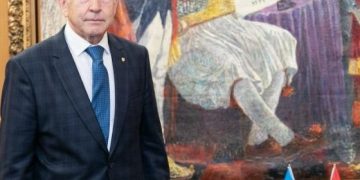


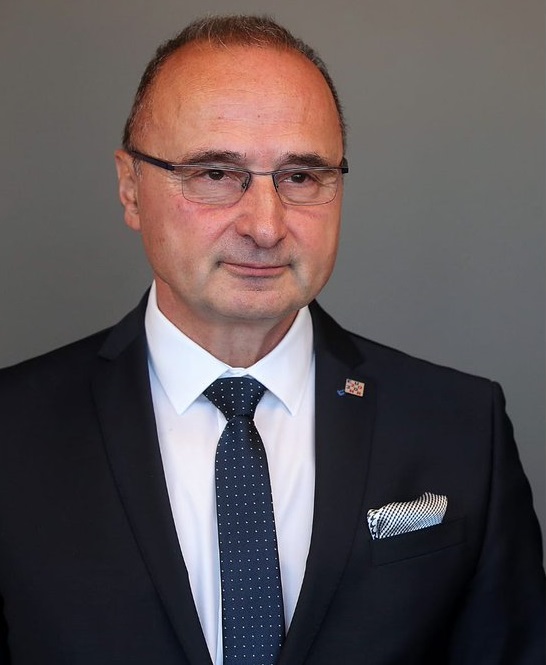
“The decision to open EU negotiations with Albania was one of the priorities of Croatia’s presidency of the Council of the EU. The Croatian Government is pleased that it has now been fulfilled. This decision is a result of an intense political and diplomatic effort by the Croatian Government, which remained persistent in pursuit of that goal,” said Croatian FM Gordan Grlic-Radman
By Genc Mlloja
Senior Diplomatic Editor
“Firstly, let me congratulate Albania as the European Union made a major political decision to open the membership negotiations. I also congratulate Albania for its achievements that enabled this move by the European Union. This is, by all means, a historical opportunity for your country,” has said Croatia’s Foreign Minister Gordan Grlic-Radman in an exclusive interview with Albanian Daily News.
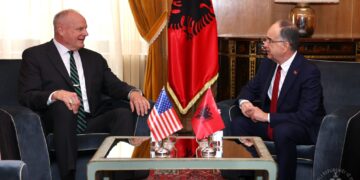
The conversation with the Croatian top diplomat focused on his working visit to Albania on March 2, 2020, which took place ahead of the EU decision having as prior objective to convey, on behalf of Croatia in its capacity of Presidency of the Council of the EU, strong support for the continuation of the integration path of Albania into the EU, while also acknowledging and recognizing Albania’s progress in that regard.
“Relations between Croatia and Albania are traditionally very friendly. Our cooperation within NATO is strong,” Mr. Radman said, adding that the two countries must not forget how their path to NATO began in 2003 when they formed the Adriatic Charter (A3) together with the United States and North Macedonia.
The Croatian FM noted that the excellent political relations between Croatia and Albania are not followed on the economic front. “In the Declaration on Strategic Partnership, which was signed by Prime ministers Plenkovic and Rama in December 2018, in addition to the strengthening cooperation in security and strategic relations, great attention has been paid to strengthening economic relations,” said the Minister who is confident that in spite of these challenging and unprecedented times Croatia and Albania will together find a way to improve their economic cooperation to the benefit of their people.
In the meantime Mr. Radman pointed out that Croatia’s presidency of the Council of the EU has demonstrated that it remains operative and capable of making important decisions in spite of the extraordinary circumstances due to the COVID-19 pandemic, which has had a profound effect on the way the EU works and communicates. “We are satisfied that one of the Croatian presidency priorities has been fulfilled – the launch of entry talks with Albania and North Macedonia. This decision is the result of months of intense political and diplomatic efforts by the Croatian Government, which remained committed to achieving this goal despite the fact that no decision was made at the European Council meeting in October last year. We have managed to bring the enlargement issue back on the EU agenda,” he said announcing that it is important that the European Commission begins working on this crucial aspect of the negotiating process. “Once the frameworks are adopted, intergovernmental conferences that will formally open the talks with Albania and North Macedonia are to be convened as soon as possible.”
The Croatian Foreign Minister was pleased that there are positive examples of successful regional cooperation in the Western Balkans, but, according to him, there are still a number of open issues between the regional countries that will have to be addressed. “The EU has made it clear that it will not import bilateral disputes and it expects the Western Balkans countries to resolve these issues as an explicit precondition for further enlargement. The issue of normalisation of relations between Serbia and Kosovo is undoubtedly one of the most pressing issues in the region,” he said.
The chief of Croatian diplomacy considered the EU’s role in the region as instrumental despite many challenges and crises that the Union itself is facing. “It is also important to underline that while all our countries are faced with the unprecedented challenges of fighting the coronavirus, the Western Balkans can count on the EU solidarity and support,” said Croatia’s Foreign Minister Gordan Grlic-Radman in the interview which follows:
Albanian Daily News: Your Excellency, you paid a visit to Albania last month. Could you please share with the readers of Albanian Daily News a wrap up of your talks in Tirana? Which is your assessment of the level of the bilateral relations between the two countries?
Foreign Minister Gordan Grlic-Radman: Firstly, let me congratulate Albania as the European Union made a major political decision to open the membership negotiations. I also congratulate Albania for its achievements that enabled this move by the European Union. This is, by all means, a historical opportunity for your country.
I paid a working visit to the Republic of Albania on March 2, 2020, primarily to convey, on behalf of the Republic of Croatia in its capacity of Presidency of the Council of the EU, strong support for the continuation of the integration path of the Republic of Albania into the EU, while also acknowledging and recognizing Albania’s progress in that regard.
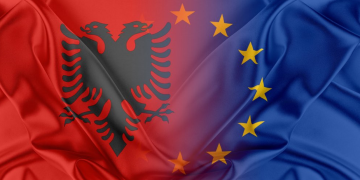
The decision to open EU negotiations with Albania was one of the priorities of Croatia’s presidency of the Council of the EU. The Croatian Government is pleased that it has now been fulfilled. This decision is a result of an intense political and diplomatic effort by the Croatian Government, which remained persistent in pursuit of that goal.
The visit also had a bilateral dimension. It was an opportunity to re-emphasise our traditionally strong ties and excellent relations. Our bilateral relations were elevated to a strategic level following Prime Ministers Plenkovic and Rama’s signing of the Statement on the Strategic Partnership in December 2018 in Zagreb.
It is worth noting that there are no open issues in our bilateral relations. Instead there are many areas of cooperation and convergence of views on numerous issues.
– Albania and Croatia are now strategic partners and they both are NATO members. How does this special relationship function, and is it delivering in concrete terms?
– Relations between Croatia and Albania are traditionally very friendly. Our cooperation within NATO is strong.
But we must not forget how our path to NATO began. In 2003 our countries formed the Adriatic Charter (A3) together with the United States and North Macedonia, countries with whom we share a common vision of a peaceful Southeast Europe fully integrated into the Euro-Atlantic community. Later on, in 2008, Bosnia and Herzegovina and Montenegro joined the Adriatic Charter (A5). Our joint efforts led to our two countries joining NATO in 2009.
In addition to the A5 cooperation, both of our countries share a distinct interest in the stability of our neighbourhood. Consequently, our countries are strong advocates of stability in the Western Balkans within NATO, and we often stress the importance of peace and stability in Southeast Europe. It is therefore no surprise that we actively support NATO’s operation in Kosovo.
We also participate side by side in the Resolute Support Mission in Afghanistan and both of our countries have taken part in the enhanced Forward Presence in the eastern part of the Alliance.
One of the examples of close cooperation was the exercise Immediate Response 19, which was held in Croatia, Slovenia and Hungary and was attended by Albanian soldiers. Such manner of cooperation shows that engaging through international exercises is an effective model of strengthening our Alliance in response to surrounding threats.
The most recent example of this concrete cooperation was on 27 March 2020 when we organized a transport for our soldiers from Afghanistan while also providing transport for soldiers from Albania.
– It is true that the Albanian-Croatian political ties are exemplary. But evidence shows that the economic exchanges lag behind. What are both parties doing to upgrade them exploiting the untapped potential existing in Albania and Croatia?
– Although over the past few years the trade exchange between our two countries is growing, it is still very modest and our excellent political relations are not followed on the economic front. The need to enhance economic co-operation is on the agenda of all meetings between Croatian and Albanian officials. In the Declaration on Strategic Partnership, which was signed by Prime ministers Plenkovic and Rama in December 2018, in addition to the strengthening cooperation in security and strategic relations, great attention has been paid to strengthening economic relations.
We strive to connect our entrepreneurs and present opportunities for cooperation through the organization of economic forums. The last two, held in Tirana in July 2019 and in Zagreb in January 2020, were attended by numerous companies from both countries. Croatia has a lot to offer to the Albanian market and its consumers. Agriculture, food industry, energy, metals, pharmaceuticals, defense, IT, waste management and manufacturing have been identified as major areas of mutual interest. The maritime area of cooperation, in its broadest aspect, was particularly emphasized. We encourage and facilitate contacts among companies and offer our support in connecting interested companies.
The potential is therefore enormous and I am confident that in spite of these challenging and unprecedented times we will together find a way to improve our economic cooperation to the benefit of our people.
– How do you comment on the opening of accession talks with Albania and North Macedonia?
– The decision to launch the accession negotiations with Albania and North Macedonia is of special importance as it continues the EU enlargement process, but also because of the difficult circumstances it was reached in.
Croatia’s presidency of the Council of the EU has demonstrated that it remains operative and capable of making important decisions in spite of the extraordinary circumstances due to the COVID-19 pandemic, which has had a profound effect on the way the EU works and communicates.
We are satisfied that one of the Croatian presidency priorities has been fulfilled – the launch of entry talks with Albania and North Macedonia. This decision is the result of months of intense political and diplomatic efforts by the Croatian Government, which remained committed to achieving this goal despite the fact that no decision was made at the European Council meeting in October last year. We have managed to bring the enlargement issue back on the EU agenda.
The decision to launch the accession talks includes a decision to start working on the negotiation frameworks as well. It is important that the European Commission begins working on this crucial aspect of the negotiating process. Once the frameworks are adopted, intergovernmental conferences that will formally open the talks with Albania and North Macedonia are to be convened as soon as possible. This decision is a message of encouragement for both countries to continue implementing the reforms.
– Despite the constructive efforts to increase regional cooperation in a peaceful environment there are still open problems between WB countries. How do you assess the general situation in the region and, in your view, are there efforts from outside it to destabilize it? Would a greater support by the EU in the geostrategic aspect be beneficial?
– Regional cooperation is an essential element of the European perspective for the Western Balkans. Although there are positive examples of successful regional cooperation in the Western Balkans, it is true that there are still a number of open issues between Western Balkans countries that will have to be addressed. The EU has made it clear that it will not import bilateral disputes and it expects the Western Balkans countries to resolve these issues as an explicit precondition for further enlargement. The issue of normalisation of relations between Serbia and Kosovo is undoubtedly one of the most pressing issues in the region.
I believe that the EU has shown its commitment to strengthening regional cooperation, reconciliation and good neighbourly relations in the Western Balkans. The EU has demonstrated clearly how important this region is for it and that the EU is ready to support the region’s efforts in finding solutions to existing problems that will contribute to stability, security and prosperity of the entire Western Balkans region.
– What is your message for Albania and other Western Balkans countries?
– The future of all the countries in the Western Balkans is in the EU. EU membership is the foreign policy priority of all Western Balkans countries. I therefore strongly believe that, although the EU is not the only game in the town, and despite many challenges and crises that EU itself is facing, the EU’s role in the region is instrumental.
That is why the Croatian Presidency has worked very hard to achieve the decision by EU Member States on the opening of accession negotiations with Albania and North Macedonia. As I have already mentioned, I am very happy that we managed to do this in very difficult conditions, when all countries’ efforts are focused on fighting the coronavirus.
I think that we sent an important and clear message to the Western Balkans that the EU enlargement policy is continuing. Simply, we showed that when a candidate country delivers, EU also delivers on its promises, even at a time of a global crisis. This is, I hope, an encouraging message for Albania and other Western Balkans countries.
It is also important to underline that while all our countries are faced with the unprecedented challenges of fighting the coronavirus, the Western Balkans can count on the EU solidarity and support. EU support, including financial, is helping to address the immediate needs in the health sector, such as: support in getting the necessary medical equipment, improving societal resilience, and helping partners mitigate the socio-economic impact of the pandemic, primarily by redirecting funds to ensure liquidity.
It is an important message that demonstrates the EU’s strong support and solidarity with the region./ADN