

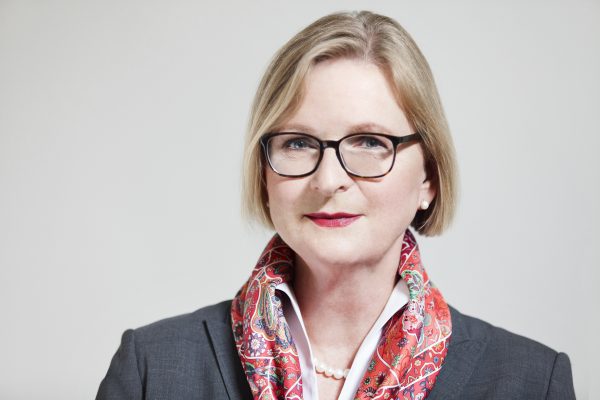
Germany aims to finalize the negotiating frameworks and hold the first intergovernmental conference with North Macedonia and, if conditions are met, also with Albania during its Council Presidency, has said Ms. Susanne Schutz, director for the region at the German foreign office.
In an interview with Balkan Insight in Berlin on August 10, 2020, Szhutz, who before being assigned the Western Balkans Director at the German Federal Foreign Office was Ambassador to Albania, made the above announcement meaning a separation of the EU accession process negotiations for North Macedonia and Albania, which were given the green light for the start of the talks by the Union in Zagreb Summit last March.
“We will work hard with our partners in the EU and with North Macedonia and Albania towards achieving this goal,” Schutz told journalist Marija Ristic.
Further on she said Germany is also watching electoral reforms in Albania, as well as developments around new media legislation that the government sees as a way to regulate the online space, but which critics also see as an attempt to curb media freedom.
“The new media bill in Albania does not yet reflect best international standards and practices,” Schutz, the former Ambassador to Tirana said in the story carried by BIRN:
The Western Balkans Director at the German Federal Foreign Office says the region will be high on the agenda during Berlin’s EU Council Presidency – but countries seeking integration must do their part.
The Western Balkans are high on the agenda of the German EU Council Presidency, but the concrete progress of states towards EU integration – from opening negotiations and chapters– depends on their own commitment to the rule of law and media freedom, Susanne Schutz, director for the region at the German foreign office, told BIRN.
Germany took over the six-month presidency of the European Union this July and Schutz says it wants to see “renewed momentum” in relations between the bloc and the West Balkans.
This follows the EU decision to open accession talks with Albania and North Macedonia, and the substantive solidarity package of 3.3 billion euros agreed for the region, to mitigate the consequences of the coronavirus pandemic.
“We want to maintain this positive dynamic. This means first and foremost continuing to lay the groundwork for accession talks with Albania and North Macedonia by finalising the negotiating frameworks. We aim to hold the first intergovernmental conference with North Macedonia and, if conditions are met, also with Albania during our Council Presidency,” Schutz explained.
In her interview for BIRN, the experienced diplomat, who served in Israel, Ukraine, Russia and Albania before becoming the Western Balkans Director in Berlin, said Germany hopes to continue accession talks with Serbia and Montenegro, further implement EU priorities for Bosnia and Herzegovina and resume the stalled Kosovo-Serbia dialogue.
“Thanks to the facilitation efforts by EU Special Representative Miroslav Lajcak, and the support of Germany and France, the EU-led dialogue [between Belgrade and Pristina] finally resumed on July 12, after its interruption 20 months ago,” she recalled.
“We see an urgent need for progress in the dialogue as the unresolved situation is holding both countries back and hampering much needed regional cooperation in the entire Western Balkans,” she added.
“A comprehensive agreement that allows for the realization of the EU perspective is in the interest of both Kosovo and Serbia, as well as the region as a whole. This agreement should also bring greater stability to the region. As is well known, we do not believe that new borders or land swaps would contribute to such a sustainable solution,” Schutz explained, referencing Germany’s known opposition to territorial exchanges as part of a final settlement.
Berlin, often seen in the region as the key decision maker when it comes to the EU aspirations of the so called “Western Balkans Six”, also plans to focus in the months ahead on demographics and migration.
In the search for better employment, nationals from the Balkans are heading to Germany increasingly every year. The latest data from the German statistical office says that last year 237,755 Serbian nationals, 232,075 from Kosovo and 203,265 from Bosnia and Herzegovina were living in Germany. Many find jobs in the German health sector.
But Schutz says this movement is also problematic. “Although Germany and other countries are gaining well-trained professionals as a result, permanent gaps remain at home – not only in the health sector,” she pointed out.
“The reasons for leaving are not only economic: They concern also persisting deficits in the rule-of-law area, non-meritocratic appointments, and corruption. Since most people from the region emigrate to EU countries, we think it is important to look for concepts that can mitigate the negative effects and make use of ‘win-win’ aspects for both the Western Balkans and the EU.
“To that end, we plan to hold a conference with the Western Balkan countries during our Council Presidency,” Schutz announced.
Progress for Serbia, Kosovo, depends on them
Both Kosovo and Serbia are looking to Berlin in the coming months, as Berlin chairs the European Union. But Schutz remains firm that there will be no watering down of conditions linked with the rule of law.
“We are aware of the great frustration in Kosovo caused by the fact that visa liberalisation is still pending,” she said.
“We see the need to achieve progress on this important issue, which is very relevant for the EU-Kosovo relations and also for the Kosovo economy. However, to convince the remaining sceptics in the EU it will be very important that the Kosovo government does its part. This means first and foremost a clear commitment to fighting corruption and organised crime and to strengthening the rule of law,” she explained.
Its northern neighbour, Serbia has not opened any new EU chapters, which many see as a reflection of Serbia’s poor progress on reform and increasingly authoritarian tendencies. Germany welcomes Serbia’s strategic choice of EU membership, but still expects reforms, Schutz said. “On its path towards the EU, Serbia has already made important progress and opened more than half of all negotiation chapters, namely 18 out of 35,” she noted.
“However, we attribute a pivotal role to progress in the key area of rule of law – dealt with in Chapters 23 and 24 – as well as to normalization with Kosovo. The European Commission’s June non-paper on the state of play regarding Chapters 23 and 24 for Serbia clearly describes deficits and identified areas where significant progress still has to be made: we need a stronger political commitment to the rule of law, especially independence of the judiciary, as well as to the freedom of media,” she said.
“It is important that Serbia accelerates the fight against corruption, particularly at the high level. To open further chapters, there must be progress in these areas,” Schutz added.
Responding to claims that the June parliamentary elections in Serbia were not free – as the majority of opposition parties boycotted them – Schutz said “the EU stands ready to provide appropriate assistance” on the issue of complaints. But she said mediation “only makes sense if the opposition and government are both willing to play an active part in coming to a solution agreeable to both sides”.
Judicial reforms at the core of Albania’s enlargement process
Reforms of the justice system as well as electoral law reform have been identified as priorities for Albania by Germany and the EU, she said.
“Since the constitutional changes in 2016, we have seen that judicial reform, including the vetting of all judges and prosecutors, is very challenging,” she added.
“It is a long and complicated process, which has temporarily also led to a partial dysfunctionality of the judiciary. However, we are convinced that there is no alternative to this crucial process. Once completed, the rule of law will be strengthened in Albania to the benefit of the Albanian people,” she continued.
Germany is also watching electoral reforms in the country, as well as developments around new media legislation that the government sees as a way to regulate the online space, but which critics also see as an attempt to curb media freedom.
“Media freedom is a very important topic for the German government in general and of course during our Council Presidency,” Schutz said. “A free and independent media is the backbone of any living democracy. This is why press and media freedom is also very important in the accession process.
“The new media bill in Albania does not yet reflect best international standards and practices,” she warned.
“We see the recent opinion by the Venice Commission as an adequate guideline for the ongoing work within the Albanian parliament to improve the bill, in particular regarding the definition of its scope, the proportionality of fines and the independence of AMA bodies [the Audio-Visual Media Authority tasked with monitoring the planned changes].
“The last interim report by the European Commission rightly called out the bill as lacking in certain areas and as not fully compatible with EU standards and best practices regarding freedom of the press and media. Improving the law in these aspects would be an encouraging step on Albania’s path towards the EU,” she said.
“The accession process provides guidance: Chapter 23 on the judiciary and fundamental rights, which includes freedom of the media, is an important pillar of this process. As one of the two fundamental chapters, it will determine the pace at which the countries of the Western Balkans move closer to the EU,” Schutz concluded.
Berlin is keeping a close eye on Bosnia
Reforms of elections and the rule of law are also a task for neighbouring Bosnia and Herzegovina, which does not yet have EU candidate country status.
“Special attention needs to be paid to the new law on the High Judicial and Prosecutorial Council, as this institution plays a crucial role for the entire judicial system in Bosnia and Herzegovina,” she said.
“The public’s trust in this institution needs to be restored without any further delay and all necessary measures should be carried out. As the rule of law is at the core of the EU accession process, Germany together with the EU Delegation to Bosnia and Herzegovina and other like-minded states will continue to support the country on its reform path.
“Another very important aspect of the 14 key priorities the European Commission outlined in its Opinion on Bosnia and Herzegovina’s membership application is the holding of elections. We welcome the fact that local elections can finally take place in Mostar. We expect that political forces will do everything necessary for elections to take place as planned, and welcome in that context that the state budget has finally been agreed on. This is essential to Bosnia and Herzegovina’s path towards the EU and the realization of the public’s legitimate aspirations to become part of the Union.
“Apart from that, politicians should start to implement the pending rulings by the European Court of Human Rights (e.g. Sejdić and Finci v. Bosnia and Herzegovina) and to address the recommendations made by ODIHR and the Venice Commission in order to bring election law into line with European standards,” she added. [ODIHR is the OSCE’s Office for Democratic Institutions and Human Rights.]
According to Schutz, another area needing improvement is refugee and asylum policy. Bosnia has been struggling with the number of people, mostly from Middle East and Africa, transiting through the country towards the European Union. Many live in poor conditions in overcrowded camps with limited access to legal assistance.
“It is necessary that all relevant actors in Bosnia and Herzegovina take responsibility for decisive action to alleviate the circumstances of refugees and migrants, thus improving the situation for all parts of society,” she said.
Bosnia should “professionalize its asylum system, so that those eligible for protection can easily file an application and receive the necessary status. At the same time, it is important for BiH and the other Western Balkan countries to steps up efforts to conclude readmission agreements with countries of origin.
“The latest EU Council conclusions on enhancing cooperation with Western Balkan partners in the field of migration and security is a good basis to further develop our joint efforts and manage the common challenge of migratory influxes more efficiently,” she said.
Support for vital reconciliation processes
Reconciliation remains an important task for the region and a cornerstone for positive development and progress on the path towards the EU, underlined Schutz.
The German government will continue to support such efforts, especially the RECOM initiative, the regional commission tasked with establishing facts about all victims of war crimes and Other serious rights violations committed in the former Yugoslavia.
It will also demand cooperation from the Kosovo authorities with the Hague-based Kosovo Specialist Chambers, set up specifically to try members of the Kosovo Liberation Army, KLA, over alleged abuses and war crimes committed in the independence war from Serbia.
“Investigating war crimes and crimes against humanity is part and parcel of Kosovo’s commitment to the rule of law. There can be no lasting peace in a society without justice,” she said, firmly.
“Germany firmly believes that fighting impunity through national and international criminal courts is part of a responsible legal and foreign policy. Together with the EU, Kosovo has taken this important step towards that end with the creation of the Kosovo Specialist Chambers, under Kosovar law, whose work Germany supports as part of the general effort to address the crimes committed during the conflicts in former Yugoslavia.”
Addressing complaints often made in Kosovo, that the Specialist Chambers are putting an entire nation on trial, she added: “The Specialist Chambers only investigate alleged crimes of individuals and do not prejudge an entire country or its people.”
Her country is also supportive of the EU rule-of-law body, EULEX, which Schutz says critically enables the work of the Specialist Chambers.
“Since 2008, the mission has supported the establishment of police, customs and border control units. This means real improvement for Kosovar citizens as a necessary prerequisite for sustainable stability. EULEX also contributes to international efforts to provide security as a ‘second responder’ with its police units,” she said.
Montenegro encouraged to resolve crisis with Church
Speaking about Montenegro, the smallest but the most advanced country in the region in terms of its EU accession process, but which is currently going through the internal crisis in relations with its largest religious community, the Serbian Orthodox Church, SOC, Schutz said Germany hopes the two sides will reach consensus on a hotly disputed law on religion.
“We welcome the fact that the Montenegrin government and the Serbian Orthodox Church have started a dialogue about the Law on Religious Freedom and we hope that – after the talks had to be delayed for some time due to the COVID-19 pandemic – they will now reach consensus soon on how to proceed,” she said.
She said she regretted that the Church was not willing to meet the Montenegrin government’s latest proposals.
“We encourage the Serbian Orthodox Church and the Montenegrin government to return to the negotiation table in order to find a solution for the above-mentioned issue as well as for a proper registration of the SOC in Montenegro. Both sides have to contribute to such a solution. Otherwise, a recourse to legal action might be a feasible option, with the European Court of Human Rights serving as the final court of appeal,” she added.
The remaining disputes in the region, including between North Macedonia and Bulgaria that hampers the latter’s EU prospects, should be resolved in the spirit of good neighbourly relations, according to Schutz.
“The draft negotiating framework proposed by the European Commission on 1 July emphasises the commitment to good neighbourly relations and closer regional cooperation, as well as the importance of achieving tangible results and implementing bilateral agreements in good faith, including the Prespa Agreement with Greece and the Treaty on Good Neighbourly Relations with Bulgaria.
“Regarding the treaty with Bulgaria, I think that the formula agreed by Prime Ministers [Zoran] Zaev and [Boyko] Borisov, according to which history should be left to historians, remains valid. Both countries should resolve open questions within the framework of the bilateral agreement, e.g. the commission of historians,” she said.
“Furthermore, the co-chairmanship of the Berlin Process this year is a very good opportunity to bridge bilateral differences, further deepen cooperation within the Western Balkans region and strengthen and expand bilateral trust.”
Germany aims to finalise the negotiating frameworks and hold the first intergovernmental conference with North Macedonia and, if conditions are met, also with Albania during its Council Presidency.
“We will work hard with our partners in the EU and with North Macedonia and Albania towards achieving this goal,” Schutz concluded.