




























Dr. Ermir I. Hajdini
Legal Analyst & University Lecturer
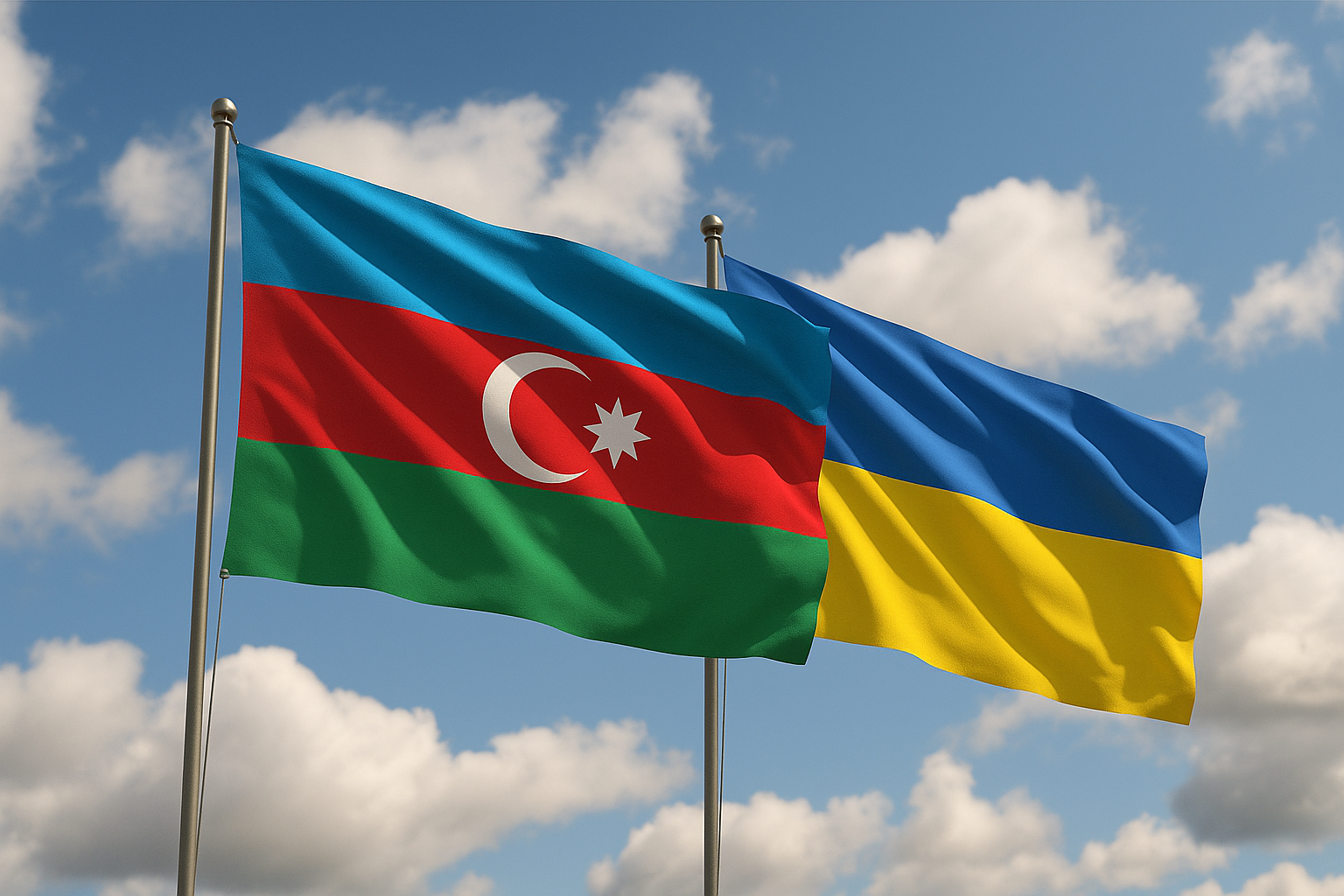
Since the onset of the full-scale war in Ukraine in 2022, the Republic of Azerbaijan has executed one of the most effective strategic maneuvers in the post-Soviet space. Geographically wedged between Russian imperial ambitions to the north and Iranian revolutionary posture to the south, Baku has systematically transformed what was historically a vulnerable geographic position into a source of formidable regional leverage. By pairing internal administrative restructuring with an active, uncompromised commitment to Ukraine’s territorial integrity, Azerbaijan has established itself as an indispensable non-aligned middle power.
This paper argues that Azerbaijan’s post-2022 foreign policy posture is neither an accident of circumstance nor a high-risk gamble, but rather a deliberate policy of calculated realpolitik. Baku actively supports Kyiv because upholding international law protects small states against great-power aggression, its formal alliance with Ankara deters Russian coercion, and its pivotal role in European energy security and Eurasian trade ensures that neither Moscow nor Western capitals can easily pressure Baku into submission.
Domestic Consolidation as the Engine of External Power Projection
A foundational tenet of realpolitik dictates that external flexibility requires absolute internal political stability. Azerbaijan’s capacity to act with diplomatic independence on the world stage rests directly upon a multi-year effort to modernize and consolidate its internal governance structures. Rather than viewing domestic political shifts in isolation, they must be understood as the foundational engine of Baku’s foreign policy agility.
The snap parliamentary elections of September 2024 accelerated a crucial generational shift within the Milli Meclis, ushering in younger, Western-educated technocrats who have replaced outdated bureaucratic inertia with a rapid-response legislative mechanism. This modernization of the legislative branch, paired with earlier constitutional adjustments that streamlined executive authority and centralized oversight over autonomous regions like Nakhchivan, eliminated internal points of friction that foreign powers historically exploited. Furthermore, the complete restoration of state sovereignty over Karabakh, followed by the full withdrawal of Russian peacekeeping forces, permanently removed Moscow’s primary structural lever within Azerbaijani domestic affairs. Complemented by the systematic modernization of state defense structures through deep integration with the Turkish military, Baku secured the domestic control necessary to project power outward without fear of internal destabilization.
Baku–Moscow Dynamics: Transactional Balancing and Strategic Independence
For decades, Baku and Moscow maintained a pragmatic partnership shaped by geography, security and shared interests. Today, that relationship is entering a new phase, as Azerbaijan seeks greater strategic autonomy while Russia struggles to preserve its traditional influence in the post-Soviet space.
Tensions between Baku and Moscow came to a head following the crash of an Azerbaijan Airlines aircraft on December 25, 2024, near Aktau, Kazakhstan. The aircraft, which was flying from Baku to Grozny, was severely damaged while attempting to divert toward Kazakhstan and ultimately crashed, killing dozens of people. Investigation findings and preliminary reports supported the conclusion that the aircraft had been struck by a Russian air-defense system, while Moscow avoided assuming full responsibility for months. For Baku, this was not simply an aviation tragedy, but an issue of sovereignty and state responsibility. President Ilham Aliyev demanded that Russia acknowledge responsibility, investigate the incident, and compensate the victims’ families. Instead of a swift response, the issue was accompanied by contradictory statements and diplomatic tensions, pushing the traditionally close Azerbaijan–Russia relationship into one of its most difficult periods in recent years.
The crisis did not remain limited to the aircraft incident. During 2025, tensions also increased over incidents involving Azerbaijani citizens and workers in Russia, diplomatic clashes, and Moscow’s continued efforts to preserve its influence across the post-Soviet space. Baku responded more firmly than it had in the past. It refused to back down under pressure, but it also avoided uncontrolled escalation. Azerbaijan demanded accountability and a relationship based on mutual respect. This is significant because Russia has historically tended to regard the former Soviet republics as part of a space where Moscow should retain a special sphere of influence. But today’s Azerbaijan is far more powerful than it was a decade ago. It has consolidated its position in the South Caucasus, gained greater economic and military weight, and expanded its ties with Türkiye, Europe, Central Asia, and other actors. This has given Baku alternatives and, above all, the ability to negotiate with Moscow without being compelled to submit to its will.
Against this backdrop, the future of Baku–Moscow relations should not mean a return to the old model of Russian pressure, political interference, or influence over its former Soviet neighbors. Cooperation can and should continue wherever the interests of the two countries converge particularly in trade, transport, energy, and regional connectivity, but it must rest on mutual respect, sovereign equality, and mutual benefit.
The result is not a rupture, but a gradual rebalancing. Baku is seeking to preserve economic and diplomatic ties with Moscow while ensuring that Russian pressure does not dictate its sovereign choices or regional priorities.
The Kyiv Axis: Transactional Realpolitik and Structural Support
Azerbaijan’s bilateral engagement with Ukraine stands out in the post-Soviet landscape because it is anchored in a firm adherence to international law rather than ideological alignment. Unlike traditional Western allies whose support for Kyiv is framed in normative terms of democratic defense, Baku’s posture toward Ukraine is structural, state-centric, and deeply pragmatic. Having experienced decades of unaddressed territorial occupation, Azerbaijan views the violation of sovereign borders as an existential threat to all small and medium-sized states.
This strategic alignment manifests through continuous high-level diplomacy, including direct consultations between President Ilham Aliyev and President Volodymyr Zelenskyy, as well as formal ministerial visits to Kyiv. Azerbaijan remains the only post-Soviet country (except Baltic states), which hosted the visit of President Zelensky. Beyond symbolic political backing, Baku provides vital material assistance that directly addresses Ukraine’s critical vulnerabilities. Azerbaijani state funds have directly financed the reconstruction of destroyed civic and municipal infrastructure in war-torn cities such as Irpin. In response to systematic attacks on Ukraine’s energy grid, Azerbaijan has consistently dispatched critical electrical infrastructure, including high-voltage transformers, generators, and extensive power cables. Crucially, Baku complements this energy lifeline with ongoing technical assistance for humanitarian demining and civil rehabilitation, demonstrating that a non-aligned state can deliver tangible strategic support without participating in Western sanction regimes.
Comparative Dynamics in the South Caucasus
The strategic logic of Baku’s posture becomes especially vivid when contrasted with the regional responses of its South Caucasus neighbors, Georgia and Armenia. While Azerbaijan has maintained a vocal defense of territorial integrity alongside substantial material shipments to Kyiv, neighboring capitals have been constrained by their own structural dependencies on Moscow.
Georgia, historically the most vocal pro-Western state in the region, has adopted a posture of caution and strategic ambiguity. Fearing direct Russian economic or military retaliation, Tbilisi refused to join bilateral economic sanctions and experienced significant political friction with Kyiv. Armenia, conversely, has attempted a diplomatic pivot toward the West to escape its historic security vulnerabilities, yet it remains deeply entangled in Russian-led economic and military institutions like the Eurasian Economic Union and the Collective Security Treaty Organization. Consequently, Yerevan’s support for Ukraine has been largely symbolic. Azerbaijan stands alone in the region as a state capable of providing direct, substantial aid to Ukraine without facing economic ruin or military retaliation from Moscow, precisely because its energy dominance, political-military alliance with Ankara and strategic cooperation with a number of Western Capitals provide complete structural insulation.
Neutralizing Moscow: Leverage and Transit Interdependence
Russia views Azerbaijan’s energy aid to Ukraine and its explicit support for Ukrainian sovereignty with clear irritation, yet Moscow’s ability to coerce Baku is strictly limited. Days prior to the 2022 invasion of Ukraine, Baku and Moscow signed a Declaration on Allied Interaction. Far from signaling a shift into the Kremlin’s orbit, Azerbaijan utilizes this agreement tactically—providing Russia with diplomatic reassurance while keeping its own foreign policy decisions entirely autonomous.
Moscow’s leverage over Baku has steadily diminished as Russian forces remain bogged down on the Ukrainian front lines, stripping the Kremlin of the military bandwidth required to enforce compliance in the South Caucasus. Moreover, severe Western sanctions have inverted the traditional power dynamic between the two nations. Russia partially relies on Azerbaijan as the transit corridor for the International North–South Transport Corridor (although large volumes of goods are transported via Caspian Sea to Iran), which links Russian markets to the Persian Gulf and South Asia. For the rest of the world Moscow mainly benefits from its Eurasian Economic Union partner – Armenia to avoid Western sanctions. According to Armenia’s Ministry of Foreign Affairs, bilateral trade turnover rose from about $5.1 billion in 2022 to $7.3 billion in 2023, and then to $12.4 billion in 2024. For the same period of time Azerbaijan–Russia trade turnover increased only from $3.71 billion to $4.80 billion.
Risk Assessment and the Buffers of Sovereign Autonomy
An analysis of Azerbaijan’s posture inevitably raises the question of risk: is Baku’s active support for Kyiv overly dangerous given its immediate proximity to Russia and Iran? In practice, Azerbaijani leadership operates with high confidence because its foreign policy is backed by four distinct structural buffers that deter regional aggression.
First, the 2021 Shusha Declaration legally codifies a mutual defense alliance between Azerbaijan and Türkiye, extending Ankara’s military deterrence over Baku without requiring the political complications of formal NATO integration. Second, through the Southern Gas Corridor, Azerbaijan has positioned itself as an indispensable energy partner to Southern and Eastern Europe, effectively converting European energy security into political protection for Baku. Third, Azerbaijan serves as the central hub of the Middle Corridor, linking East Asian trade directly to European markets while completely bypassing Russian territory. Finally, Baku balances these hard assets with pragmatic, open communication channels with both Moscow and Tehran, ensuring that diplomatic friction never escalates into military confrontation.
Deconstructing the “Realpolitik Miracle” Narrative
Within Azerbaijani domestic media and analytical circles, the country’s current strategic standing is rarely attributed to good fortune or shifting international tides. Instead, domestic discourse frames the “realpolitik miracle” as the logical output of a calculated national strategy built on four core tenets.
First, domestic analysts emphasize that sovereignty is earned through national strength rather than granted by international institutions. Having witnessed thirty years of ineffective international mediation over Karabakh, Baku’s policy is rooted in absolute self-reliance. Second, Baku’s support for Ukraine is framed as a matter of strict legal consistency rather than Western appeasement; supporting the principle of territorial integrity anywhere is essential to maintaining it everywhere. Third, domestic coverage continuously reinforces that internal administrative efficiency is the direct prerequisite for external strength. Finally, the national media narrative stresses the primacy of leverage over formal alignment, asserting that making Azerbaijan indispensable to both Western and Eastern trade networks is the ultimate guarantee of state survival.
Conclusion and Strategic Outlook
Azerbaijan’s post-2022 foreign policy demonstrates how a non-aligned middle power can successfully navigate an increasingly polarized, multipolar international system. By coupling internal administrative modernization with a foreign policy anchored in international law and hard strategic leverage, Baku has successfully converted its geographic vulnerabilities into long-term geopolitical strength.
For Ukraine and its Western partners, the key takeaway is to engage Azerbaijan not as a prospective Western client state, but as an independent, sovereign actor whose national interests naturally align with regional stability and international law. Strengthening technical, energy, and transit partnerships across the Middle Corridor offers the West its most reliable bridge to Central Asia and a resilient counterweight to regional hegemony in the South Caucasus.
© 2026 Argumentum