













































'/%3E%3C/svg%3E)

Dr. Dorian Koçi
Diplomat, Former Director of National Historical Museum of Albania
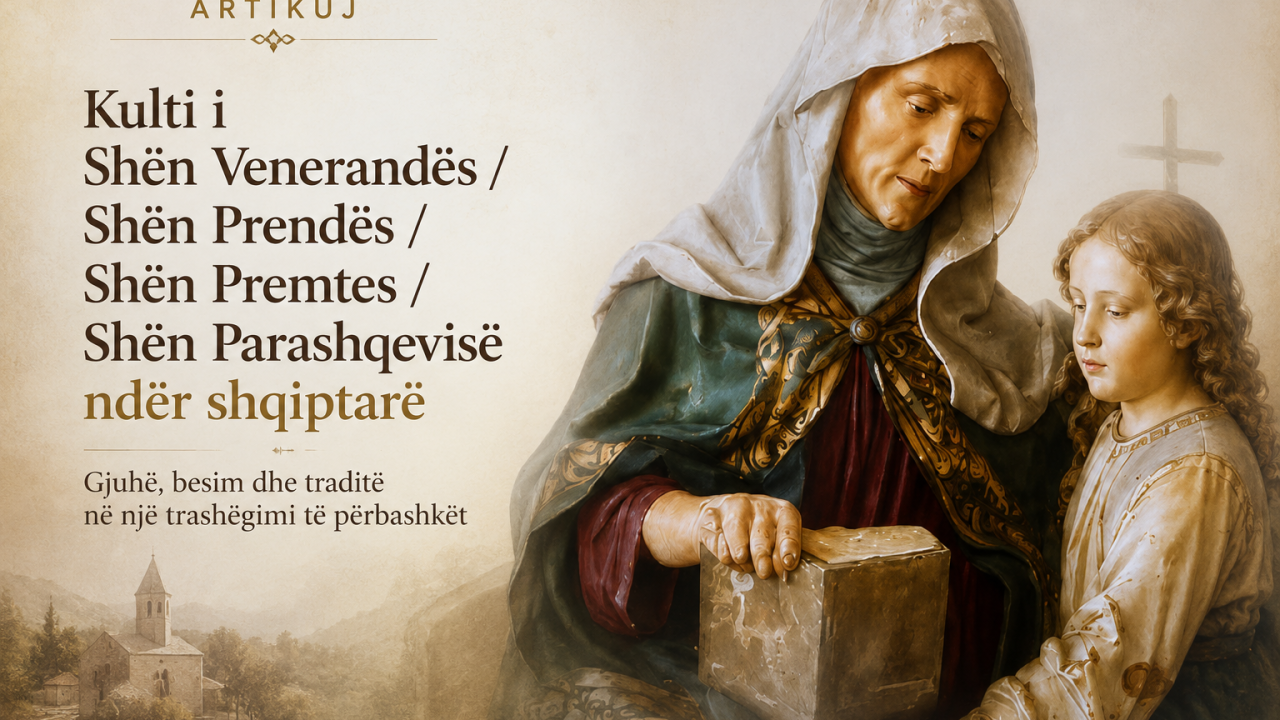
The Feast of Saint Premte, celebrated in the liturgical calendar on 26 July, represents one of the most beloved figures of popular Christian devotion in the Albanian lands. The saint, known in different languages as Veneranda in Latin, Paraskeva (Παρασκευή) in Greek, and Shën Premte or Shën Prenda in Albanian, bears witness to an ancient and widespread cult, deeply intertwined with the traditions of Christian faith and the Albanian language.
In Latin, her name is associated with Veneranda, a name connected with the concept of veneration and holiness. The Latin designation is also linked, in the broader Christian tradition, to dies Veneris, the name for Friday, just as in several Romance languages the name of the day derives from the Latin expression for the day of Venus. In Greek, Παρασκευή (Paraskevi) means “Friday,” but also carries the meaning of “preparation,” reflecting the religious context of the day of preparation for the Sabbath, the sacred day of rest in Jewish tradition and, subsequently, within the Christian understanding of the liturgical week. This multiplicity of meanings highlights the linguistic and theological layers that have influenced the development and spread of the saint’s cult.
In Albanian, the name Shën Premte appears to have entered early Christian usage and carries both the phonetic adaptation of ancient religious names and symbolic meanings associated with the life and miracles attributed to the saint. While Shën Pren(d)a is more commonly encountered in northern Albanian regions, Shën Premte is widespread in central and southern Albania. The Albanian language, as many scholars have noted, preserves a complex combination of Indo-European linguistic elements and traces of early Christian vocabulary, giving the cult of saints a distinctive cultural and linguistic character.
Saint Premte is regarded as one of the patron saints associated with women, particularly those who pray for health, fertility, and protection from illness. In the Eastern Christian tradition, Saint Paraskeva is venerated as a martyr of the second or third century, associated with Roman Thrace and remembered for her devotion to ascetic life, charity, and Christian faith. Her cult spread from the Christian East throughout the Balkans and acquired a particularly strong resonance within Albanian culture.
Toponymy provides some of the most vivid evidence of the geographical spread of this cult. In the village of Shën Premte in Gramsh, at Qafa e Shën Premtes in Progonat, and in the former Church of Saint Premte in Sul, traces of this devotion can still be found. Beyond formal confessional distinctions, these places testify to a profound spiritual sensibility that often transcends the conventional division between Catholicism and Orthodoxy. Such sites are frequently associated with local legends, sacred springs, pilgrimage days, and popular beliefs concerning healing and protection.
Within the Albanian Catholic tradition, the cult of Saint Prenda—also known as Shën Premte, Shën Veneranda, or, in some contexts, Shën Veneranda/Prenë—occupies a particularly significant place in the religious and cultural heritage of northern Albania. In Catholic communities, especially in the historical regions of Shkodra, Lezhë, Mirdita, Puka, and the surrounding mountainous areas, the saint has traditionally been venerated as a powerful female intercessor and protector. Her cult became intertwined with the spiritual life of Catholic Albanian communities, where churches, chapels, local shrines, and place names dedicated to her served as centres of prayer and communal devotion. The name Prenda, widespread in northern Albania, is itself an important reflection of the local adaptation of the saint’s name and of the deep roots of Christian tradition in Albanian culture. The celebration of her feast on 26 July was historically accompanied in some communities by gatherings, pilgrimages, prayers, and popular customs, illustrating how Catholic religious practice and Albanian folk tradition often developed together. The cult of Saint Prenda is therefore important not only as an expression of Catholic devotion but also as evidence of the continuity and localization of Christianity among Albanians, where universal Christian figures were given distinctive Albanian names, meanings, and forms of popular veneration.
An interesting aspect is also the connection between Friday and popular ritual traditions. In many Albanian regions, Friday was considered a sacred day on which certain types of work were forbidden, including working with wool or sewing clothes, in honour of Saint Premte. In some traditions, it was believed that violating these customs could bring punishment, illness, or misfortune. Such beliefs demonstrate a form of cultural syncretism between Christianity and older popular traditions, in which saints acquired an enduring intermediary role between human beings, the sacred world, and nature.
For this reason, a deeper linguistic and historical study is needed to determine whether the Albanian word “premte” is a direct historical development from the Latin tradition associated with Veneris dies, or whether its formation and semantic evolution were also influenced by the Greek concept of paraskevi, meaning “preparation.” The Albanian language, in this case, is not merely the bearer of an everyday word for a day of the week; it also preserves a long cultural and religious memory shaped by centuries of interaction between the Latin and Byzantine Christian worlds.
Saint Premte, with all her different names and cultural manifestations, is therefore an important testimony to the way Albanians preserved, adopted, and adapted figures of Christian sanctity according to their own linguistic and spiritual sensibilities. Her cult, present in settlements, geographical names, churches, shrines, and popular customs, forms an integral part of the Albanian religious mosaic and offers valuable evidence of the deep and enduring roots of Christianity in this part of the Balkans.
At the same time, the study of Saint Premte opens broader questions concerning the early Christianization of the Albanian-speaking lands. The coexistence of Latin, Greek, and Albanian forms of the saint’s name reflects the historical position of the Albanian territories at the crossroads of the Western and Eastern Christian worlds. The cult of Veneranda–Paraskeva–Premte/Pren(d)a can thus be viewed as part of a wider cultural history in which linguistic change, religious transmission, local memory, and popular belief interacted over many centuries.
© 2026 Argumentum