





























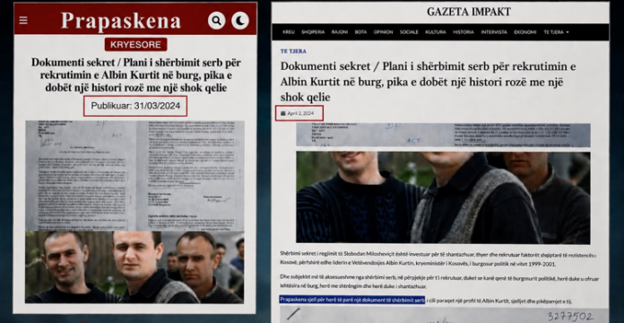
In March 2024, the “Prapaskena” portal in Albania published a document that was presented as allegedly “compromising” for Kosovo’s acting Prime Minister, Albin Kurti.
For months, this material was presented to the public as an “exclusive leak” from independent media sources outside Kosovo.
However, the background to this publication reveals a clear pattern of hybrid warfare: an operation by Serbia’s intelligence service (BIA) that used journalism as a cover and Kosovo and Albania as theatres for disinformation operations.
According to information exposing this network, the document in question was not the product of any journalistic investigation, but material delivered directly by a senior officer of Serbia’s BIA, Bojan Dimić. The recipient and executor of the directives on the ground was Fatmir Sheholli, who, by exploiting his profile and access to media circles, undertook to organise the placement of this material with a single objective: to damage the public image of Kosovo’s prime minister.
The “Third Country” Method
After attempting to share this document with various influential figures in Kosovo’s media, Sheholli and his handlers within the BIA chose a more refined strategy: using a third country (Albania) for the initial publication.
This tactic served as a form of information “laundering”. By being published in Tirana, the document created the illusion of neutral distance. It concealed the traces leading back to the BIA in Belgrade and its intermediaries in Prishtina, causing media outlets in Kosovo subsequently to republish it not as a coordinated attack originating from Serbia, but as “a story uncovered by colleagues in Albania”. Sheholli used his status as a journalist and the legal right to “protect his source” to conceal the BIA official, Bojan Dimić.
The Domino Effect
Once the material takes the form of a news story published elsewhere, domestic media outlets cite it with less scrutiny, thereby achieving the adversary’s ultimate objective: feeding public opinion with doubts about Kurti’s character and reputation.
The Soviet Doctrine
What happened in the “Kurti” case is not a new invention by Belgrade. This operation follows, point by point, the well-known Soviet doctrine of “Active Measures” (Aktivnye Meropriyatiya), which Russian intelligence services and their satellites (including the BIA) have used for decades to bring down governments and destroy the reputations of opposing leaders.
This methodology demonstrates that the Serbian service is using asymmetric tools in which the media are not viewed as a space for providing information, but as an operational weapon for striking political targets without leaving direct traces of state involvement.
If we analyse operations exposed by Western intelligence services over the years, we find striking similarities with the Sheholli case:
- Narrative Laundering through Foreign Media (the “Congo Fever” Case – KGB): During the Cold War, the KGB sought to spread the false claim that the United States was using biological weapons in Pakistan. The KGB did not publish the story in Moscow. Instead, it used a small newspaper under its control in India (the third country), called “The Patriot”. Once it was published there, other media outlets around the world picked it up as an established news story. This is the same mechanism the BIA used with the portal in Albania for the document targeting Kurti.
- The Use of “Journalists” as Agents of Influence (the “Doppelgänger” Case – GRU, Russia): In recent Russian operations exposed by German intelligence (BfV) and French intelligence (DGSI), it was discovered that Russia paid or directed pseudo-journalists and local analysts to publish falsified documents in Western media. Like Sheholli in Kosovo, these individuals used their media credentials to lend credibility to material prepared in intelligence offices in Moscow.
- A Modified “Hack-and-Leak” Operation (the Macron Case, France 2017): When the Russian military intelligence service (GRU) stole emails belonging to Emmanuel Macron’s staff ahead of the presidential election, it did not simply publish them. Russian intelligence inserted false and manipulated documents among genuine ones in order to manufacture artificial scandals. The document delivered by Bojan Dimić follows the same logic: the creation of supposedly “compromising” material intended solely to produce an immediate emotional and political impact.
In the indictment filed by Kosovo’s Special Prosecution, the defendant Fatmir Sheholli admitted during questioning that he had received the document known as “Leptiri” directly from Serbian intelligence structures (BIA).
Sheholli told investigators that the operational document concerning Albin Kurti had been sent to his mobile phone by Bojan Dimić. In addition to acknowledging that he had received the document from the BIA, Sheholli stated that he subsequently forwarded the material to other individuals. Among them, he mentioned Milazim Gashi (whom he described as a friend of his within Albania’s State Intelligence Service, SHISH), Blerim Canaj, as well as another person named Bashkim Pushkolli.
© 2026 Argumentum