

• SHQIPËRI
  • KOSOVË
  • MAQEDONIA E VERIUT
  • MALI I ZI
  • Revista në PDF
5 September, 2026
 
  • Home
  • OP/ED

    Resolution 522 – When the U.S. Congress Honored Skanderbeg

    The Reconfiguration of Maritime Governance: Structural Hegemonic Decline and the Arctic Pivot

    Between Political Calculation and Retreat: Croatian Communists at the End of an Era

    The West is buying time, but to whom is it giving it?

    27 July 1941 – A Site of Memory Between War, Revolution and Europe

    The cult of Saint Veneranda / Saint Pren(d)a / Saint Premte / Saint Paraskeva among Albanians

    The Self-Inflicted Decoupling: How U.S. Immigration Policy Is Ceding the Tech Edge to China

    The Blueprint Does Not Stop at the Drina

    The Underlying Logic behind China’s Economic Success

  • Interview

    Exclusive Interview with Oleksandr Tyshchenko: A 40-Year Legacy of Chernobyl, Nuclear Risks, and Global Responsibility

    INTERVIEW: ZLATKO KRAMARIĆ – THOUGHTS ON THE OLD CONTINENT

    EXCLUSIVE / Ukrainian Ambassador to Albania, Volodymyr Shkurov: “Ukraine wants peace, but not at the expense of its freedom and independence”

    EXCLUSIVE| Ambassador Tayyar Kagan Atay: Türkiye and Albania, a Strategic Partnership Rooted in Shared Heritage and a Common Vision for the Future

    “Diplomacy, Not War”: Palestinian Ambassador to Albania Calls for Justice, Peace, and Global Action for Gaza

    Exclusive: “Even After Tito – Tito”/ Ambassador Zlatko Kramarić on Authoritarian Legacies and Democracy’s Future in the Balkans

    The Conclusion of the Diplomatic Mission / Ambassador Dancho Markovski: Strengthening Albania-North Macedonia Relations for a Shared European Future

    A Century of Diplomatic Relations Between Albania and Russia: Exclusive Interview with the Russian Ambassador to Albania, H.E. Alexey Zaytsev

    Exclusive/ The chairman of the Freedom Party, Ilir Meta: “The will of the citizens will triumph in Albania, as it did in North Macedonia”

  • Realpolitik

    Belgrade, Zelensky and the Consulates! The European Pact takes water! Drone in Leipzig and hybrid war! Why a  ceasefire is needed in September

    The Summit of Unity! Think of peace and prepare for war! It’s only the start to the end! Just a pause between two wars!

    Peace with war diplomacy! The protest,  image and tourism! Why this silence from the EU Commission and Council? A deal or a pause?

    Just kind words  in Tivat! Where is the peace!? A deal yes, peace No!What is happening with USA and  EU?  5 elections but no solution!

    IBAR? ”Sufficiently! Much ado about nothing! Shart contrasts in Beijing! Where is the exit?!

    Neither peace nor war! Peace with bombs?! IBAR in autumn?! Not another Hormuz in Taivan! 

    IBAR – a springing board or an obstacle? Can we catch the EU Negotiation train 2027? When the dress makes the news!  EU electoral April  ends in a draw 1:1!  

    The European Parliament building in Strasbourg, France with flags waving calmly celebrating peace of the Europe. July 12, 2020.

    EU 2027 or 2037! Even half membership failed! No exit strategy!     

    What next?

  • Current Events

    By Blood

    New Swiss Ambassador Siri Walt presents credentials to President Bajram Begaj 

    Albanian Opposition Leader Sali Berisha to Return to U.S. Five Years After Entry Ban

    Bekim Sejdiu Named Consensus Candidate for Kosovo Presidency

    President Begaj Receives New Dutch Ambassador Marleen Monster

    Albania on Alert: Bomb Threats Target Several Institutions

    Belgium Opens First-Ever Embassy in Tirana, Strengthening Bilateral Ties

    MEFA: Albania Successfully Repatriates Five Citizens, Including Women and Children, from Syria

    Hoxha: A Modern Diplomacy for a European Albania

  • Top News

    Albania Plans Distribution of 17,000 Textbooks to Albanian Diaspora for 2026–2027 School Year

    Belgium Opens First-Ever Embassy in Tirana, Strengthening Bilateral Ties

    US Launches Economic Offensive Against Iran, Bessent Warns Countries to Cut Tehran’s Lifelines

    Rama, Vučić, Zelensky: Where Is Albania’s National Interest?

    Council of Albanian Ambassadors Raises Concern Over Serbian Plan to Alter the Ibër River

    Rama: Foreign Information Manipulation Has Become One of the Greatest Threats to Democracy and European Security

    The Council of Albanian Ambassadors condemns chauvinistic rhetoric by Serbian officials and calls for diplomatic action

    NATO at Ankara 2026: Strategic Rebalancing Between Russia Deterrence, Turkey’s Rise, and National Interests

    Daniel Serwer: A Bad War Ending Badly May Still Be Good News

  • YOUR VOICE
  • ARGUMENTUM MAGAZINE
  • Shqip
No Result
View All Result
Argumentum
  • Home
  • OP/ED

    Resolution 522 – When the U.S. Congress Honored Skanderbeg

    The Reconfiguration of Maritime Governance: Structural Hegemonic Decline and the Arctic Pivot

    Between Political Calculation and Retreat: Croatian Communists at the End of an Era

    The West is buying time, but to whom is it giving it?

    27 July 1941 – A Site of Memory Between War, Revolution and Europe

    The cult of Saint Veneranda / Saint Pren(d)a / Saint Premte / Saint Paraskeva among Albanians

    The Self-Inflicted Decoupling: How U.S. Immigration Policy Is Ceding the Tech Edge to China

    The Blueprint Does Not Stop at the Drina

    The Underlying Logic behind China’s Economic Success

  • Interview

    Exclusive Interview with Oleksandr Tyshchenko: A 40-Year Legacy of Chernobyl, Nuclear Risks, and Global Responsibility

    INTERVIEW: ZLATKO KRAMARIĆ – THOUGHTS ON THE OLD CONTINENT

    EXCLUSIVE / Ukrainian Ambassador to Albania, Volodymyr Shkurov: “Ukraine wants peace, but not at the expense of its freedom and independence”

    EXCLUSIVE| Ambassador Tayyar Kagan Atay: Türkiye and Albania, a Strategic Partnership Rooted in Shared Heritage and a Common Vision for the Future

    “Diplomacy, Not War”: Palestinian Ambassador to Albania Calls for Justice, Peace, and Global Action for Gaza

    Exclusive: “Even After Tito – Tito”/ Ambassador Zlatko Kramarić on Authoritarian Legacies and Democracy’s Future in the Balkans

    The Conclusion of the Diplomatic Mission / Ambassador Dancho Markovski: Strengthening Albania-North Macedonia Relations for a Shared European Future

    A Century of Diplomatic Relations Between Albania and Russia: Exclusive Interview with the Russian Ambassador to Albania, H.E. Alexey Zaytsev

    Exclusive/ The chairman of the Freedom Party, Ilir Meta: “The will of the citizens will triumph in Albania, as it did in North Macedonia”

  • Realpolitik

    Belgrade, Zelensky and the Consulates! The European Pact takes water! Drone in Leipzig and hybrid war! Why a  ceasefire is needed in September

    The Summit of Unity! Think of peace and prepare for war! It’s only the start to the end! Just a pause between two wars!

    Peace with war diplomacy! The protest,  image and tourism! Why this silence from the EU Commission and Council? A deal or a pause?

    Just kind words  in Tivat! Where is the peace!? A deal yes, peace No!What is happening with USA and  EU?  5 elections but no solution!

    IBAR? ”Sufficiently! Much ado about nothing! Shart contrasts in Beijing! Where is the exit?!

    Neither peace nor war! Peace with bombs?! IBAR in autumn?! Not another Hormuz in Taivan! 

    IBAR – a springing board or an obstacle? Can we catch the EU Negotiation train 2027? When the dress makes the news!  EU electoral April  ends in a draw 1:1!  

    The European Parliament building in Strasbourg, France with flags waving calmly celebrating peace of the Europe. July 12, 2020.

    EU 2027 or 2037! Even half membership failed! No exit strategy!     

    What next?

  • Current Events

    By Blood

    New Swiss Ambassador Siri Walt presents credentials to President Bajram Begaj 

    Albanian Opposition Leader Sali Berisha to Return to U.S. Five Years After Entry Ban

    Bekim Sejdiu Named Consensus Candidate for Kosovo Presidency

    President Begaj Receives New Dutch Ambassador Marleen Monster

    Albania on Alert: Bomb Threats Target Several Institutions

    Belgium Opens First-Ever Embassy in Tirana, Strengthening Bilateral Ties

    MEFA: Albania Successfully Repatriates Five Citizens, Including Women and Children, from Syria

    Hoxha: A Modern Diplomacy for a European Albania

  • Top News

    Albania Plans Distribution of 17,000 Textbooks to Albanian Diaspora for 2026–2027 School Year

    Belgium Opens First-Ever Embassy in Tirana, Strengthening Bilateral Ties

    US Launches Economic Offensive Against Iran, Bessent Warns Countries to Cut Tehran’s Lifelines

    Rama, Vučić, Zelensky: Where Is Albania’s National Interest?

    Council of Albanian Ambassadors Raises Concern Over Serbian Plan to Alter the Ibër River

    Rama: Foreign Information Manipulation Has Become One of the Greatest Threats to Democracy and European Security

    The Council of Albanian Ambassadors condemns chauvinistic rhetoric by Serbian officials and calls for diplomatic action

    NATO at Ankara 2026: Strategic Rebalancing Between Russia Deterrence, Turkey’s Rise, and National Interests

    Daniel Serwer: A Bad War Ending Badly May Still Be Good News

  • YOUR VOICE
  • ARGUMENTUM MAGAZINE
  • Shqip
No Result
View All Result
Argumentum
No Result
View All Result
Home Current Events

By Blood

5 September, 2026
in Current Events, ENGLISH
A A
Share on FacebookShare on Twitter

Mother Teresa belonged to the world. She also said, “By blood, I am Albanian.” The life behind that sentence belongs to a nation that has never had one religion.

By Maringlen Cara (Tirana)

“By blood, I am Albanian.”

Mother Teresa said it herself. The sentence continues: “By citizenship, an Indian. By faith, I am a Catholic nun. As to my calling, I belong to the world. As to my heart, I belong entirely to the Heart of Jesus.”

She said it in that order. Blood first. The world has spent decades remembering the fourth clause more readily than the first.

We gave her to the world and she belongs to it. That is not a grievance. A saint belongs beyond the nation that produced her. India has every claim on the citizen, Calcutta has the woman who spent most of her life there, the Catholic Church has Saint Teresa, and the poor she served required no passport from her.

But before she was anyone’s, she was ours.

Albania marks 5 September as an official holiday under the legal title Day of the Canonisation of Mother Teresa, a date that replaced the beatification holiday of 19 October in 2018. The calendar is slightly untidy. Pope Francis canonised her on 4 September 2016. She died on 5 September 1997, and since last year that date has also been her optional memorial in the General Roman Calendar. Because the Albanian holiday falls on a Saturday this year, the day off carries into Monday, when the Bank of Albania will remain closed.

Kosovo does not close. Since 2022 its government has called 5 September Humanism Day, and each year the president, the speaker and the prime minister lay wreaths at her statue in the centre of Prishtina. The United Nations calls it the International Day of Charity because it is the date on which she died. And in Prishtina, in a country where 93.5 per cent of those counted in the 2024 census identified as Muslim, a Catholic cathedral carries her name and keeps a relic of her blood. A boulevard a few minutes away carries her name too.

Those are facts about the memory. The facts about the life sit somewhere else.

The blood
Gonxhe Bojaxhiu was born in Skopje on 26 August 1910 into an Albanian Catholic family. Her father’s line came from Prizren, where a cousin, Nikollë Mini, was still the parish priest when she first came back to the city in 1970. Her mother’s roots ran through Novosellë (Novo Selo), on the Gjakova side. The family that met in Skopje therefore carried Kosovo with it before there was a Kosovo state to claim anything from the child.

She did not need descendants to discover this for her. She supplied the adjective herself, and the adjective was Albanian: not Yugoslav, not Macedonian, not vaguely Balkan, not merely Catholic. Skopje gave her a birthplace. Kosovo gave her the blood, and then it gave her the decision.

Letnicë
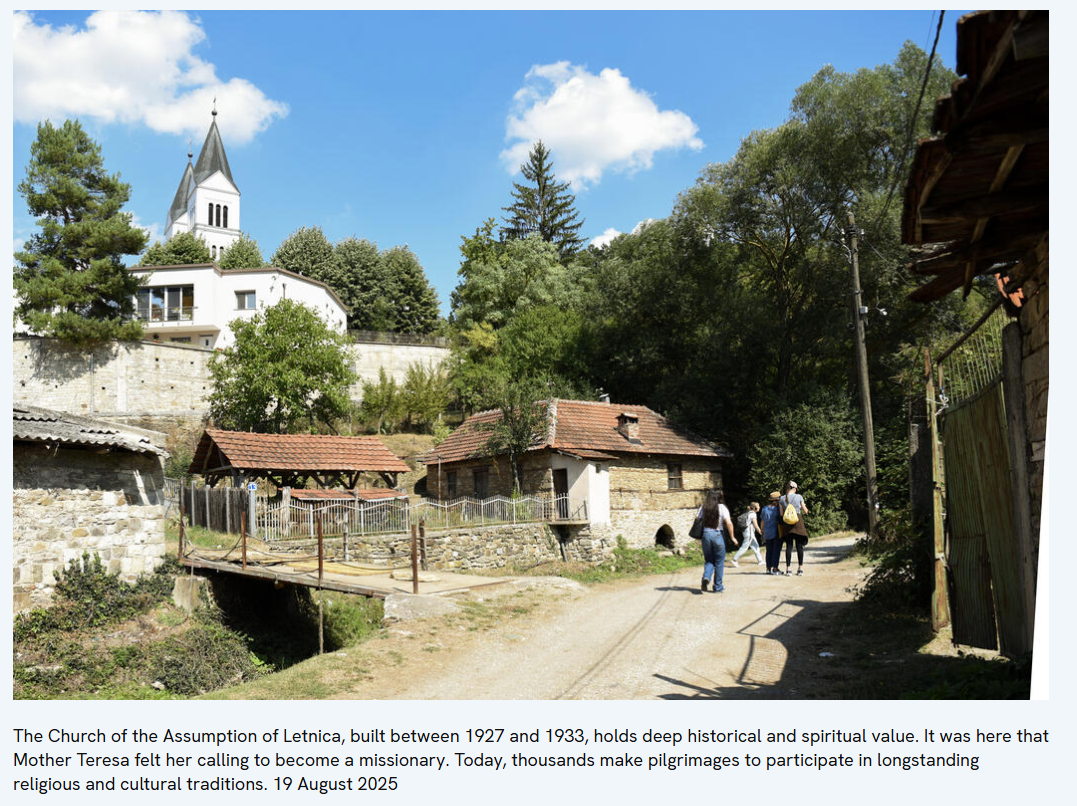
Every August, Catholics from Skopje made the pilgrimage to the Marian shrine at Letnicë (Letnica), above Vitia. The Bojaxhiu family went with them. Gonxhe later remembered that the first sense of a religious vocation came to her there when she was twelve. She thought and prayed about it for years. Then, on 14 August 1928, twelve days before her eighteenth birthday, she was again at Letnicë, and the decision hardened into a yes.

Vatican News marked the anniversary again this August, locating that decisive moment precisely where it happened: at the shrine in Letnicë, Kosovo. The European Union did something less theological but almost as useful a few weeks earlier, announcing the reopening, with EU support, of the old pilgrimage route between Skopje and Letnicë, the road travelled by generations of pilgrims including the young Gonxhe.

That autumn she left home for the Sisters of Loreto in Ireland. In January 1929 she reached India. Everything that came afterwards happened elsewhere: the sari, Calcutta, the Missionaries of Charity, the Nobel Prize, Rome, sainthood. She came back five times in the decades that followed, in 1970, 1978, 1980, 1982 and 1986, and on four of those journeys she went up to Letnicë again; her biographer Lush Gjergji has the itineraries. But the decision that determined everything after it happened on a hill in Vitia, to an Albanian girl, in a Catholic shrine, in Kosovo.

Hold those four facts together for a moment. Not every account of this land can.

Three faiths
There is a way of telling the story of Kosovo in which religion and nation are the same thing, so that to name a person’s faith is to have named their people, and to name the land’s churches is to have named its owners. It is an old habit in this part of Europe and not only here. It has one difficulty. It cannot place Mother Teresa.

Albanians were Christian centuries before most of them became Muslim. For centuries before the Ottomans came they lived under Byzantine, Bulgarian and Serbian rule and were Orthodox wherever the Eastern Church held sway, Kosovo included, and Catholic wherever Rome’s jurisdiction reached, along the Adriatic and in the highlands behind it; the line between the two churches ran through Albanian lands, not around them. Under the Ottomans most Albanians became Muslim, over roughly three centuries, family by family and village by village, and the ones who converted did not stop being Albanian, any more than the ones who did not. The Catholic parishes of Prizren, Gjakova and Letnicë survived beside the new Muslim majority for the whole of that time. A nation that has held three faiths, and holds all three today, cannot be filed under one of them, and any map of this land drawn by religion alone will find people it cannot explain. Gonxhe Bojaxhiu is one of those people whom the whole world knows by name: an Albanian Catholic from a Prizren family, called to her vocation at a Catholic shrine in Kosovo.

She is not the exception to Albanian history. She is what it looks like.

And the same history built her cathedral. A society that is more than nine tenths Muslim by census put a Catholic church in the centre of its capital and gave it the name of an Albanian Catholic nun. Ibrahim Rugova, from a Muslim family, laid its cornerstone on her ninety-fifth birthday in 2005; it was consecrated on 5 September 2017, twenty years to the day after her death. Nobody needed her to become less Catholic for Kosovo to claim her, and nobody needed Kosovo to become more Christian. A people of three faiths does not experience one of them as foreign. Anyone who comes to Prishtina with a story in which faith and nation are one thing has to pass that cathedral on the way in. It is worth looking up.

The state that closes for her
There is another history here, and this one belongs to us. Mother Teresa’s Albanian blood does not give the Albanian state an uncomplicated claim on her. Quite the opposite.

After Gonxhe left Skopje, her mother Drane and sister Aga eventually settled in Tirana. They lived for years in a modest house on Rruga Hajdar Hidi, near Rruga e Kavajës, and later moved to another flat. Drane died in 1972. Aga followed in 1973. They are buried at Sharra.

The daughter tried to come. For years the People’s Republic refused her requests to enter Albania. Across the border, among the other Albanians, she moved without difficulty. In June 1980 Skopje made her an honorary citizen and she prayed at her father’s grave there; days later Kosovo’s Executive Council received her in Prishtina. In October 1982 she opened a house of her own Missionaries of Charity in Peja. Her sisters were working among Albanians in Yugoslavia nine years before Tirana would allow them across the border. In 1986, after Enver Hoxha’s death, Mother Teresa telephoned the Albanian embassy in Rome herself and asked to enter simply as a visitor, to pay homage at the graves of her mother and sister. She received no answer. By then she had held the Nobel Peace Prize for seven years.

In 1989 the calculation changed and the regime admitted her. Before the visit she asked for a church in which she could pray. The request was denied. She visited the graves. She visited the house on Hajdar Hidi. Then she asked for something else: permission to bring four Missionaries of Charity to Albania to care for the elderly and the abandoned. The communist state had spent decades insisting that it had abolished the social need for both God and charity, and its answer was therefore predictable. Albania had doctors, nurses and state institutions. The Republic would look after its own.

The daughter kept asking. The regime fell first.

So the Albanian claim on Mother Teresa is a claim with a wound inside it. We can call her ours because she called herself ours. But the state whose airport, hospital, square and official calendar now carry her name once denied her the elementary privilege of kneeling at her mother’s grave and finding an open church in which to pray. Blood is the thing the dictatorship could not nationalise and could not abolish.

Two maps
That house on Hajdar Hidi still stands in Tirana, modest, marked by a plaque and by the murals a festival painted on the alley in 2020, a few minutes’ walk from the public architecture through which Albania now remembers her.

Elsewhere her name is enormous. At Rinas it is written across the airport. In Tirana it sits on a major square and on the university hospital. In Prishtina it rises over a cathedral and runs down a boulevard. In Rome it is written into the calendar of the universal Church. At Letnicë there is still the road, and pilgrims walked it before governments discovered Mother Teresa and walk it now, towards the place where a girl carrying the blood of Prizren and Gjakova made a decision whose consequences reached Calcutta and then the world.

We gave her to that world. She belonged to the world. But she was ours to give.

Communist Albania spent forty years behaving as though that sentence were not true and has spent the decades since monumentalising it. Any account of this land that sorts its people by a single faith has the opposite problem. It has room for the monasteries, the saints and the graves of one Christian tradition, all of which belong to the history of Kosovo. What it cannot accommodate is the Christian history beside them: an Albanian Catholic family from Prizren, an Albanian girl at Letnicë, and a Muslim-majority Kosovo that calls her its daughter without requiring her to become anything other than Catholic.

Mother Teresa does not prove that Kosovo is Christian.

She proves why the question is wrong.
https://tiranaexaminer.com/by-blood

Related Posts

ENGLISH

The Delusion of Trade Defense: Why Washington and Brussels Cannot Tariff Their Way Out of Structural Decline

4 September, 2026
ENGLISH

Resolution 522 – When the U.S. Congress Honored Skanderbeg

4 September, 2026
Current Events

New Swiss Ambassador Siri Walt presents credentials to President Bajram Begaj 

3 September, 2026
Argumentum

“Argumentum”, një proces intelektual …

Contact Us

[email protected]
[email protected]
[email protected]

Follow Us

Media Partner

Register

Receive Argumentum Magazine by Email
  • Home
  • Privacy Policy
  • About Us
  • Contact

© 2022 Argumentum. All Rights Reserved. | NUIS: L91415033Q

Welcome Back!

Login to your account below

Forgotten Password?

Retrieve your password

Please enter your username or email address to reset your password.

Log In

Add New Playlist

No Result
View All Result
  • Home
  • OP/ED
  • Interview
  • Realpolitik
  • Current Events
  • Top News
  • YOUR VOICE
  • ARGUMENTUM MAGAZINE
  • Shqip

© 2022 Argumentum. All Rights Reserved. | NUIS: L91415033Q

This website uses cookies. By continuing to use this website you are giving consent to cookies being used. Visit our Privacy and Cookie Policy.