





By Dr. Gurakuq Kuçi
Professor at Universum College and external associate at ISLH “OCTOPUS”
Within the span of just a few days, two statements from Serbia showed us how little the political mindset that produced the crimes of the 1990s has changed.
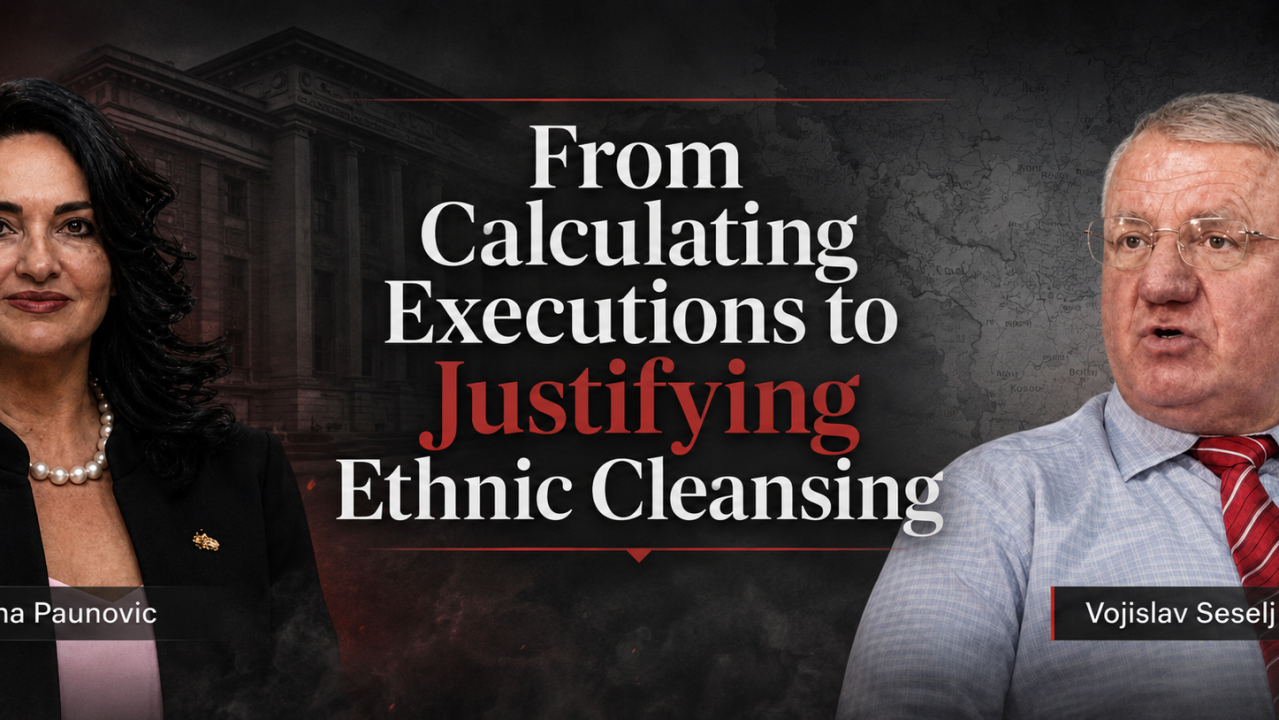
First, Vojislav Seselj spoke about the executions in Srebrenica as though they were a mathematical operation. He calculated how many people seven individuals could execute within a few hours and then said: “Those of you who have never executed anyone do not know what it is like.”
A few days later, Serbian Minister Snezana Paunovic declared that, had she been in Slobodan Milosevic’s position, she would have “ethnically cleansed Kosovo.” In the same interview, she described the Kosovo Liberation Army as “guerrillas trained as butchers,” while referring to the entry of NATO and KFOR into Kosovo as an “occupation.”
These statements expose the true face of Vucic’s regime, which speaks through the mouths of others.
Seselj rationalizes the manner in which the executions were carried out. Paunovic rationalizes what, in her view, the Serbian state should have done to the Albanians. The former minimizes the crime through technical calculations. The latter presents ethnic cleansing as a strategic option that Milosevic failed to carry through to completion.
In both cases, the victim disappears as a human being. What remains in their place are numbers, execution capacity, “terrorists,” “butchers,” and a population that was supposed to be expelled.
This is the same ideology that denies the genocide in Srebrenica, relativizes the Račak massacre, criminalizes Albanian resistance, and portrays NATO’s intervention as an act of aggression against Serbia.
The difference is that Seselj is a convicted war criminal, while Paunovic is a serving government minister.
This is precisely where the danger lies. The language that once came from radical structures continues today to be articulated from within state institutions. When executions are rationalized and ethnic cleansing is justified, we are not dealing merely with the denial of the past.
We are dealing with the preservation of the moral and political climate that makes its repetition possible.