

• SHQIPËRI
  • KOSOVË
  • MAQEDONIA E VERIUT
  • MALI I ZI
  • Revista në PDF
24 July, 2026
  • Home
  • OP/ED

    The Self-Inflicted Decoupling: How U.S. Immigration Policy Is Ceding the Tech Edge to China

    The Blueprint Does Not Stop at the Drina

    The Underlying Logic behind China’s Economic Success

    Do Not Misuse the U.S. Declaration of Independence to Justify the Narrative of Insurrection in Albania

    The visit that changed Albania’s strategic future

    Pierre Nora and the institution of memory we lack in Eastern Europe

    The Blueprint of a Diplomatic Debacle: Analyzing Germany’s Historic UNSC Loss

    Between Russia, Iran and Europe: Azerbaijan as a balancing power in the South Caucasus

    The Zero-Tariff Gate: Sovereignty as a Service in the Sino-African Corridor

  • Interview

    Exclusive Interview with Oleksandr Tyshchenko: A 40-Year Legacy of Chernobyl, Nuclear Risks, and Global Responsibility

    INTERVIEW: ZLATKO KRAMARIĆ – THOUGHTS ON THE OLD CONTINENT

    EXCLUSIVE / Ukrainian Ambassador to Albania, Volodymyr Shkurov: “Ukraine wants peace, but not at the expense of its freedom and independence”

    EXCLUSIVE| Ambassador Tayyar Kagan Atay: Türkiye and Albania, a Strategic Partnership Rooted in Shared Heritage and a Common Vision for the Future

    “Diplomacy, Not War”: Palestinian Ambassador to Albania Calls for Justice, Peace, and Global Action for Gaza

    Exclusive: “Even After Tito – Tito”/ Ambassador Zlatko Kramarić on Authoritarian Legacies and Democracy’s Future in the Balkans

    The Conclusion of the Diplomatic Mission / Ambassador Dancho Markovski: Strengthening Albania-North Macedonia Relations for a Shared European Future

    A Century of Diplomatic Relations Between Albania and Russia: Exclusive Interview with the Russian Ambassador to Albania, H.E. Alexey Zaytsev

    Exclusive/ The chairman of the Freedom Party, Ilir Meta: “The will of the citizens will triumph in Albania, as it did in North Macedonia”

  • Realpolitik

    The Summit of Unity! Think of peace and prepare for war! It’s only the start to the end! Just a pause between two wars!

    Peace with war diplomacy! The protest,  image and tourism! Why this silence from the EU Commission and Council? A deal or a pause?

    Just kind words  in Tivat! Where is the peace!? A deal yes, peace No!What is happening with USA and  EU?  5 elections but no solution!

    IBAR? ”Sufficiently! Much ado about nothing! Shart contrasts in Beijing! Where is the exit?!

    Neither peace nor war! Peace with bombs?! IBAR in autumn?! Not another Hormuz in Taivan! 

    IBAR – a springing board or an obstacle? Can we catch the EU Negotiation train 2027? When the dress makes the news!  EU electoral April  ends in a draw 1:1!  

    The European Parliament building in Strasbourg, France with flags waving calmly celebrating peace of the Europe. July 12, 2020.

    EU 2027 or 2037! Even half membership failed! No exit strategy!     

    What next?

    “With diplomatic velvet“! Major question marks! In Washington yes, but  in the White House NO! A strange dinner in Brussels!

  • Current Events

    Who Is Interested in War in the Balkans?

    From Calculating Executions to Justifying Ethnic Cleansing

    When Algorithm Becomes the Most Powerful Manipulator: The Case of the Protests in Tirana

    NATO Summit in Ankara: Allies Adopt Declaration Reaffirming Collective Defence and Long-Term Security Commitments

    The Diplomacy of Gas and Algorithms: The Nuances of Official Tirana—Is It Breaking the European Taboo with Azerbaijan?

    Protection for Serbs, or Protection for Radoicic?

    The Architecture of Selective Sovereignty:Corporate Immunity, Technological Protectionism, and the Erosion of Credibility

    Montenegro’s Unfinished Transition

    The Paradox of Selective Capitalism: How Western Rule-Breaking Accelerates Its Own Systemic Demise

  • Top News

    The Council of Albanian Ambassadors condemns chauvinistic rhetoric by Serbian officials and calls for diplomatic action

    NATO at Ankara 2026: Strategic Rebalancing Between Russia Deterrence, Turkey’s Rise, and National Interests

    Daniel Serwer: A Bad War Ending Badly May Still Be Good News

    Friedrich Merz, Keir Starmer, António Costa, Donald Trump, Emmanuel Macron, Mark Carney, Ursula von der Leyen, Giorgia Meloni and Sanae Takaichi

    G7 Leaders Gather in Évian Amid Global Uncertainty, Focus on Security, Economy and International Cooperation

    Russian Ambassador in Tirana: “Without a Strong and Sovereign Russia, the Creation of a Just World Order Is Impossible”

    “The Flamingo Revolution”: Day 10 of Protests in Albania Draws International Attention

    Rama alleges ‘hybrid war’ behind protests against Kushner-linked coastal development

    No End in Sight: Trump, Netanyahu and the Expanding Middle East War

    Tirana – €20 Million EU–Banking Agreement Boosts Albanian SMEs

  • YOUR VOICE
  • Shqip
No Result
View All Result
Argumentum
  • Home
  • OP/ED

    The Self-Inflicted Decoupling: How U.S. Immigration Policy Is Ceding the Tech Edge to China

    The Blueprint Does Not Stop at the Drina

    The Underlying Logic behind China’s Economic Success

    Do Not Misuse the U.S. Declaration of Independence to Justify the Narrative of Insurrection in Albania

    The visit that changed Albania’s strategic future

    Pierre Nora and the institution of memory we lack in Eastern Europe

    The Blueprint of a Diplomatic Debacle: Analyzing Germany’s Historic UNSC Loss

    Between Russia, Iran and Europe: Azerbaijan as a balancing power in the South Caucasus

    The Zero-Tariff Gate: Sovereignty as a Service in the Sino-African Corridor

  • Interview

    Exclusive Interview with Oleksandr Tyshchenko: A 40-Year Legacy of Chernobyl, Nuclear Risks, and Global Responsibility

    INTERVIEW: ZLATKO KRAMARIĆ – THOUGHTS ON THE OLD CONTINENT

    EXCLUSIVE / Ukrainian Ambassador to Albania, Volodymyr Shkurov: “Ukraine wants peace, but not at the expense of its freedom and independence”

    EXCLUSIVE| Ambassador Tayyar Kagan Atay: Türkiye and Albania, a Strategic Partnership Rooted in Shared Heritage and a Common Vision for the Future

    “Diplomacy, Not War”: Palestinian Ambassador to Albania Calls for Justice, Peace, and Global Action for Gaza

    Exclusive: “Even After Tito – Tito”/ Ambassador Zlatko Kramarić on Authoritarian Legacies and Democracy’s Future in the Balkans

    The Conclusion of the Diplomatic Mission / Ambassador Dancho Markovski: Strengthening Albania-North Macedonia Relations for a Shared European Future

    A Century of Diplomatic Relations Between Albania and Russia: Exclusive Interview with the Russian Ambassador to Albania, H.E. Alexey Zaytsev

    Exclusive/ The chairman of the Freedom Party, Ilir Meta: “The will of the citizens will triumph in Albania, as it did in North Macedonia”

  • Realpolitik

    The Summit of Unity! Think of peace and prepare for war! It’s only the start to the end! Just a pause between two wars!

    Peace with war diplomacy! The protest,  image and tourism! Why this silence from the EU Commission and Council? A deal or a pause?

    Just kind words  in Tivat! Where is the peace!? A deal yes, peace No!What is happening with USA and  EU?  5 elections but no solution!

    IBAR? ”Sufficiently! Much ado about nothing! Shart contrasts in Beijing! Where is the exit?!

    Neither peace nor war! Peace with bombs?! IBAR in autumn?! Not another Hormuz in Taivan! 

    IBAR – a springing board or an obstacle? Can we catch the EU Negotiation train 2027? When the dress makes the news!  EU electoral April  ends in a draw 1:1!  

    The European Parliament building in Strasbourg, France with flags waving calmly celebrating peace of the Europe. July 12, 2020.

    EU 2027 or 2037! Even half membership failed! No exit strategy!     

    What next?

    “With diplomatic velvet“! Major question marks! In Washington yes, but  in the White House NO! A strange dinner in Brussels!

  • Current Events

    Who Is Interested in War in the Balkans?

    From Calculating Executions to Justifying Ethnic Cleansing

    When Algorithm Becomes the Most Powerful Manipulator: The Case of the Protests in Tirana

    NATO Summit in Ankara: Allies Adopt Declaration Reaffirming Collective Defence and Long-Term Security Commitments

    The Diplomacy of Gas and Algorithms: The Nuances of Official Tirana—Is It Breaking the European Taboo with Azerbaijan?

    Protection for Serbs, or Protection for Radoicic?

    The Architecture of Selective Sovereignty:Corporate Immunity, Technological Protectionism, and the Erosion of Credibility

    Montenegro’s Unfinished Transition

    The Paradox of Selective Capitalism: How Western Rule-Breaking Accelerates Its Own Systemic Demise

  • Top News

    The Council of Albanian Ambassadors condemns chauvinistic rhetoric by Serbian officials and calls for diplomatic action

    NATO at Ankara 2026: Strategic Rebalancing Between Russia Deterrence, Turkey’s Rise, and National Interests

    Daniel Serwer: A Bad War Ending Badly May Still Be Good News

    Friedrich Merz, Keir Starmer, António Costa, Donald Trump, Emmanuel Macron, Mark Carney, Ursula von der Leyen, Giorgia Meloni and Sanae Takaichi

    G7 Leaders Gather in Évian Amid Global Uncertainty, Focus on Security, Economy and International Cooperation

    Russian Ambassador in Tirana: “Without a Strong and Sovereign Russia, the Creation of a Just World Order Is Impossible”

    “The Flamingo Revolution”: Day 10 of Protests in Albania Draws International Attention

    Rama alleges ‘hybrid war’ behind protests against Kushner-linked coastal development

    No End in Sight: Trump, Netanyahu and the Expanding Middle East War

    Tirana – €20 Million EU–Banking Agreement Boosts Albanian SMEs

  • YOUR VOICE
  • Shqip
No Result
View All Result
Argumentum
No Result
View All Result
Home ENGLISH

Iraq 2019 mass protests: The third wave of Arab Spring

21 November, 2019
in ENGLISH, English Top News
A A
Share on FacebookShare on Twitter

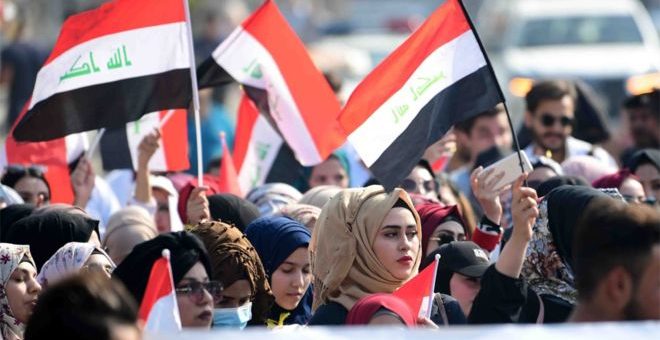
At the beginning of October 2018, two years after the final military victory over the so-called Islamic State (ISIL), Iraq was rocked by the largest wave of protests since 2003 American intervention and establishment of democratic order. The main demands of young Iraqi protesters are more job opportunities, fight against corruption and better public services such as health care, electric power and drinking water supply etc. The situation escalated when Iraqi authorities brutally reacted to mass protests using not only tear gas but also live ammunition, killing more than 250 protesters and injuring thousands more. 

The uprising swept Baghdad and the Shia south of the country, notably Basra, Nasiriyah and Maysan – the centres of oil industry accounting for about 95% of oil production in Iraq, which makes about 90% of national budget income of this restless state that is strongly dependent on production and export of oil through its southern ports in Basra.

Since 2003, protests have been daily events in Iraq, reflecting the transition from a single-party system with its cult leader Saddam Hussein to the promised democracy. However, due to massive participation of young protesters and their persistence, recent demonstrations have bewildered Iraqi authorities which are completely isolated in the carefully protected “green zone” for state institutions and foreign corpses such as the US and British embassy.

The protesters soon detected the powerlessness of their government in Baghdad that is completely controlled by Iran and the pro-Iranian Shia militia, hence the main slogan of the protests (Iran go out), the burning of Iranian flags and assaults against Iran’s diplomatic representations in the Shia holy city of Karbala.

Paradoxically, in this rich country lying on the Tigris and Euphrates river basin with the fourth largest oil reserves in the world and a budget of $112 billion (2019), around 25% of the population, i.e. nine million (mostly young and educated) people live under the poverty threshold. Although around 55% of Iraq’s territory represents arable land, agriculture accounts for only 3.3% of GDP and employs just one fifth of the workforce.

All this reflects the systematic weakening of national economy as result of 1991-2003 international sanctions and the incapable and corrupt political elites that have been in power since 2003. According to the corruption index from Transparency International, Iraq is ranked as low as 169th of all together 180 countries which were included in the global survey on corruption.

Protests against Iran

Protests that have spread through the Shia part of Iraq, which was long the cradle of Iran’s influence, came as a shock to Iranian authorities who have in recent years boasted about having control over four Arab capitals: Baghdad, Damascus, Beirut and Sanaa, as well as a large influence on the Palestinian Authority in the Gaza Strip with the Sunni population.

The Kurdish north of Iraq does not participate in the protests, since their problems are much less acute than in other parts of the country. Sunnis are afraid to join the protests, taught by the bloody experience from 2013-2014 demonstrations that were brutally suppressed and labelled as the revolt of Salaam’s regime followers, which eventually led to the birth of ISIL. In the war against Islamic State their urban centres Mosul, Anbar and Diyala were destroyed and consequently six million Sunnis were displaced within and outside of Iraq.

Constitutional changes

The protesters rejected the offer to reconstruct or change the government. They are aware that the power has been in the hands of the elite since 2005 and do not believe in the political system with 263 registered political parties with religious or sectarian programmes. They demand constitutional changes and introduction of presidential system, with a hint of nostalgia for Saddam Hussein’s autocratic regime.

Constitutionality of the present political system is disputed in aspects such prohibition of discrimination based on race, religion and nationality. Namely, the function of the President of the Republic belongs exclusively to the Kurds, the function of Prime Minister to the Shia and that of the Parliament Speaker to the Sunni.  Although this is not officially laid down in the Constitution, it has been in practice since the new Constitution was adopted at the 2005 referendum.

Para-military units and militias are prohibited by the Constitution and they are regarded illegal unless they are organised by the military-security structures of the central government in Baghdad or by the Kurdistan regional government (KRG), which is an autonomous but still a constituent and parallel part of the central structures.  

During the war with ISIL Iraq gave birth to Shia militias called Popular Mobilisation Forces (PMF), that have shown great loyalty to Iran. They were legalised in 2017 with the resolution of Iraqi Parliament and became a constituent element of Iraqi security forces. The ruling elite privatised national oil resources – Iraq’s main source of wealth – and transformed them into a kind of party-militia feud. The money thus fills the pockets of the elite through a sophisticated system of clientelism. In despair, the young demonstrators are willing to face Shia militias’ live bullets. In its present form Iraqi government, despite all its promises, lacks the political will and capacity to lead the state that has become so divided between political feuds.

The young no longer believe that they can change the situation through political methods. Election turnout has decreased as the voters massively boycotted the last election in 2018. Although the turnout was officially claimed to be 44%, many believe that it was much smaller – not more than 12%. The month following the election, party militias deliberately set fire to the building where ballot boxes were kept, burning more than  half of them. The election results were later “rectified” by the Independent Electoral Commission of Iraq, which is obviously not so independent.

The third wave of Arab Spring

The so called Arab Spring begun in 2011 with the first wave of protests that swept through some Arab states and deposed most dictatorships in Tunis, Egypt, Libya and Yemen. The second wave followed in 2018 when the military governments in Sudan and Algeria were overthrown. The third wave of protests is currently raging in Lebanon and Iraq, targeting the “democratic” regimes in those countries. Having been democratically elected, although far from the basic alphabet of modern democracy, the ruling elites believed they enjoyed sovereign immunity, either with the support of foreign forces (the US or Iran) or based on their sectarian democracy. 

According to some analysts the three waves of Arab Spring have shown that democracy is not the magical solution that can provide clear answers to citizens’ demands, especially not in countries where the democratic process was built on sectarian or ethnic grounds, such as Iraq and Lebanon, but to a lesser degree also Sudan and Yemen. 

Most protesters call for eradication of corruption and demand the ruling elite to return the plundered assets into state budget. They also demand the abolishment of sectarian quotas for appointing the government and state functionaries, and insist that regional and foreign forces (especially the US and Iran through their militias) stop interfering into Iraq’s internal affairs, call for the consolidation of sound state management so as to ensure jobs for the young and provide basic rights to social protection and health care.

Adel Abdul Mahdi is described as the worst Iraqi Prime Minister since the 2003 US intervention.  Despite his readiness to resign if the Parliament found another prime minister, Mahdi remained in power, mostly thanks to Qasem Soleimanj, Major General of Islamic Revolutionary Guard and commander of Quds force, who secretly visited Baghdad in the beginning of October 2019 during the rage of protests. Leaders of two Iraqi main political blocks Muqtada Al-Sadr and leader of national mobilization forces Hadi Al-Amiri agreed to sacrifice him in order to calm down the protesters. 

The present situation in Iraq is very dangerous since the protests reflect harsh conflicts between two external rivals – Iran and the United States – and the internal forces, marionettes and followers. Iraq should become the role model of democracy, respect of human rights and economic prosperity. 

Iran’s Supreme Leader Ayatollah Ali Khamenei accused the US, Israel and Saudi Arabia of instigating the protests.

However, protesters went out on the streets of Baghdad, Karbala, Najaf, Basra and Amarah not at the US’s behest but due to famine, poverty, corruption, unemployment and lack of basic public services, water, electricity and medicines. Despite the country’s rich oil and other resources, one fifth of Iraqi citizens live under the poverty threshold.

Who are the leaders of protests?

The organisers and leaders of protests in Iraq are not publicly known. Spontaneous gatherings triggered by social networks have grown into present mass demonstrations. Protest movements seeking revolutionary changes in other Arab states now aspire for the Sudan model (2019) of organising national masses. The activists in Iraq and Lebanon protests are inspired with Sudan’s example where professional and trade union associations negotiated with the army to reach the transitional period pending the formation of democratic civilian government. 

Their challenges regarding the organisation of protests depend on the ability of the civil society and trade unions to consolidate their efforts within a single coordinating unit such as the Sudanese Professionals Association. In Iraq those associations are still in the phase of transforming into an organised social and political force independent of political parties, which will be able to voice the protesters’ demands in future negotiations about eventual changes to the 2005 constitution which were initiated by Iraq’s President Barham Salih in the beginning of November 2019.

Nevertheless, the political challenges are even more complicated. Since 2003 Iraq’s political parties are formed on sectarian (Shia and Sunni) and national basis (Arabs, Kurds, Turkmens, Chaldean Catholics, Orthodox Assyrians, Sabaeans and other). Political forces are already trying to intimidate people with the return of Saddam’s party Baath or ISIL on the pretext of protecting the national interest. So far those manipulations have not affected the protesters who carry the flag of Iraq without any religious or national emblems.

Analysts have noted that Iraq can clearly no longer be led by the present sectarian system on which the political blocks are formed in the Parliament. The government cannot explain or justify the severe violation of Iraq’s sovereignty and the use of paramilitary militias of Iranian revolutionary guard to brutally quell the protesters with violence, abductions and torture. They have finally taken off their sectarian mask and revealed their true face to the public. In order to maintain their privileged status, the politicians in Iraqi Parliament are desperate to preserve the present system and are therefore ready to continue their bloody crackdown on the protests. 


IFIMES – The International Institute for Middle-East and Balkan Studies, based in Ljubljana, Slovenia, has a special consultative status with the Economic and Social Council ECOSOC/UN since 2018.
Related Posts

ENGLISH

A constant in an era of radical change

22 July, 2026
ENGLISH

Azerbaijan’s Policy in the Middle East: ties, overlaps, and divergences

22 July, 2026
ENGLISH

The Summit of Unity! Think of peace and prepare for war! It’s only the start to the end! Just a pause between two wars!

20 July, 2026

Follow US

Subscribe

Receive Argumentum Magazine by Email

Last Posts

A constant in an era of radical change

22 July, 2026

Who Is Interested in War in the Balkans?

22 July, 2026

Azerbaijan’s Policy in the Middle East: ties, overlaps, and divergences

22 July, 2026

The Summit of Unity! Think of peace and prepare for war! It’s only the start to the end! Just a pause between two wars!

20 July, 2026

The Self-Inflicted Decoupling: How U.S. Immigration Policy Is Ceding the Tech Edge to China

20 July, 2026
Argumentum

“Argumentum”, një proces intelektual …

Contact Us

[email protected]
[email protected]
[email protected]

Follow Us

Media Partner

Register

Receive Argumentum Magazine by Email
  • Home
  • Privacy Policy
  • About Us
  • Contact

© 2022 Argumentum. All Rights Reserved. | NUIS: L91415033Q

Welcome Back!

Login to your account below

Forgotten Password? Sign Up

Create New Account!

Fill the forms bellow to register

*By registering into our website, you agree to the Terms & Conditions and Privacy Policy.
All fields are required. Log In

Retrieve your password

Please enter your username or email address to reset your password.

Log In

Add New Playlist

No Result
View All Result
  • Home
  • OP/ED
  • Interview
  • Realpolitik
  • Current Events
  • Top News
  • YOUR VOICE
  • Shqip

© 2022 Argumentum. All Rights Reserved. | NUIS: L91415033Q

This website uses cookies. By continuing to use this website you are giving consent to cookies being used. Visit our Privacy and Cookie Policy.