











































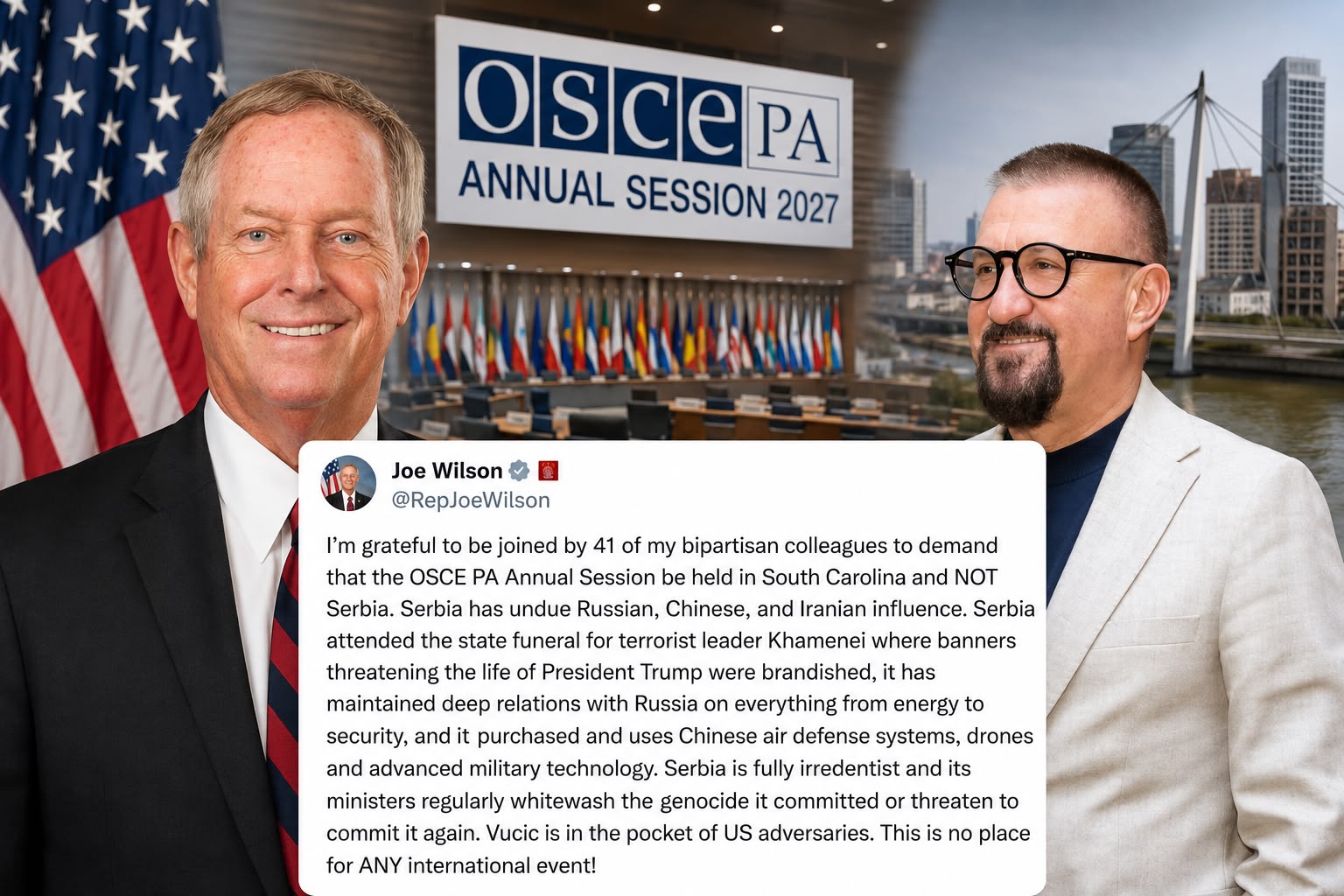
Congressman Joe Wilson’s Initiative Is a Welcome and Necessary Call
By Indrit Hamiti
The decision regarding where the 2027 Annual Session of the Parliamentary Assembly of the Organization for Security and Co-operation in Europe (OSCE) will be held is not merely a matter of protocol or logistical convenience. It is a decision of considerable political and symbolic significance. A host country for such a forum provides more than conference facilities and infrastructure—it represents the very values upon which the organization itself was founded.
For this reason, the initiative by U.S. Congressman Joe Wilson, supported by 41 Republican and Democratic lawmakers, calling for the next OSCE Parliamentary Assembly session to be held in Charleston, South Carolina, rather than Belgrade, deserves serious consideration and broad support. It is an initiative aimed at safeguarding the credibility of Euro-Atlantic institutions.
Joe Wilson’s message is about much more than opposition to a particular geographic location. It is a warning that international organizations should not send the wrong signals at a time when the international order is facing unprecedented challenges. In his statement, Wilson highlights several serious concerns: Serbia’s close relations with Russia and Iran, its military cooperation with U.S. adversaries, its strategic ties with Moscow, as well as revisionist rhetoric and the relativization of war crimes. The essence of his message is clear: an international security forum should not be hosted by a country whose strategic orientation continues to raise serious questions.
Equally significant is the fact that this is not merely the personal initiative of a single congressman. The support of 41 American legislators from both major political parties demonstrates that concerns about Serbia’s foreign policy are not a partisan issue but rather an assessment shared across the political spectrum in Washington. At a time when bipartisan consensus in the United States is increasingly rare, this united position should be taken seriously.
The OSCE was established to promote peace, security, respect for state sovereignty, human rights, and international cooperation. Consequently, the country hosting such an event should embody these principles not only in official declarations but also in its political conduct.
Unfortunately, Serbia continues to pursue a dual-track foreign policy. On the one hand, it declares its aspiration to join the European Union; on the other, it maintains privileged relations with the Russian Federation and has refused to align itself with European sanctions imposed on Moscow following its aggression against Ukraine. At the same time, Serbia has expanded military and technological cooperation with countries regarded as strategic competitors of the United States while continuing to cultivate relationships with actors whose policies frequently conflict with the strategic interests of the West.
This strategy of “sitting on two chairs” cannot be without political consequences. No one disputes Serbia’s sovereign right to shape its foreign relations according to its national interests. However, it is equally legitimate for Western allies to assess whether a country truly represents the values that should be reflected by an international security forum.
Another issue that cannot be ignored is Belgrade’s continuing policy toward Kosovo. Serbia still refuses to recognize Kosovo’s independence, while recurring tensions in northern Kosovo and persistent nationalist rhetoric continue to undermine regional stability. Although the dialogue between Belgrade and Pristina must continue, it cannot be overlooked that a state’s conduct should be taken into account when it seeks to host an organization dedicated to promoting security and cooperation.
This makes Joe Wilson’s question entirely legitimate: What message does the Euro-Atlantic community send if it chooses as host for a major security conference a country whose strategic position toward the Western alliance remains ambiguous?
Ultimately, this is a debate about standards. International organizations derive their authority from consistency. If they expect states to uphold democracy, international law, and solidarity with allies, then their own institutional decisions should reflect those same principles.
For Albania and Kosovo, this issue carries particular significance. Both countries have made a clear Euro-Atlantic choice and have consistently demonstrated solidarity with NATO and European Union policies. Albania has unequivocally aligned itself with sanctions against Russia and has supported every allied initiative aimed at defending the international order. In this context, holding a major security forum in a country that does not demonstrate the same strategic clarity would create a difficult contradiction to justify.
Hosting a session of the OSCE Parliamentary Assembly is not an automatic entitlement; it is a privilege that should reflect a country’s credibility and its commitment to the values the organization represents.
History has taught us that collective security is built not only through political declarations or international conferences. It is built on trust, on alliances, and on consistency between words and actions. That is precisely what Congressman Joe Wilson’s initiative reminds us of. It is a message in defense of the integrity of international institutions.
In the end, an organization dedicated to safeguarding security must be just as careful in choosing the symbolism of its decisions as it is in shaping their substance. The place where representatives of democratic nations gather is not merely a point on a map—it is a political statement.
And in times of global uncertainty, political statements matter.
© 2026 Argumentum