




























Dr. Gurakuç Kuçi
Senior Research at Institute for Hybrid Warfare Studies “OCTOPUS”*
Hybrid warfare has made the transition from being a purely theoretical concern to a multifaceted and pervasive strategy that fundamentally affects the structure of modern societies. It has transcended the boundaries of propaganda and disinformation, by transforming these tools into powerful weapons to influence democratic processes and government decision-making. In this context, the Western Balkans represents a dynamic laboratory where hybrid strategies are clearly manifested, which not only challenge the stability of the region, but also reconfigures its political and social landscape.
The phenomenon of “Srpski Svet” (Serbian World) and “Ruski Mir” (Russian World) constitute two of the most visible strategies operating in this space. Built on the goals of global multipolarization, these projects are an integral part of Russia’s Eurasian strategy, which seeks to challenge Western dominance and expand its influence in the region. Multipolarization has evolved from a simple theoretical idea into a reality characterized by concrete and interventionist actions, as illustrated by the initiatives undertaken by the BRICS countries, which clearly aim to reshape the global balance of power.
A significant example of this dynamic is the overthrow of pro-Western structures in Montenegro, a process that has been the product of direct intervention by Russia and Serbia. Following these developments, the next strategy seems to be to create a legal framework that would allow Serbian citizens of Montenegro to automatically obtain Serbian citizenship. This move follows a broader narrative of demographic and political influence, supported by recent census data. Its results show an increase in the number of citizens who identify as Serbs, thus creating a demographic base that favors the strategic ambitions of Belgrade and Moscow.
This combination of covert influence, manipulated demography, and political interference poses a serious challenge not only to the countries of the region, but also to the broader Euro-Atlantic security architecture. In this context, hybrid warfare in the Western Balkans presents itself as a clear model of complex hybrid strategies, which require in-depth analysis and a coordinated response from international actors.
Dual citizenship law in Montenegro: a tactic to expand the “Serbian world”
In May 2024, the Institute for Hybrid Warfare Studies “OCTOPUS” published a scientific study that analyzes the geopolitical strategy of Russia and Serbia comparing to Montenegro, focusing on hybrid warfare as a means to influence the country’s demographics and political structure. This study sheds light on how Russia and Serbia are using ethnic engineering and political influence to strengthen Serbian identity and consolidate the concept of the “Serbian world”. One of the main tools of this strategy is the demand of dual citizenship for Serbian citizens of Montenegro.
Currently, Montenegro has a strict stance on dual citizenship. According to the current legislation, a foreign citizen seeking Montenegrin citizenship must surrender his previous citizenship. This legal provision constitutes an obstacle to the implementation of proposals by pro-Serbian and pro-Russian parties, which demand that Montenegrin citizens of Serbian origin have the right to have dual citizenship, including that of Serbia.
These efforts resulted as part of a broader strategy to change the demographic and political balance in Montenegro, significantly strengthening ties between the Serbian community and Serbia. This scenario creates a favorable basis for political manipulation and increasing Belgrade’s influence in Montenegro.
Demographic statistics show profound changes in the ethnic composition of Montenegro over the past decades. In the last census, 41.12% of the population declared themselves Montenegrins, while 33% declared themselves Serbs—an increase of 4% compared to the 2011 census. This change is particularly significant when compared to historical data:
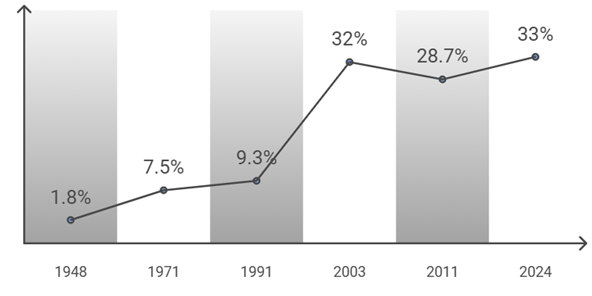
- 1948: 1.8% Serbs
- 1971: 7.5% Serbs
- 1991: 9.3% Serbs
- 2003: 32% Serbs
- 2011: 28.7% Serbs
- 2021: 33% Serbs
These figures show a disproportionate growth of the Serbian community, especially after the collapse of Yugoslavia. This trend has important implications, suggesting a well-thought-out strategy to change the ethnic composition and to overthrow the political dominance of Montenegrins.
The results of the latest census and the growth trends of the Serbian community constitute a clear indication of what can be described as ethnic engineering. The main goal is to create a demographic base that would enable the realization of major strategic objectives:
- Referendum on unification with Serbia: A possible scenario where Serbia uses its demographic majority to organize a referendum on unification with Montenegro.
- Division of a part of the territory by referendum: The other scenario is when a part of Montenegro dominated by a Serbian majority and a pro-Serbian and pro-Russian majority organizes a referendum on separation.
- Changing geopolitical circumstances: In the case of international tensions, a Serbian invasion of Montenegro could be justified on the basis of “protecting” the Serbian community.
- Expansion of Serbian identity: Through culture, religion and politics, an empowered Serbian identity is promoted in Montenegro.
This strategy is not simply a demographic or legal issue, it rather represents a serious threat to Montenegro’s sovereignty. As Serbian influence in the country’s ethnic and political structure grows, Montenegro’s internal stability and territorial integrity are at risk. In particular, Serbia’s and Russia’s hybrid interventions through disinformation, diplomatic pressure, and the fomentation of ethnic divisions aim to undermine the country’s democratic structures.
The ethnic and social engineering efforts in Montenegro will not stop because this country constitutes a substantial component of the completion of the dream of the “Serbian world” and constitutes Russia’s current easiest route to sea access to warm waters.
Hybrid warfare and the geopolitical strategies of Russia and Serbia
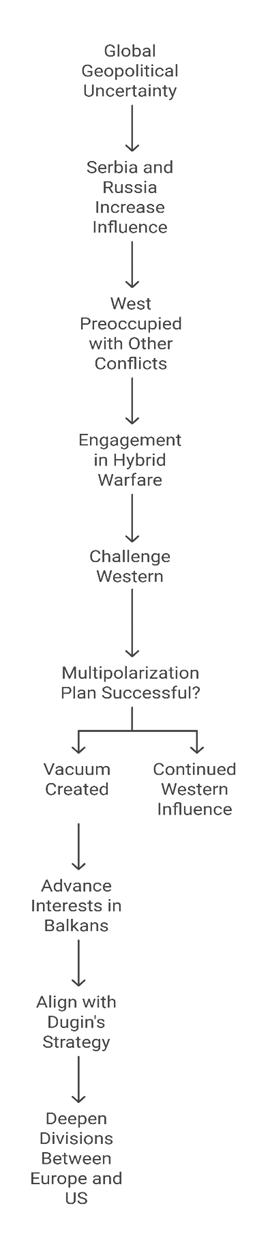
In a broader context, Serbia and Russia have taken advantage of global geopolitical uncertainty to increase their influence in the Balkans. With Donald Trump’s rise to power, Serbia expects greater independence of action in the Western Balkans while the West is preoccupied with other conflicts and challenges, such as the Middle East, the war in Ukraine, and competition with China. These tactical advantages have enabled Serbia and Russia to increase their involvement in the Balkans, transforming the region into a porous zone to the influences of hybrid warfare.
From a strategic perspective, Russia and its BRICS partners are working towards a multipolar world that challenges Western hegemony. If the multipolarization plan succeeds, it could force the West to withdraw from several areas, including the Balkans. This potential vacuum would create favorable conditions for Russia and Serbia to advance their interests in the “Balkan Rimland,” a strategically important space for controlling ties between East and West.
Alexander Dugin’s strategy for a Europe free from American influence provides an ideological basis for the Russian approach. This idea has also found support in the narratives of President Putin, who has repeatedly emphasized that Europe will reach a point when it will no longer be a “vassal” of the United States. If the divisions between Europe and the United States deepen, even to a small extent, this could create space for Putin to advance his strategies. Moreover, a gradual withdrawal of American interest from the continent would strengthen Serbia’s position, allowing it to advance its interests in the region.
In this context, the Balkans remain a flashpoint on the map of global conflicts. The hybrid warfare taking place in this region represents not only an attempt to maintain local influence, but part of a global strategy to challenge the West.
Lessons from Georgia and Ukraine: parallels to hybrid strategies in the Balkans
Hybrid warfare is no longer in terms of “threat” but in real and tangible terms. A comparative example from the Western Balkans is Russia’s hybrid warfare in Georgia and Ukraine, two cases where hybrid tactics have led to severe destabilization and territorial intrusions. In Georgia, hybrid interventions began with support for separatists in South Ossetia and Abkhazia, escalating into the 2008 conflict. Russia used a combination of disinformation, diplomatic pressure, and military interventions to undermine Georgia’s sovereignty and maintain control over this strategic Caucasus country.
In Ukraine, the beginning of the hybrid conflict was marked by the annexation of Crimea in 2014 and support for separatists in the Donbas region. Hybrid warfare in Ukraine included a wide range of tools, such as cyberattacks against critical infrastructure, massive disinformation campaigns, and the exploitation of local discontent to create social and political divisions. Russia built a narrative that promoted the protection of the Russian and Russian-speaking population, a strategy that resembles efforts to empower Serbian communities in Montenegro and Kosovo.
These examples provide a model for understanding how hybrid interventions in the Balkans can be advanced by Serbia and Russia. In both cases, Georgia and Ukraine, the key elements have been:
- The use of demography as a political tool: In both countries, Russia has used Russian-speaking communities as a basis for legitimizing interventions.
- Cultural and historical narratives: Promoting “historical and cultural unity” has been a justification for influencing the sovereignty of these countries.
- Combining hybrid and traditional tools: From disinformation and cyberattacks to direct military interventions.
In this context, the parallel with the Balkans is evident. If the scenarios in Georgia and Ukraine serve as precedents, the risks for Montenegro, Kosovo and Bosnia and Hercegovina are high, especially if local communities are used as a tool to create division and destabilization. The main lesson from these cases is that a delayed reaction by the West only reinforces these hybrid strategies and paves the way for further escalation.
The Russian-Serbian hybrid war against Kosovo through electoral manipulation and terrorist attack
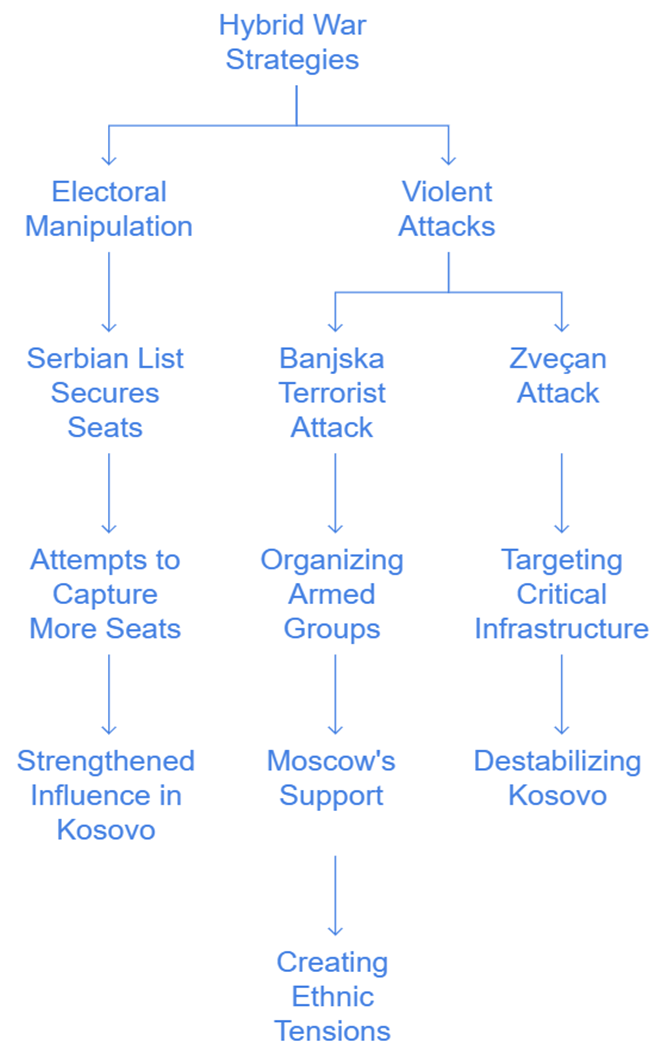
Russia and Serbia’s hybrid efforts to destabilize Kosovo have taken increasingly complex forms, including electoral manipulation and the use of violence to create uncertainty and fuel plans for the partition of Kosovo. These strategies represent a clear attempt to undermine Kosovo’s sovereignty and create space for political and social interference to the detriment of regional stability. The case of electoral manipulation through the Serbian List and the terrorist attack in Banjska are clear examples of these efforts.
Russian-Serbian hybrid war in Kosovo through electoral manipulation
In the Kosovo parliamentary elections held on 14 February 2021, the Srpska Lista secured 10 seats reserved for the Serb community, strengthening its role as a political instrument directed by Belgrade. But its strategy went beyond these 10 seats, aiming to manipulate the electoral system to capture other seats reserved for non-majority communities such as Bosniaks, Roma, Ashkali and Egyptians. By transferring votes from the Serb community to candidates affiliated with the Srpska Lista, this party sought to achieve up to 17 seats in the Kosovo Assembly.
This electoral manipulation constitutes a form of institutional hybrid warfare, where democratic instruments are used to undermine democracy itself. If this strategy were to be realized, it would give Serbia unprecedented influence over Kosovo’s parliamentary and governmental decision-making, creating opportunities to block critical decisions or to strengthen the positions of Serbian parallel structures in the north and throughout Kosovo in areas inhabited by Serbs in the majority.
This approach is consistent with tactics that Russia and Serbia have used in other Balkan countries, such as Montenegro and Bosnia and Herzegovina, where pro-Serb parties have manipulated political processes to weaken national institutions and increase the influence of Belgrade and Moscow.
The terrorist attack in Banjska: a provocation of hybrid proportions
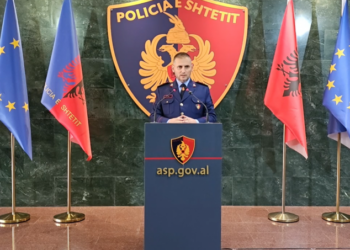
The terrorist attack in Banjska, where an armed group of Serbs led by Milan Radoicic attacked the Kosovo police on 24 September 2023, represents another escalation of Serbia’s hybrid efforts. This terrorist attack, which left behind casualties and deep tensions, was a clear attempt to destabilize Kosovo and create a justification for further intervention.
The attack was characterized by numerous elements of hybrid warfare:
- Organizing armed groups by Serbian parallel structures: These groups are part of a broader strategy to maintain Serbia’s influence in northern Kosovo, despite efforts by Kosovo and international authorities to dismantle them.
- Moscow’s silent support: Russia, through its propaganda and diplomatic channels, used this incident to present a narrative blaming Kosovo institutions for the “oppression” of the Serbian minority, helping to divide international opinion.
- Creating ethnic tensions: The attack was intended to provoke a violent reaction from the Kosovo authorities, inciting divisions between communities and making it more difficult to maintain order and security in the north, which would lead to the division of Kosovo.
The attack in Banjska recalls tactics used by Russia in Ukraine and Georgia, where local armed groups were used to create destabilization, paving the way for further political and diplomatic intervention.
The Attack on Zveçan: a hybrid strategy following the Russian model
The recent attack in Zveçan, targeting the Ibër Lepenci canal—a critical source of drinking water and a key component of the Kosovo Energy Corporation’s electricity production—marked yet another step in Serbia’s hybrid strategy against Kosovo, showcasing an adaptive approach to hybrid warfare. The Chair of the Foreign Affairs Committee in the German Bundestag, Michael Roth, described this act as a “Russian terrorist method” against a sovereign country in the heart of Europe.
This attack, resembling strikes on energy infrastructure in Ukraine and the sabotage of underwater cables in the Baltic Sea, represents an effort to exploit energy chaos and psychological pressure as tools of destabilization. Unlike the assault in Banjska, which focused on territorial division and establishing a base for separatist tendencies, the Zveçan attack aimed to weaken Kosovo’s vital infrastructure. This effort sought to create, through multi-levels security chaos, an environment conducive to further actions by armed Serbian groups—some operating actively within Kosovo and others positioned along the border between Kosovo and Serbia.
The attack underscores the use of hybrid warfare tactics, where a combination of psychological, energy, economic, and security threats continues to undermine Kosovo’s sovereignty and stability. By plunging Kosovo into a state of chaos—with an uncontrollable north, an energy crisis, and a lack of drinking water—Serbia aims to provoke severe political, social, and economic crises, leading to extreme polarization and, ultimately, the failure of the Kosovo state.
This incident reinforces the well-established model of hybrid conflicts employed by Russia in Georgia and Ukraine, where critical infrastructure serves as a target to generate destabilization and achieve strategic gains. In this context, the attack in Zvecan should not be viewed as an isolated incident but as part of a deliberate strategy designed to escalate tensions in the region and restore Serbian influence in northern Kosovo.
The US resistance against the Russian-Serbian triangle in the Western Balkans
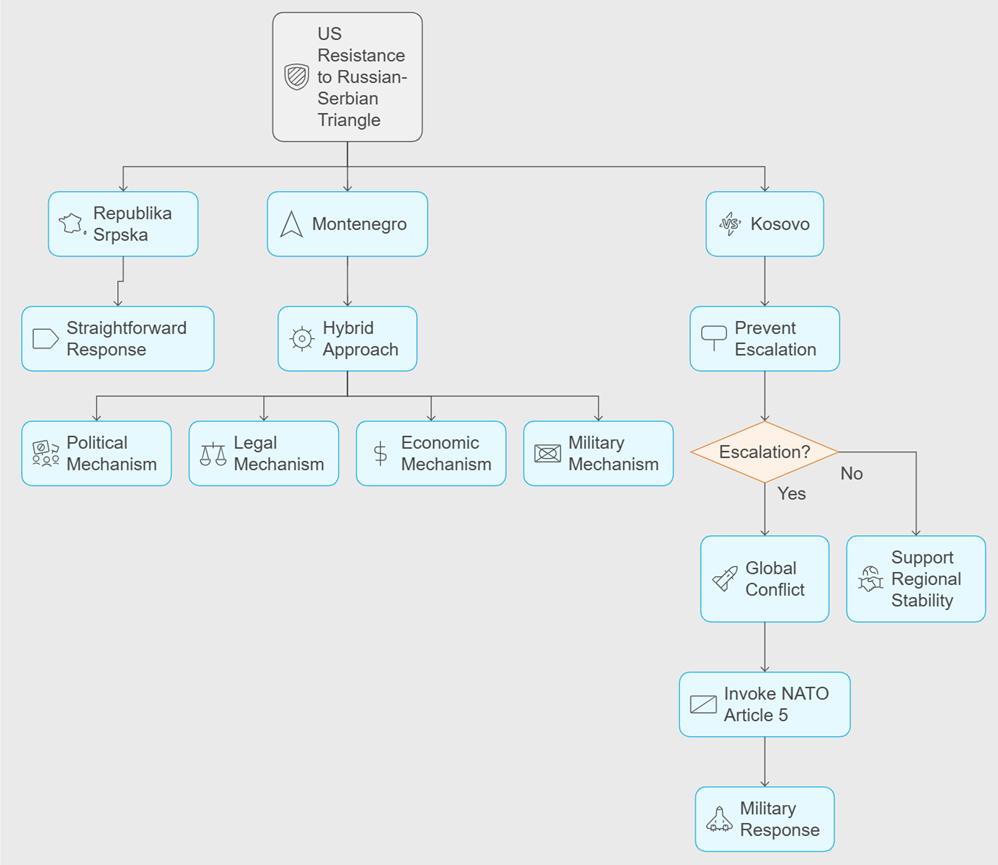
In the Western Balkans, Serbia’s strategic triangle is Republika Srpska, Montenegro and Kosovo. While actions in Republika Srpska are easier, in Montenegro actions must be taken in a hybrid form, using political, legal, economic and military mechanisms that reshape the composition until NATO is put out of play. Regarding Kosovo, most of the previous options have been blocked following the failure of the terrorist attack in Banjska. In this situation, the most likely option for Serbia appears to be the escalation of hybrid warfare by creating chaos and awaiting the possibility of a global conflict. In this scenario, it is hoped that, in the name of avoiding a greater tragedy, Western powers will be compelled to accept the partition of Kosovo.
In this context, a quote made by former US President Donald Trump in 2018 about Montenegro takes on a deeper meaning: “Montenegro is a small country with very powerful and aggressive people. They can get aggressive and congratulations, you’re in World War III.” This assessment, which indirectly includes Albania as part of this equation, reflects a perception of the region’s fragility and its potential for escalation into global conflict.
The parallel with World War I, which began when Russia came to Serbia’s aid against Austria-Hungary, raises an interesting question: Could World War III break out if the US decides to support Montenegro against a Russo-Serbian alliance? This scenario highlights the importance of Article 5 of the NATO Charter, which provides for the mutual defense of allies in the event of an armed attack. Surely, Article 5 only is used if the aggressor countries (especially Russia) believe that the US is really serious about it. If Russia thinks that Mr. Trump will not enter the war to protect smaller NATO members, then the chances of conflict increase.
If resistance to Russian-Serbian influences fails, the Western Balkans could become a new arena of division between East and West. Instead of this division occurring as in Cold War Germany, a new “iron curtain” could be erected in the Balkans, deepening polarization and changing the security architecture in the region. To avoid this, Western actors must be determined to prevent escalation and support regional stability through a coordinated and balanced approach.
Conclusion
The Western Balkans remain a key point in international geopolitical dynamics, where historically inherited tensions combine with modern threats of hybrid warfare. Hybrid warfare, as a sophisticated and multidimensional strategy, has transcended the usual frameworks of previous conflicts, becoming a means of influencing the political and social structures of the region. Serbia and Russia use these tactics to achieve their agendas in the region, directly challenging the sovereignty and stability of countries such as Kosovo, Montenegro and Bosnia and Hercegovina.
One of the most visible strategies of this phenomenon is the implementation of the “Srpski Svet” project, which aims to create a demographic and political base that supports the interests of Belgrade and Moscow. This is achieved through demographic engineering, electoral manipulation, and historical and cultural narratives that promote Serbian identity and its ties to Russia. Similarly, the hybrid tactics used in Georgia and Ukraine provide a clear model for understanding the potential for escalating tensions in the Balkans, involving the use of demographics, ideological narratives, and hybrid tools.
It is also clear that these efforts are not limited to demographic or legal aspects. On the contrary, they represent a multidimensional threat that jeopardizes the regional security architecture and the Euro-Atlantic integration of the Western Balkan countries. The manipulation of democratic processes and the creation of ethnic tensions through hybrid means underlines the necessity for a rapid and coordinated response by Western actors.
The experience of hybrid conflicts in Georgia and Ukraine shows that a delayed response only reinforces the strategies of the aggressors and creates space for further destabilization. In this regard, the continued engagement of NATO and the European Union in supporting the stability of the Balkans is vital to avoid further escalation of the situation.
Ultimately, hybrid warfare in the Balkans should not be treated as an isolated issue. It is part of a broader global strategy to challenge Western and create a new multipolar international order. Therefore, the response to these challenges must be equally strategic and comprehensive, including strengthening democratic and security capacities in vulnerable countries, as well as addressing the sources of hybrid influence.
/Argumentum.al