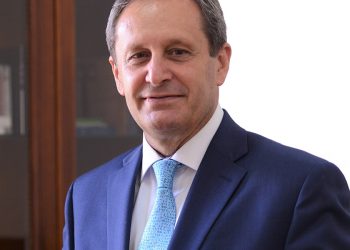




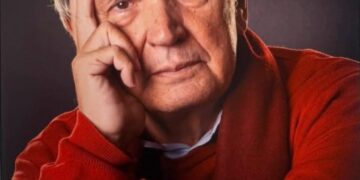






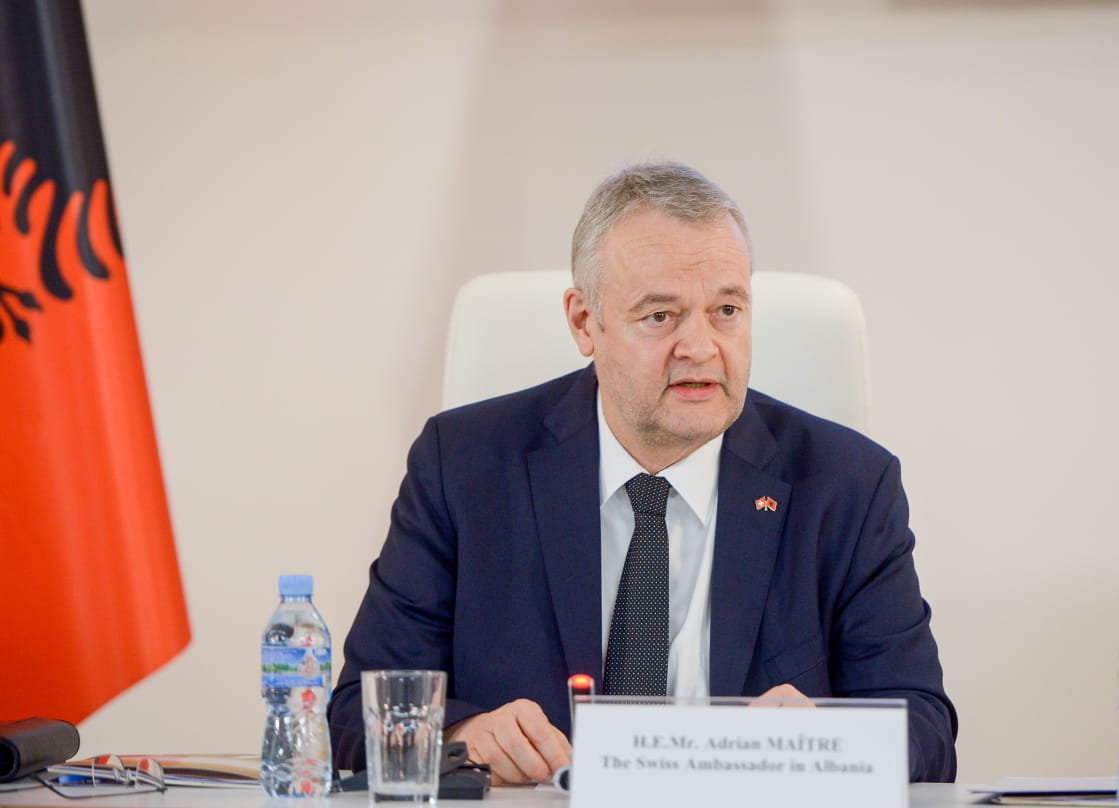
“For a better health sector in Albania we have to take care of three elements: Service, Status, System. I call this the 3S formula. Health service is a result of good infrastructure but also of good knowledge and skills from doctors and nurses. Health status comes as a result of good health service, and the population’s knowledge and behaviour. Finally, for a good health system a country needs to commit adequate financial resources – both domestic and in cooperation with partner countries and multilateral organisations – and also ensure statistics and data. All of these elements make up a better and sustainable healthcare sector,” said Swiss Ambassador to Tirana Adrian Maitre
By Genc Mlloja
Senior Diplomatic Editor
Several health centres throughout Albania have been completely renovated recently. Switzerland – through its ‘Health for All’ project – has supported this as part of its cooperation programme with this country where health is one of the priority sectors. Health support by Switzerland is even expanding currently. To find out more about Switzerland’s contribution to the health sector in Albania the newspaper Albanian Daily News interviewed Ambassador Adrian Maitre and spoke to the Head of Governance and Health at the Embassy of Switzerland, Ms. Chantal Nicod.
In the course of the talk Ambassador Maitre announced with pleasure that 2020 is the year which marks the 50th anniversary of the establishment of diplomatic relations between Switzerland and Albania.
Below follow the opinions of Ambassador Maitre and Ms. Chantal Nicod:
-Mr. Ambassador, you have been in Albania for over a year now. How would you describe the situation of the health sector?
-It is pleasure to have this interview at the beginning of the year which marks the 50th anniversary of the establishment of diplomatic relations between Switzerland and Albania. Regarding the health sector, first of all, we have a very good cooperation with the Ministry of Health and with the Minister herself. In health – as in other sectors where Switzerland assists – the leadership and guidance of Albania’s authorities is essential for the success of our joint efforts. The Swiss programme on health matches well with the government’s targets. I notice a proactive role on the part of the Ministry especially in making primary health care stronger and in promoting healthier lifestyles. Both are related to each other and they are also part of our objectives of support. Shifting health care services more from hospitals to primary health care centres is an approach we share with the Albanian government.
-Recently Swiss funding enabled the renovation of several health centres such as the one in Patos, the polyclinic& health centre in Lushnje, and later that in Vora. What is the overall strategy of Swiss support in health?
-Yes, we are engaged in improving infrastructure for health centres. Previously the commitment was for 16 health centres where the ones you mentioned in Patos, Lushnja and Vora are three important examples. This funding was a response to the priorities of the government which include reconstruction of infrastructure in health centres. In addition, after the devastating earthquake of November 2019, the government of Albania through the Ministry of Health and Social Protection asked us for an additional contribution. As an early reconstruction measure based on the initial needs assessment done by the Ministry, we added nearly 470,000 Euros for the rehabilitation of up to 5 health centres that were severely damaged in Durres, Tirana and Kruja. These centres – mostly in rural areas – will be functional again and serve over 40,000 people. This is part of Switzerland’s contribution prior to the earthquake conference that will take place in Brussels later this month.
-Is health support then mainly about infrastructure?
-No, we have a broader approach in our support for the health sector in Albania. A higher performance and a higher quality of healthcare is what we are aiming for. Although infrastructure is the first thing people see and it is easier to grasp, a large part of our work in the health sector goes towards developing national policies on primary health care, on health workforce management , and on strengthening clinical capacities. For example, on the latter point – strengthening capacities – our project introduced peer review groups as one instrument for continuing education of doctors and nurses; it developed management skills for health professionals and worked in improving health behaviour at population level.
Another example is the support to accreditation of a new Master’s programme in health management. These examples are less visible than a brand-new reconstructed health centre, but not less important
When I visited the health centre in Portez, Fier which we supported with training and equipment, I asked the director ‘What has changed most in the last years?’; he replied: ‘We have changed’ and explained that the personnel are better trained and equipped for services for patients and with a higher sense of responsibility.
-In your view, what will it take for Albania to have a better healthcare system?
-For a better health sector in Albania we have to take care of three elements: Service, Status, System. I call this the 3S formula. Health service is a result of good infrastructure but also of good knowledge and skills from doctors and nurses. Health status comes as a result of good health service, and the population’s knowledge and behaviour. Finally, for a good health system a country needs to commit adequate financial resources – both domestic and in cooperation with partner countries and multilateral organisations – and also ensure statistics and data. All of these elements make up a better and sustainable healthcare sector.
As Swiss cooperation we are actively engaged in improving the first 2 S’s of this ‘formula’: health service and status. For the system part, we are in discussion with the Ministry and partners like World Health Organisation (WHO) and World Bank in order to put our cooperation on good and firm ground.
-Finally, since you mentioned the need for health knowledge and behaviour, what would be your message to the wider Albanian population regarding health?
-Improvements in the health system go hand in hand with improving health knowledge and behaviour. People need to be more proactive and preventive in their behaviour, especially for non-communicable diseases. Soon we will start a new project to promote good health behaviour and prevent diseases. The message will be: Eat better, have a good lifestyle, do sports!
In one of our recent campaigns together with Municipality of Tirana we promoted the idea that sport can make you healthier. As part of this we had even a greeting from the famous Swiss tennis champion Roger Federer who encouraged children in Tirana to engage in sports and tennis. According to him, playing sports can make you a better person as well!
Opinions of Ms. Chantal Nicod
-Ms. Nicod, you are leading the Swiss government’s programmes on health in Albania; where do you see the greatest need of the health system here?
-For Switzerland, several elements are important in supporting the Albanian government’s effort to strengthen the health system in the country. First, we need to have a clear picture on the health status of the population, as well as the results achieved so far. Secondly, as the Ambassador mentioned, the government needs support in financial investment for the sector bearing in mind the priorities. Finally, it is very important to set up an efficient coordination between international institutions that support the health sector. It is encouraging to see that concrete actions towards this systemic approach have started.
In this sense, Switzerland is currently engaged in supporting the government, – in coordination with WHO and the Word Bank – in two concrete processes: first in establishing a coordination mechanism that puts together the resources of the government, donors, private sector and international organisations, and secondly, in making an assessment of the national health strategy 2016-2020, which can then be the basis for future national policies and external support.
– Can you distinguish a few main results achieved in the four years of Swiss support through the ‘Health for All’ project?
-The quality of primary health care in priority areas of Diber and Fier has improved. Our indicators show an improvement in the satisfaction of people visiting health centres and a 10% increase in using primary health centres. More than 200 family doctors and around 1,200nurses have been supplied with equipment bags enabling them to improve the quality of the service they provide.
More than 70% of family doctors and 80% of nurses attended peer review groups. Besides clinical skills, through the ‘Health for All’ project we have worked on improving health management skills. Swiss support established the first Master’s programme on health management at the Faculty of Medicine in Tirana, and also introduced Manager Forums where 75% of health centre managers are participating. The project has also improved the health knowledge among populations especially in rural areas. More than 20,000 citizens have benefited directly from health promotion activities. Furthermore, nearly 200,000 people were reached through TV campaigns that promoted prevention of diabetes and hypertension, and the benefits of regular check-ups in primary care.
-Switzerland stands apart as one of the few partner countries that supports the health sector in Albania. What is the aim of the Swiss Cooperation regarding health?
-Our health support envisions a higher performance and a higher quality of healthcare, as well as a higher level of health knowledge among the population. So, Swiss engagement goes towards better services, closer to the population, and also towards prevention by promoting healthy behaviour.
In response to your statement: yes Switzerland is one of the few bilateral donors in health, but we enjoy and promote a close coordination with international organisations such as the WHO and the World Bank – always under the main lead of the government.
Another Swiss specialty is our engagement for a holistic, multidimensional and cross-sectoral approach in the health sector. This means coordination with different Ministries, e.g. Health, Education, Agriculture as well as other actors in the country.
-What can be done by Albania itself – authorities and the public – to improve the health services and the health status in the country?
-The government of Albania should continue to lead all the efforts to improve the health sector and ultimately the health outcomes of the population. Access to quality health services remains a top priority and this needs to be coupled with financial protection for Albanian citizens so that they do not suffer financial harm in addition to the burden of the disease itself. The future Swiss engagement in the health sector here requires a complete assessment of the current national health strategy 2016-2020 and a new health strategy with defined priorities and a clearer health sector financing including domestic and external resources.
It would also be a great step forward to clarify the role of municipalities in the health sector in the country. A clarification on what can be expected from local governments in view of health promotion and management of health facilities would be an important contribution for making progress.
-You mentioned new engagements in the health sector. What are the future objectives of Swiss government support in health sector in Albania?
-A new programme is starting this year that aims to promote healthy behaviour at school settings. It is based on a cross-sectoral approach and it promotes cooperation among health, education and agriculture sectors with the ultimate objective of reducing exposure of children, teachers, and parents to the major risk factors for non-communicable diseases like diabetes which levels are increasing in the country. Diseases like diabetes are increasing. Municipalities will also have a key role in this new Swiss programme.
This complements our current ‘Health for All’ programme which improves primary health care services with a focus in the areas of Diber and Fier. In short, Switzerland will reinforce its engagement on health services and support preventive healthcare.