







Once again, it turned out that Ernest Hemingway was right in saying that we do not ask for whom the bell rings because it always rings for us. There is no doubt that we are all on the same boat, gens una sumus. And that fine thought should always be kept in mind. One has to believe that the times of selfishness and greed are gone
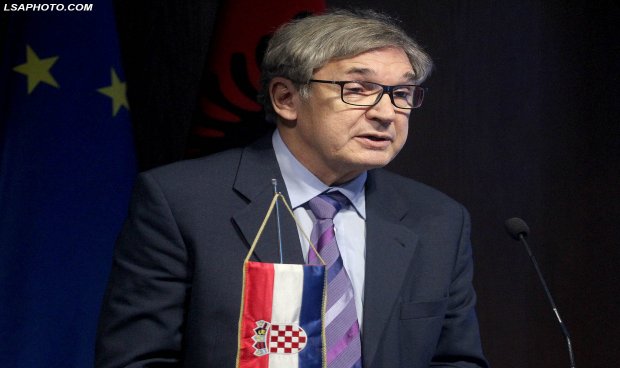
By Zlatko Kramaric,
Croatian Ambassador to Albania
When we thought that after this pandemic nothing could surprise us anymore, the early hours of March 22 denied us. Zagreb was hit by a strong earthquake. The pictures we watched on November 26, 2019 in Durres are back
In the early hours of November 26, last year, Albania was hit by a 6.4 magnitude earthquake according to Richter. The epicenter of the earthquake was in the Adriatic Sea, close to the city of Durres, which has a population of 400,000, the second largest in Albania and the country’s largest port.
The largest industrial zone developed between Tirana and Durres (approximately 30 km away), connecting them so much that one could speak freely of a unique urban entity, a kind of Albanian megalopolis, with almost 35 percent of Albanian citizens living in a relatively small area. But as Durres is a much older city than Tirana, the beginnings of the city go back to ancient times, with traces still visible such as the remains of an ancient arena, an amphitheater, a medieval castle…
Just a few weeks before the earthquake, we were in Durres with the Mayor of Split, Andor Krstulovic Opar, who expressed his intention to establish friendly relations in all segments of the activity. It would try to overcome the poor connectivity of cities on the Adriatic, since the Adriatic-Ionian corridor is still on the list of “good wishes” of the European bureaucracy. However, Durres is well connected with some ports in Italy, but its leaders are well aware that it would be desirable for this port, and thus Albania, to better connect with its first neighbors, Greece, Montenegro, and then Croatia.
It must be said that the citizens of Albania as a whole have a very positive opinion of Croatia. Given this fact our politics and diplomacy, but even more so our economy should be able to capitalize in a real and friendly-partner way. And there is plenty of room for action. Turkey, for example, has more than six companies in Albania.
Albania uses its geostrategic position very skillfully. It is therefore no wonder that recently Edi Rama, the Prime Minister of Albania, told Russian President Vladimir Putin that their choice for Euro-Atlantic integration is a conscious and deeply thought-out choice. There is no doubt that after all the previous experiences, living with the USSR and China, and then unnecessary (self) isolation, Albanian politicians are well aware that their European path has no alternative.
Rapid response from the international community
What was fascinating about the tragedy was the speed with which the international community (USA, EU countries, Japan, China, Turkey, Arab countries, but also first neighbors, Kosovo, Serbia, Montenegro, Northern Macedonia…) reacted and sent the necessary assistance. Albanian politicians responded in the same way, so early in the morning Edi Rama, the Albanian prime minister, visited Durres and encouraged the citizens with his presence. In addition to the Albanian army and police, rescue forces from other countries, Kosovo, Croatia, Romania, took part in the rescue operation. It must be admitted that the Government of the Republic of Croatia reacted promptly, sent two HRZ helicopters with crews and a specialized search and rescue team in the ruins, which arrived in Durres as early as November 26, in the afternoon. The team consisted of fifteen members of the State Intervention Unit of the Directorate of Civil Protection of the Ministry of Internal Affairs of the Republic of Croatia and eight rescue dogs. They truly deserve the highest praise for their contribution to repairing the damage. Their contribution was obvious to the Albanians, and the Prime Minister himself rewarded them for their selfless efforts. The award is still on the premises of the Embassy of the Republic of Croatia in Tirana, so we look forward to the opportunity to pass it on to those who deserved it. It was only an honor for us to receive it and to thank the Prime Minister and the Albanian people on their behalf.
In addition to direct ad hoc assistance, our Government has decided at the Donors’ Conference to pay one million euros in additional assistance for the reconstruction of demolished schools and health facilities. Some cities like Pula, Zagreb, as well as some entrepreneurs, have decided to help, first of all, the city of Durres and the surrounding towns.
Of course, without the help of the international community it would have been impossible, as it was necessary to take care of the homeless citizens in the short term, to arrange accommodation, initially in tents, and after a few days most of them were moved to numerous hotels. Because the earthquake happened in the late fall, beyond the tourist season, so it was possible, but it was clear to everyone that this was not a long-term solution. We must also acknowledge Albanian politicians, in particular Edi Rama, who was able to sensitize the international public to organize a donor conference, held in Brussels on 17 February this year, which raised 1.15 billion euros in aid, and the direct damage was estimated at some less than a billion euros.
The Albanian Prime Minister’s communication skills should be commended. Already on November 30, a few days after the tragedy, he was able to bring together all accredited diplomats and send clear messages: assistance must be quick and visible, because only in this way can the situation in the country calm down, or keep people. Already on the first day after the earthquake, about two thousand citizens left the country, and the number of twenty thousand is mentioned; admittedly, most of them went to Kosovo, mostly to relatives, for the sake of simplifying the schooling of children.
Furthermore, it is not possible to resolve this crisis without the elemental consensus of all relevant political parties, independent intellectuals, journalists, non-governmental organizations… But unfortunately, this consensus did not come, because some of the actors participated in the unnecessary politicization of the tragedy.
Earthquake scale
The citizens of Tirana were very aware of the power of the devastating earthquake. It should be said that it shook on September 21, too. I took office only a few days after the first “major” earthquake, which experts rated as one of the strongest ever recorded in Albania. Fortunately, there were no casualties other than minor damage. However, the earthquake on November 26 was also felt in Greece, Italy, Montenegro, BiH, but also in the Dubrovnik coast. The earthquake of that “Black Tuesday”, which took 51 lives, was more powerful than the July 1963 which hit Skopje, causing extensive damage and killing more than 1,300 citizens. Most interestingly, the buildings which did not withstand were those of the 1970s, the most tragic period of Enver Hoxha’s reign, when he consciously isolated the country completely, gave up with the USSR and after that cooperated with China. He was forced to introduce the so-called “Voluntary work”. Also the buildings that were built after the 1990s, in the early years of “uncontrolled transition”, were damaged.
We could say that life in Albania quickly returned to normal after the earthquake. As early as November 27, when we visited Durres, life went “as if” nothing terrible had happened, people were sitting in cafes, traffic was running normally, all shops and markets were working properly. If tents were not erected on the city’s football field for those who lost their homes and that no visible damage was seen on many residential buildings, it would not be possible to conclude that just 24 hours earlier that city was hit by an extremely strong earthquake. The behavior of the citizens of Drac reminded me greatly of the beginning of the Osijek war days. Almost the same way my Osijek people behaved. Namely, when the first conflicts in the immediate vicinity began, in Sarvas, Tenja, Dalj, the vast majority of Osijekers did not give up the usual rituals, peacetime habits. And there were cafes full of carefree Osijek youth, some still thought that there was no reason not to play a tennis party in the city park, and the promenade along the Drava was still full of walkers. And when shells began to fall on the outskirts of the city, through Green Field, through South II, those who lived in the central city neighborhoods behaved in accordance with the philosophy of “as if” all this was normal, because all this was happening somewhere far away, to someone else …
Only when shells began to fall in their homes they did realize that they too were participating in a real, not virtual war! Only then they could fully understand that scenes from films like The Matrix were not fiction, but that it was a harsh reality. But chroniclers noted that music was playing on the Titanic as that pride of British shipbuilding disappeared into the cold Atlantic Ocean. It was the month of April! Therefore, one should always understand such behaviors that consciously defy the seriousness and tragic nature of the moment.
Zagreb reprise
I am not one of those who like to think that everything is always better with the neighbors than in your own yard, your own house. But I must be honest and admit that life in Tirana is much livelier than life in our Zagreb. But the image of “city turmoil” has been completely changed with the appearance of coronavirus. The streets are eerily desolate. Driving private cars is prohibited. Whoever is arrested for driving will be revoked the license for three years.
Since our residence is located near the central city park, we have the unique opportunity to observe the numerous visitors, old and young, walking, exercising daily… Unfortunately, this picture can no longer be seen, since the Prime Minister was forced to bring some drastic measures after the appearance of Covid-19, and one of them is the decision to close city parks. Since March 15, the beautiful complex, which I have not been able to fully get to know in six months, has been closed to the public.
The desirable and visible normalization of life in Albania after the earthquake, after all, as in other European countries, was interrupted by Covid-19, so it will be interesting to see how, in the new circumstances, now that life is completely interrupted, the promised international funds will be “swiftly implemented”. Admittedly, it should be said that most of the bases for the rapid implementation of international community funds have already been prepared by hardworking UNDIP people. And for all segments of life. We had the opportunity to see studies related to the reconstruction of dilapidated schools and kindergartens, the reconstruction of the damaged hospital in Durres, as well as smaller dispensaries in the city districts as well as in rural households. Of course, there is also the care of demolished and damaged houses. Thus, there is a project on the necessity of urgent construction of six residential units. We are pleased to hear that this project will go on regardless of the new situation. Being aware of the fragility of their health care system by the Albanian authorities, we are not surprised at all by these radical measures, which are by any means more restrictive than those currently implemented in Croatia. Allegedly, not all medical facilities in Albania have more than 30 respirators! Truly sad these days the once cheerful and playful Tirana seems. We want to believe that this situation will soon be overcome and that science will be able to find a vaccine to help put an end to this plague of the 21st century.
And just when we thought that nothing could surprise us after this pandemic, the early hours of March 22 denied us. And Zagreb was hit by a strong earthquake. The pictures we recently viewed in Durres are back. Nature has once again sent us a scary message. There is no doubt that one form of civilization is racing its last, honorary circle. We are witnessing the collapse of our institutions (cathedrals, churches, Parliament, museums, archives, galleries, faculties…), the guardians of our national memory, our identity, both political and cultural, spiritual, religious… Obviously, as soon as possible, you need to find new ways to store that memory. According to some new civilization paradigm! We must by no means allow all this, and our history, our traditions, our culture, and our memories, to go out into the smoke, into the dust, and just disappear overnight.
Once again, it turned out that Ernest Hemingway was right in saying that we do not ask for whom the bell rings because it always rings for us. There is no doubt that we are all on the same boat, gens una sumus. And that fine thought should always be kept in mind. One has to believe that the times of selfishness and greed are gone. (Biweekly magazine for literature, art and science – “Vijenac” No. 680)