














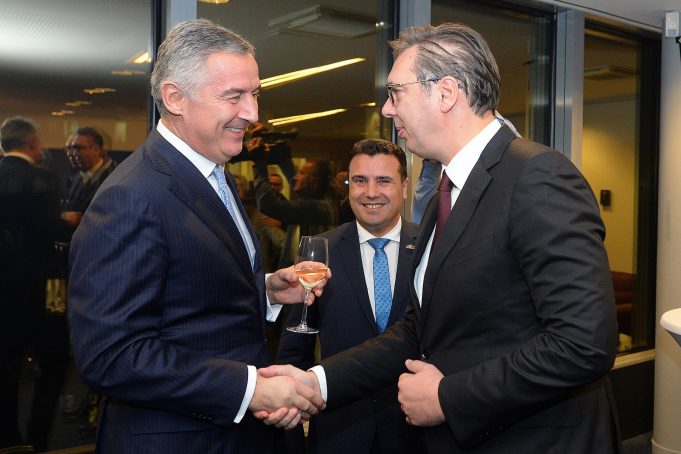
Even though current circumstances might put them on hold, parliamentary elections are expected to take place this year in North Macedonia, Serbia and Montenegro.
Parliamentary elections in North Macedonia were scheduled for 12 April, and in Serbia for 26 April, while in Montenegro the prospective date is still unknown.
However, besides the question of their postponement due to the COVID-19 pandemic, there are also concerns about each elections’ implementation, with one of the particular challenges being the financing of political campaigns.
Serbia: Much more could and should have been done
Parliamentary elections in Serbia were scheduled for Sunday, April 26, unless changes are made due to the declared pandemic.
The previous parliamentary elections held in 2016 were marked by numerous irregularities when it came to financing political campaigns. This primarily refers to the failure to submit or submitting incomplete reports of political parties on campaign expenditures to the Anti-Corruption Agency, the absence of announcements on party websites about contributions that exceeded the legal limit for donations of individuals and legal entities, and misuse of funds.
At the end of July 2019, a series of roundtables was launched on the occasion of the upcoming parliamentary and local elections in Serbia, organized by the Faculty of Political Science and the Open Society Foundation, Serbia. MEPs have joined the dialogue between the authorities and the opposition, which aimed to improve electoral conditions. Under their pressure, electoral legislation related to this area was amended.
Program Director of the Center for Research, Transparency and Accountability (CRTA), Raša Nedeljkov believes that, despite the amendments of the laws, given the experience so far, we can hardly expect that there will be no problems in this area, and points out that certain irregularities are repeated from cycle to cycle.
Asked how changing the Law on Financing Political Activities before the election can affect the election itself, Nedeljkov states that as much as these interventions were necessary, they are not sufficient to create better electoral conditions.
“The latest amendments to the Law have more precisely defined what can be considered the cost of an election campaign, stipulated in more detail the ban on misuse of public resources as a way of financing political parties, and introduced short deadlines for the Anti-Corruption Agency to act on reports during an election campaign. These are the most important changes. Still, much more could and should have been done,” Nedeljkov said.
The Law on Financing Political Activities obliges parties to report all campaign costs, and concealing revenue can also be a criminal offense punishable by up to three years in prison. Nedeljkov explains that the Agency’s Information Booklet contains precise data on the number of misdemeanor charges filed and that this number has increased over the years, which on the one hand shows that the Agency is doing its job, but that, on the other, political parties repeat the same mistakes.
“As for the sanctions, they are not decided by the Agency, but by the misdemeanor courts. However, there is a lack of criminal charges filed by the Agency to the prosecution for the crime prescribed by the Law. There were only a few, as the Agency called them, reports sent to the prosecution, but none led to a charge, let alone a conviction”, explains Nedeljkov.
According to him, there are several explanations for this state of affairs.
“First of all, the crime is poorly defined in law, since the intent of the perpetrator is required and the intent is extremely difficult to prove in the proceedings. Also, the Agency does not have investigative powers and this greatly limits the ability to obtain quality evidence. In the end, the prosecutor’s offices did not show much interest in prosecuting crimes when the perpetrators are political parties and the persons associated with them,” Nedeljkov said,
He believes that this could also be problematic from the aspect of political influence on the prosecutor’s office, which is much talked and written about, but there is not enough evidence to confirm that pressures do exist.
Although the Anti-Corruption Agency controls the parties’ reports, the question is how much we can rely on the truthfulness of the records of political party contributions. Covert financing, third party financing and misuse of public resources have been identified as problems for years.
Nedeljkov points out that money laundering is a complex crime requiring the fulfillment of certain specific elements, but since the contribution must be paid to the political party’s account from the contributor’s account, it is difficult to hide the origin of the donated money.
“Cases that have attracted a lot of public attention during the previous elections are related to a large number of donations by individuals in the same amount, or at the legal limit that allows a party not to publish such donations on its website. Such cases indicate a tendency to exploit loopholes in the law. It can also be interpreted as an intention to cover up the trace of money, according to the principle of splitting large cash contributions into many smaller ones,” Nedeljkov explains, adding that this situation, however, may be brought under violation of the Law on Financing Political Activities rather than under money laundering offense.
This was evident during the now ruling Serbian progressive party’s (SNS) campaigns for parliamentary elections in 2012, 2014 and 2016 as well as during presidential elections in 2012 and 2017. According to BIRN, in the 2012 parliamentary and presidential elections, out of the 2,300 individual SNS donors, 98 percent paid the exact same amount. The same year, the Agency found that 33 donations to the party were paid by people who received social assistance from the state, according to a report published on its website after the election. In 2014, 95 percent of more than 2,800 donors paid 40,000 Serbian dinars, which was close to the average monthly salary in Serbia. While in 2017, that was the case with 98 percent of nearly 7,000 donors.
According to Nedeljkov, it is worrying that such cases did not have an epilogue before the authorities.
Montenegro: Turning a blind eye
Parliamentary elections in Montenegro are still not scheduled, however the deadline for election to be held is in November, by law.
During the previous cycle, certain irregularities were observed. Suspicious and unexplored allegations of misuse of state resources and functionary campaigns remain in the public, and some studies by CSOs show that the financial reports of parties are full of questionable data.
Montenegro regulated this area with the Law on Financing Political Entities and Election Campaigns from 2014 with the last amendment of the Law adopted in December last year. Therefore, as in the case of Serbia, the question arises whether the financing of this year’s campaign is expected to be in accordance with the law, taking into account the experience of previous campaigns.
Milica Kovačević, President of the Center for Democratic Transition (CDT) based in Montenegro, states that their experiences from previous campaigns have shown that the problems and affairs observed have remained largely at the level of media writing and findings by journalists and CSOs.
“The accusations and allegations of illegal campaign financing have not been adequately vetted by the competent authorities, and the institutional response to the affairs has often been reduced to turning a blind eye to the problems. Given these recent experiences and the fact that little has been changed in the legislative and institutional framework, it is difficult to expect any major improvement in this campaign”, says Kovačević.
She reminds that a part of the changes to the electoral laws that required a simple majority was adopted in December unilaterally, without opposition, without consensus and compromise.
“Election legislation is not passed by a qualified majority without a reason, and such unilateral moves have no political value. It was an attempt by the ruling party to materialize the mistakes made by the opposition in the dialogue in the electoral legislation and gain points with the international community”, Kovačević explains, adding that, however, these laws will in no way affect the increase in confidence in the elections.
As in the case of Serbia, the Montenegrin Law on Financing Political Entities and Election Campaigns obliges parties to report all campaign expenses, with prescribed penalties for concealing costs. However, Kovačević points out that the Agency for Prevention of Corruption, which is responsible for controlling campaign cost reports, has chosen to do superficial administrative checks and trust what the parties present to it.
“The public has thus heard various unfounded claims from the Agency, such as that there were no misuse of state resources in the campaigns, that the parties did not spend money for field work, that there were no corporate donations and so on”, Kovačević explains.
She reminds that the sanctions were almost completely absent, and indeed a public image was created of the impunity of this unlawful conduct.
“We have repeatedly criticized such an approach by the Agency, as well as by the EU in its reports. Unfortunately, the changes to the Law have not brought about any improvements in the field of control of campaign financing. The prosecution has been able to respond to some extent to misuse of public resources for electoral purposes through prosecution for offenses against official duty, but that reaction has always been absent”, Kovačević explains, stating that with the introduction of new crimes, the prosecution was given a broader space for the processing of illicit funding, and reduced room for excuses.
When it comes to funds, parties are required to submit financial reports to the Agency for Prevention of Corruption. Although the Agency is responsible for controlling the reports, the question is how transparent is the data of political parties.
Kovačević says that CDT monitoring in previous years has shown that media advertising expenditures appear much lower than real, that reporting non-monetary contributions and discounts is rare, and that parties have not reported any corporate donations for years, which would make Montenegro a unique country in a world where capital is not interested in influencing politics.
“There are also doubts that the 2016 campaign was funded from foreign sources, and there have been many accusations in the media that it came from Russia. However, there is no official decision or verdict yet to confirm what the sources and channels of financing are”, Kovačević said.
She added that the Agency stated after the 2018 presidential elections that there was no funding of candidates from abroad, but that this was only one of the statements in the Agency’s report that was not supported by appropriate arguments.
North Macedonia: “Black suitcase” financing
North Macedonia’s snap elections have been scheduled for Sunday, April 12, however they were postponed due to the declared pandemic.
As in the case of Serbia and Montenegro, irregularities in the financing of political parties during the previous parliamentary elections were observed in North Macedonia, namely, financing through unknown sources and clientelist links with the media. In North Macedonia, this area is governed by the Law on Financing Political Parties from 2004, with the most recent amendment in 2018.
EWB spoke with researcher and program coordinator of the Institute for Democracy Societas Civilis based in Skopje, Misha Popovikj. He states that previous experience shows two ways of breaking campaign finance rules.
“The first one is funding through unknown origins, colloquially called ‘from a black suitcase.’ Typically, we saw that in order to ‘launder’ these funds, many sympathizers donated lots of money in smaller amounts, even though big enough to raise eyebrows. The institutions failed to investigate on the origin of these donations, even though, before the Special Prosecutor initiated the investigation on these issues, many of the sympathizers claimed to journalists they have never given such donations,” stressed Popovikj.
The example of “black suitcase” is the same problem that Serbia is facing, as mentioned above.
“The second is clientelist ties with media, which offered ample space to their patrons well before the stricter campaign rules start (several weeks before election day), shaping public opinion in their favour. I intentionally write for the period before the campaign, because media typically behave according to the rules during the campaign, with the exception of acting as donors, and later forgetting to request invoices be paid – which significantly increased the amount of donation”, states Popovikj.
These are the first parliamentary elections held since the latest changes to the Law. The question is therefore whether can we expect to see improvement in electoral conditions this time. Popovikj explains that the new rules address the inconsistencies indirectly.
“In the first case, they decrease the need of political parties for private funding. As for the media-political party linkage, classical media advertising is now completely funded with public money, as is to a certain degree – internet advertising. We are seeing, however, that the number of voters not linked through clientelism is increasing, which is a good thing,” highlights Popovikj and adds that in short, the rules somewhat decreased the risks, however, the biggest risks are in non-enforcement of control.
However, the changes were made without a public debate, but only with mutual agreement of the parties. Popovikj says that the reason for this is simple.
“The discussion would have been between the parties and the expert community. And they, I think, expected two strains of reaction – people insisting on less public funds, if any funds at all. The other strain would have been total public funding with a ban on private funding, which leaves less maneuverable space for informality”, stresses Popovikj.
The Law on Financing Political Parties in North Macedonia is similar to the laws in Serbia and Montenegro. What is different is that in addition to the Anti-Corruption Agency, the revenue of political parties is also controlled by the State Audit Office, the Public Revenue Office and the Central Registry.
Popovikj says that the Audit Office is meticulous and often finds inconsistencies, however the biggest failure has so far been the control of the origin of funding, which the Tax Authority has means to do.
“We are yet to see if the new Anti-corruption commission will ask them to perform certain controls. The sanctions are limited and are mostly if a political party fails to produce a report, so the Ministry of Justice stops disbursing funds to them. The Audit Office has so far identified some inconsistencies in political party funding. But the number of investigations is smaller than the identified practices”, explains Popovikj and adds that this shows him that the Prosecution tolerates certain informalities in political party funding, which must not be the case.
Similar patterns, similar problems
Certainly there are similar patterns when it comes to the irregularities regarding financing of the political parties and their activities, such as anti-Corruption agencies mostly working on administrative and formal aspects with superficial approach, absence of reactions from the prosecution, the absence of verdicts, and the changes to the electoral laws without broader political consensus.
But citizens are yet to see if the new changes to the laws which regulate this area will bring improvement in 2020 elections in all three countries./EWB