









• SHQIPËRI
  • KOSOVË
  • MAQEDONIA E VERIUT
  • MALI I ZI
  • Revista në PDF
3 June, 2026
  • Home
  • OP/ED

    Cyber Attribution, Corruption, and the False-Flag Question in Albania’s 2022 Alleged Iranian Cyberattack

    Between Russia, Iran and Europe: Azerbaijan as a balancing power in the South Caucasus

    The Zero-Tariff Gate: Sovereignty as a Service in the Sino-African Corridor

    Albania vs. the Sea/ Marginal Notes on A. Leka’s Novel The Hidden Side of the Albanian Socialist Garden

    May 9 and the long shadow of a Letter: Is Europe still Schuman’s Project?

    The Arbnesh of Zadar: A living memory of Albanian identity on the Adriatic coast

    Science Diplomacy and Academic Freedom: A strategic nexus for contemporary diplomacy

    Serbia and Kosovo between new regional alliances and old geopolitical patterns

    Hungarian Writers and the European Spirit: Between Central Europe, Auschwitz, and Inner Exile

  • Interview

    Exclusive Interview with Oleksandr Tyshchenko: A 40-Year Legacy of Chernobyl, Nuclear Risks, and Global Responsibility

    INTERVIEW: ZLATKO KRAMARIĆ – THOUGHTS ON THE OLD CONTINENT

    EXCLUSIVE / Ukrainian Ambassador to Albania, Volodymyr Shkurov: “Ukraine wants peace, but not at the expense of its freedom and independence”

    EXCLUSIVE| Ambassador Tayyar Kagan Atay: Türkiye and Albania, a Strategic Partnership Rooted in Shared Heritage and a Common Vision for the Future

    “Diplomacy, Not War”: Palestinian Ambassador to Albania Calls for Justice, Peace, and Global Action for Gaza

    Exclusive: “Even After Tito – Tito”/ Ambassador Zlatko Kramarić on Authoritarian Legacies and Democracy’s Future in the Balkans

    The Conclusion of the Diplomatic Mission / Ambassador Dancho Markovski: Strengthening Albania-North Macedonia Relations for a Shared European Future

    A Century of Diplomatic Relations Between Albania and Russia: Exclusive Interview with the Russian Ambassador to Albania, H.E. Alexey Zaytsev

    Exclusive/ The chairman of the Freedom Party, Ilir Meta: “The will of the citizens will triumph in Albania, as it did in North Macedonia”

  • Realpolitik

    IBAR? ”Sufficiently! Much ado about nothing! Shart contrasts in Beijing! Where is the exit?!

    Neither peace nor war! Peace with bombs?! IBAR in autumn?! Not another Hormuz in Taivan! 

    IBAR – a springing board or an obstacle? Can we catch the EU Negotiation train 2027? When the dress makes the news!  EU electoral April  ends in a draw 1:1!  

    The European Parliament building in Strasbourg, France with flags waving calmly celebrating peace of the Europe. July 12, 2020.

    EU 2027 or 2037! Even half membership failed! No exit strategy!     

    What next?

    “With diplomatic velvet“! Major question marks! In Washington yes, but  in the White House NO! A strange dinner in Brussels!

    From a great ‘apple of disaccord’ to a  point of  cooperation! A bad start! The strange absence in Davos!

    5 lessons from the American 3 January! Don’t count the chicken before they are hatched! Will NATO freeze in Greenland? Wrong diplomatic messages!

    German Chancellor Friedrich Merz, European Commission President Ursula von der Leyen, Ukraine's President Volodymyr Zelenskiy, U.S. Special Envoy Steve Witkoff and Jared Kushner, son-in-law of U.S. President Donald Trump line up for a family photo opportunity at the Chancellery in Berlin, Germany, December 15, 2025.    REUTERS/Lisi Niesner/Pool

    A Strategy that could change the world! Europe in Berlin! Why an historic compromise? Only charm diplomacy in Athens!

  • Current Events

    Serbia – China 2026: Technological partnership, geopolitical positioning and a new phase of the Chinese presence in the Western Balkans

    The Digital Protectorate: How the EU AI Act Codified Silicon Valley’s Monopoly

    The 28th MFC Annual Conference in Durrës / Sulaj: Microfinance remains a key instrument for financial inclusion

    Serbia at the Crossroads of EU Integration and Geopolitical Balancing: IFIMES Analysis

    Tirana – €20 Million EU–Banking Agreement Boosts Albanian SMEs

    The Myth of Independence: How Chinese Efficiency is Rewriting the Constitution of Modern Geopolitics!

    Europe Yesterday and Today: Why 9 May Still Matters

    “EU4Municipalities II” Project, a Strategic Investment for Strengthening Municipalities and Accelerating Albania’s Path towards the EU

    Eight Years in the Service of Identity: The Journey of the Montenegrin Community in Albania

  • Top News

    No End in Sight: Trump, Netanyahu and the Expanding Middle East War

    Tirana – €20 Million EU–Banking Agreement Boosts Albanian SMEs

    “EU4Municipalities II” Project, a Strategic Investment for Strengthening Municipalities and Accelerating Albania’s Path towards the EU

    Albania, Italy deepen defence ties with naval shipbuilding deal

    U.S. Embassy: Iran-Linked Groups May Target Americans and Iranian Opposition in Albania

    The Council of Albanian Ambassadors disappointed with the voting of the draft law on the foreign service in the parliamentary committees.

    Prime Minister Edi Rama Addresses Israel’s Knesset in Historic Special Session

    Kazakhstan’s Strategic Reform Agenda: Stability, Modern Governance, and Responsible Diplomacy

    Trump Invites Rama to Peace Board, Prime Minister: Proud of Albania

  • YOUR VOICE
  • Shqip
No Result
View All Result
Argumentum
  • Home
  • OP/ED

    Cyber Attribution, Corruption, and the False-Flag Question in Albania’s 2022 Alleged Iranian Cyberattack

    Between Russia, Iran and Europe: Azerbaijan as a balancing power in the South Caucasus

    The Zero-Tariff Gate: Sovereignty as a Service in the Sino-African Corridor

    Albania vs. the Sea/ Marginal Notes on A. Leka’s Novel The Hidden Side of the Albanian Socialist Garden

    May 9 and the long shadow of a Letter: Is Europe still Schuman’s Project?

    The Arbnesh of Zadar: A living memory of Albanian identity on the Adriatic coast

    Science Diplomacy and Academic Freedom: A strategic nexus for contemporary diplomacy

    Serbia and Kosovo between new regional alliances and old geopolitical patterns

    Hungarian Writers and the European Spirit: Between Central Europe, Auschwitz, and Inner Exile

  • Interview

    Exclusive Interview with Oleksandr Tyshchenko: A 40-Year Legacy of Chernobyl, Nuclear Risks, and Global Responsibility

    INTERVIEW: ZLATKO KRAMARIĆ – THOUGHTS ON THE OLD CONTINENT

    EXCLUSIVE / Ukrainian Ambassador to Albania, Volodymyr Shkurov: “Ukraine wants peace, but not at the expense of its freedom and independence”

    EXCLUSIVE| Ambassador Tayyar Kagan Atay: Türkiye and Albania, a Strategic Partnership Rooted in Shared Heritage and a Common Vision for the Future

    “Diplomacy, Not War”: Palestinian Ambassador to Albania Calls for Justice, Peace, and Global Action for Gaza

    Exclusive: “Even After Tito – Tito”/ Ambassador Zlatko Kramarić on Authoritarian Legacies and Democracy’s Future in the Balkans

    The Conclusion of the Diplomatic Mission / Ambassador Dancho Markovski: Strengthening Albania-North Macedonia Relations for a Shared European Future

    A Century of Diplomatic Relations Between Albania and Russia: Exclusive Interview with the Russian Ambassador to Albania, H.E. Alexey Zaytsev

    Exclusive/ The chairman of the Freedom Party, Ilir Meta: “The will of the citizens will triumph in Albania, as it did in North Macedonia”

  • Realpolitik

    IBAR? ”Sufficiently! Much ado about nothing! Shart contrasts in Beijing! Where is the exit?!

    Neither peace nor war! Peace with bombs?! IBAR in autumn?! Not another Hormuz in Taivan! 

    IBAR – a springing board or an obstacle? Can we catch the EU Negotiation train 2027? When the dress makes the news!  EU electoral April  ends in a draw 1:1!  

    The European Parliament building in Strasbourg, France with flags waving calmly celebrating peace of the Europe. July 12, 2020.

    EU 2027 or 2037! Even half membership failed! No exit strategy!     

    What next?

    “With diplomatic velvet“! Major question marks! In Washington yes, but  in the White House NO! A strange dinner in Brussels!

    From a great ‘apple of disaccord’ to a  point of  cooperation! A bad start! The strange absence in Davos!

    5 lessons from the American 3 January! Don’t count the chicken before they are hatched! Will NATO freeze in Greenland? Wrong diplomatic messages!

    German Chancellor Friedrich Merz, European Commission President Ursula von der Leyen, Ukraine's President Volodymyr Zelenskiy, U.S. Special Envoy Steve Witkoff and Jared Kushner, son-in-law of U.S. President Donald Trump line up for a family photo opportunity at the Chancellery in Berlin, Germany, December 15, 2025.    REUTERS/Lisi Niesner/Pool

    A Strategy that could change the world! Europe in Berlin! Why an historic compromise? Only charm diplomacy in Athens!

  • Current Events

    Serbia – China 2026: Technological partnership, geopolitical positioning and a new phase of the Chinese presence in the Western Balkans

    The Digital Protectorate: How the EU AI Act Codified Silicon Valley’s Monopoly

    The 28th MFC Annual Conference in Durrës / Sulaj: Microfinance remains a key instrument for financial inclusion

    Serbia at the Crossroads of EU Integration and Geopolitical Balancing: IFIMES Analysis

    Tirana – €20 Million EU–Banking Agreement Boosts Albanian SMEs

    The Myth of Independence: How Chinese Efficiency is Rewriting the Constitution of Modern Geopolitics!

    Europe Yesterday and Today: Why 9 May Still Matters

    “EU4Municipalities II” Project, a Strategic Investment for Strengthening Municipalities and Accelerating Albania’s Path towards the EU

    Eight Years in the Service of Identity: The Journey of the Montenegrin Community in Albania

  • Top News

    No End in Sight: Trump, Netanyahu and the Expanding Middle East War

    Tirana – €20 Million EU–Banking Agreement Boosts Albanian SMEs

    “EU4Municipalities II” Project, a Strategic Investment for Strengthening Municipalities and Accelerating Albania’s Path towards the EU

    Albania, Italy deepen defence ties with naval shipbuilding deal

    U.S. Embassy: Iran-Linked Groups May Target Americans and Iranian Opposition in Albania

    The Council of Albanian Ambassadors disappointed with the voting of the draft law on the foreign service in the parliamentary committees.

    Prime Minister Edi Rama Addresses Israel’s Knesset in Historic Special Session

    Kazakhstan’s Strategic Reform Agenda: Stability, Modern Governance, and Responsible Diplomacy

    Trump Invites Rama to Peace Board, Prime Minister: Proud of Albania

  • YOUR VOICE
  • Shqip
No Result
View All Result
Argumentum
No Result
View All Result
Home ENGLISH

Kosovo and Serbia: An incomplete peace

3 August, 2020
in ENGLISH, English OP/ED
A A
Share on FacebookShare on Twitter

By Professor Dr. Blerim Reka

Talks between Kosovo and Serbia on a potential final peace agreement remains the hottest geopolitical issue in the Western Balkans. After two years of war and two decades of incomplete peace, it remains unclear if, when and how an agreement between the two sides can be reached.

In 2010, the International Court of Justice ruled that Kosovo had not violated international law when it declared independence from Serbia two years earlier. Based on that decision, the United Nations put the European Union in charge of normalizing relations between the two states. This was supposed to occur through a process dubbed the Brussels Dialogue.

After eight years of negotiations (2011-2018), there were 33 agreements signed on the matter, but none were fully implemented. Kosovo and Serbia remain formally at war: there is no peace accord, no reconciliation process, no mutual recognition, no established full diplomatic relations and no border demarcation.

Professor Dr. Blerim Reka

Territory and trade

The Brussels Dialogue began as talks on technical issues and later developed into political negotiations. They stopped two years ago when Serbia began pushing for a land swap and Kosovo responded with tariffs on Serbian goods.

After this hiatus, the United States began pushing for a peace deal. The two sides were due to meet for talks on June 27, 2020, at the White House. After the meeting was announced, the EU declared it would restart the Brussels Dialogue on June 25. President Macron called for talks in Paris on July 17. The planned White House meeting was canceled after Kosovan President Hashim Thaci was indicted on war crimes charges by prosecutors in the Kosovo Specialist Chambers in the Hague.

The U.S. and the EU have taken disparate approaches to the talks

The U.S. intended to restart the process through “economic cooperation” that would end with a binding bilateral agreement on mutual state recognition. Yet that final outcome seems impossible as long as Serbia remains averse to recognizing the Republic of Kosovo. Serbian President Aleksandar Vucic has offered many reasons for his resistance. Recently, he has used the justification that the EU does not expect his country to recognize Kosovo’s independence. Instead, Brussels only wants Belgrade to refrain from blocking Kosovo’s UN membership.

The U.S. and the EU have taken disparate approaches to the talks. Washington initially mentioned the goal was mutual recognition and a path toward EU accession for both. Until mid-June 2020, there was a perception that the U.S. supported any accord agreed upon between the two countries that would achieve these goals – including one that included a land swap.

However, Richard Grenell, President Donald Trump’s envoy for the negotiations, denied that was the official position and contended the redrawing of borders was an idea put forward by former National Security Advisor John Bolton. Mr. Bolton has refuted that assertion, saying Presidents Thaci and Vucic had tabled the idea themselves.

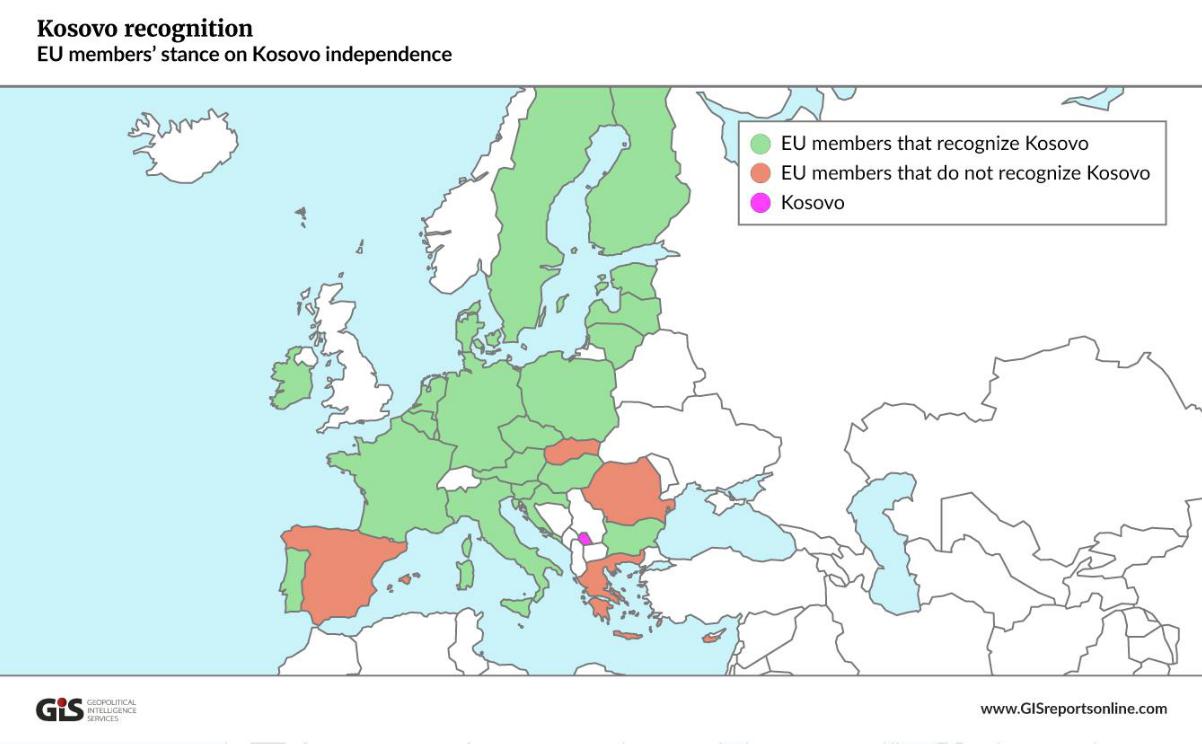
EU envoy Miroslav Lajcak, from Slovakia, was more careful, avoiding any reference to a land swap and mutual recognition. He and his boss, High Representative of the European Union Josep Borrell of Spain, hail from two of the five EU member states that have not yet recognized the Republic of Kosovo. Having these two men in charge of the EU’s Kosovo policy put the credibility of their mediation in question.

After meeting with Mr. Lajcak in Belgrade on June 22, President Vucic declared that he respected Mr. Grenell’s attempts to move things along, but that the dialogue with Kosovo should be mediated by the EU.


With Kosovan President Hashim Thaci (L) indicted for war crimes, Serbian President Aleksandar Vucic is in the stronger position in the negotiations (source: dpa)

While the EU and U.S. squabbled over how best to move the dialogue forward and which would take the lead, Russia’s position remains consistent. In a June 18 meeting in Belgrade with President Vucic, Russian Minister of Foreign Affairs Sergei Lavrov repeated Moscow’s view that any Kosovo-Serbia agreement would have to be approved by the UN Security Council.

On June 23, Serbian President Vucic met Russian President Vladimir Putin in Moscow. His visit to the Kremlin took place four days before the expected meeting at the White House, and two days before his visit to Brussels. The message was clear: before talks with the U.S. and EU, President Vucic went to Moscow for instructions.

To facilitate the talks at the White House, Kosovo ended trade tariffs and what were termed “reciprocal measures” against Serbia, stopped applications for membership in Interpol and UNESCO, and allowed Serbian elections to go forward in Kosovo (which were certain to pad the victory of Mr. Vucic’s party). Serbia’s only concession was to promise to stop campaigning against recognition of Kosovo. Belgrade quickly broke this promise, however, when Serbian Minister of Foreign Affairs Ivica Dacic made official statements thanking Algeria and Mexico for their “principled stance” in not recognizing Kosovo.

Hopes for speedy negotiations toward a deal were dashed after the Hague’s special prosecutor brought its war crimes indictment against President Thaci. The leader of the Democratic Party of Kosovo (PDK) was also indicted on war crimes charges. A special pretrial judge is set to review the indictment and rule on whether to confirm the indictments by October 24, 2020. Until then, it will hamper Pristina’s position in talks with Belgrade.

On July 10, EU officials hosted a video conference between President Vucic and Kosovo’s Prime Minister Avdullah Hoti. The two met face-to-face in Brussels on July 17. Neither meeting yielded results.

Moreover, the proceedings at the Specialist Chambers will cast a shadow over the government. The Hoti administration’s most vocal supporter is President Thaci. If his indictment is confirmed, it will further undermine its position.

No change in Serbia

In contrast to Kosovo, those pulling on the levers of power in Serbia remain in place. In the June 21 elections, President Vucic’s party won 63 percent of the vote, giving it 158 seats in the 250-seat National Assembly. Its junior coalition partner won 11 percent of the vote, meaning that the government now has the two-thirds majority necessary to approve any deal with Kosovo. The main opposition coalition, Alliance for Serbia, boycotted the election, resulting in the country’s lowest-ever turnout for parliamentary elections. Neither the EU nor the U.S. voiced any objection to the validity of the vote.

President Vucic enters this phase of the dialogue with the upper hand

President Vucic now has a stable majority and the political capital he needs to finalize talks with Kosovo. He enters this phase of the dialogue with the upper hand. In Kosovo, the prime minister (with a formal but unstable grip on power) and the president (who holds the real power but has been indicted for war crimes) continue to jockey for primacy. The most likely outcome is that

Prime Minister Hoti, with his fragile majority, will take the lead in the talks. He may ask the opposition PDK party to join in a unity government to shore up his position.

In contrast to Serbia, there is no political party in Kosovo’s parliament with a majority of votes. In fact, the opposition is particularly strong. The Levizja Vetevendosje (Self-determination Movement, LVV) and the PDK party together have 54 votes. Even a small shake-up in loyalties could turn the tables.

Wider consequences

Within the region, talk of the land swap has increased fears that other such deals might be sought. North Macedonian President Stevo Pendarovski has warned of a possible domino effect and has asked for international guarantees against such an outcome.

So far, the U.S. and Europe have preferred stability to democracy, and have been willing to put up with corruption. If the West continues to take this approach, it will lose the trust of people in the Western Balkans, who will see its demagogic lectures on the rule of law, anti-corruption measures and the fight against organized crime as hypocritical. This tolerance for kleptocracy will push the Western Balkans away from the Euroatlantic community. Unfortunately, the region’s history shows how often such lofty values are sacrificed to achieve other interests.

Scenarios

Globally, any unfinished Kosovo-Serbia peace process will destabilize the transatlantic partnership, with Washington, Berlin, Paris and the European Commission all potentially taking different approaches. Washington and Brussels will tussle for primacy in mediation, while Russia will insist on inclusion.

It is likely that ahead of the November elections, if President Trump is looking for a quick foreign policy win, he may push for a resumption of talks between Pristina and Belgrade. However, at that time Germany will still hold the rotating EU presidency, and Chancellor Angela Merkel’s government will hold the line for a solution without border changes.

Moscow is unlikely to change its stance that the Security Council must approve any deal

Berlin will probably push for a restart of talks in Paris. If President Trump is reelected, however, Washington is likely to take over the peace process and try for a Camp David-style negotiation. If Mr. Biden is elected, the outcome will bethe result of a U.S.-EU partnership.

Regardless, Moscow is unlikely to change its stance that the Security Council must approve any final deal. This will constitute the trickiest part of unraveling the Balkans’ last Gordian knot: the U.S. trying to avoid a showdown at the UN, and Russia trying to ensure it. If President Trump is reelected, there will likely be a diplomatic trade-off between the West and Moscow, possibly including a situation in which the Kremlin approves a Kosovo deal if the U.S. recognizes Russia’s annexation of Crimea. If Mr. Biden wins, the U.S.-Russia bargaining at the UN will drag on, with little prospect for compromise.

Locally, the victory of President Vucic’s party will strengthen his position in negotiations, and will also have a destabilizing effect on Kosovo’s political scene. It is less likely that the current government of Kosovo will survive in the long term, especially without the support of the PDK. With the government so wobbly and President Thaci’s indictment further destabilizing it, Kosovo will probably have to hold new elections by the end of the year. That will postpone the dialogue with Serbia for at least a half year, pushing back substantive talks until possibly the first half of 2022.

Any deal will have regional repercussions as well. The best outcome for stability in the Western Balkans would be an agreement that includes mutual recognition under the existing borders. Any other result could be taken as a precedent for similar changes. If the Kosovo-Serbia deal ends with an exchange of territory, how could such an outcome be prevented in Bosnia and Herzegovina or North Macedonia? After all, if a Serbian minority of just 5 percent warrants a land swap in Kosovo, would not the 25 percent of Albanians in North Macedonia also be justified in calling for a similar solution?

Considering such negative effects, an exchange of territory based on ethnicity would be a dangerous scenario that threatens peace and stability in the Western Balkans.

https://www.gisreportsonline.com/kosovo-and-serbia-an-incomplete-peace,politics,3274,report.html

© Argumentum
Tags: Blerim Rekadialoguehashim thacikosovoSerbiaVucic

Related Posts

Current Events

Serbia – China 2026: Technological partnership, geopolitical positioning and a new phase of the Chinese presence in the Western Balkans

1 June, 2026
ENGLISH

IBAR? ”Sufficiently! Much ado about nothing! Shart contrasts in Beijing! Where is the exit?!

1 June, 2026
ENGLISH

How Alkida Lushaj is redefining democratic inclusion globally

31 May, 2026

Follow US

Subscribe

Receive Argumentum Magazine by Email

Last Posts

Serbia – China 2026: Technological partnership, geopolitical positioning and a new phase of the Chinese presence in the Western Balkans

1 June, 2026

IBAR? ”Sufficiently! Much ado about nothing! Shart contrasts in Beijing! Where is the exit?!

1 June, 2026

How Alkida Lushaj is redefining democratic inclusion globally

31 May, 2026

Cyber Attribution, Corruption, and the False-Flag Question in Albania’s 2022 Alleged Iranian Cyberattack

30 May, 2026

The Digital Protectorate: How the EU AI Act Codified Silicon Valley’s Monopoly

30 May, 2026
Argumentum

“Argumentum”, një proces intelektual …

Contact Us

[email protected]
[email protected]
[email protected]

Follow Us

Media Partner

Register

Receive Argumentum Magazine by Email
  • Home
  • Privacy Policy
  • About Us
  • Contact

© 2022 Argumentum. All Rights Reserved. | NUIS: L91415033Q

Welcome Back!

Login to your account below

Forgotten Password? Sign Up

Create New Account!

Fill the forms bellow to register

*By registering into our website, you agree to the Terms & Conditions and Privacy Policy.
All fields are required. Log In

Retrieve your password

Please enter your username or email address to reset your password.

Log In

Add New Playlist

No Result
View All Result
  • Home
  • OP/ED
  • Interview
  • Realpolitik
  • Current Events
  • Top News
  • YOUR VOICE
  • Shqip

© 2022 Argumentum. All Rights Reserved. | NUIS: L91415033Q

This website uses cookies. By continuing to use this website you are giving consent to cookies being used. Visit our Privacy and Cookie Policy.