



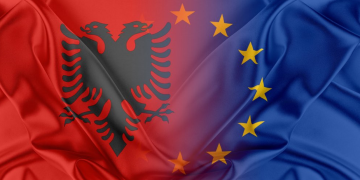

Approaching the thirtieth anniversary of the end of Communism it is high time for the leaderships in the two countries to make bold moves in the direction of resolving the various problems and disputes in a European and democratic manner. The world – both globally and in our neighbourhood – has become too dangerous to have the luxury of allowing wounds between two friendly nations, which see their future firmly within the EU and the Western world, to fester. The leaderships should also systematically work to improve relations at the societal level and support politically and financially all ideas and efforts – in education, research, youth, civil society, media, and the economy – that aim to dispel myths of animosity and build strong bonds of trust and cooperation between the two nations.


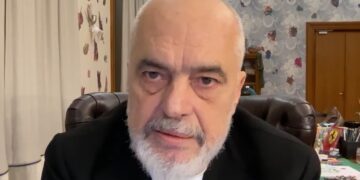
Professor Ioannis Armakolas/ Greece and Albania Should Dispel Animosity Myths
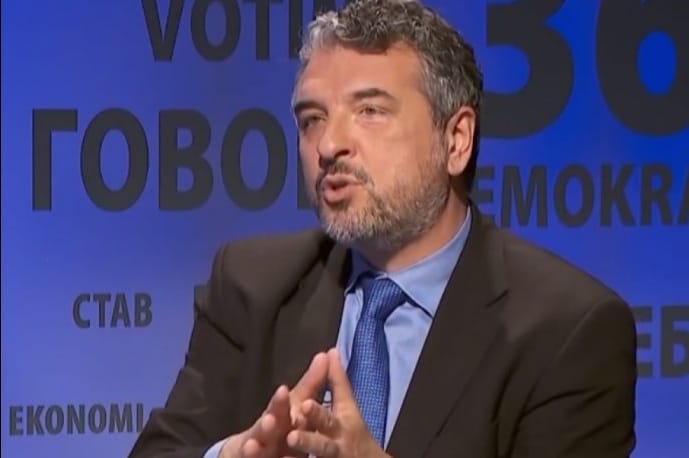
“The world – both globally and in our neighbourhood – has become too dangerous to have the luxury of allowing wounds between two friendly nations, which see their future firmly within the EU and the Western world, to fester,” has said Greek Professor Ioannis Armakolos
By Genc Mlloja
Senior Diplomatic Editor
“I am a firm believer of the opinion that the state of affairs between Greece and Albania since the end of the Communism is among the biggest diplomatic failures of the two countries,” has said the Greek Professor, Ioannis Armakolos, who holds that these two countries, together with others which did not take part in the Balkan wars of the 1990s, could have led the efforts for a fast regeneration of the region and its economic and political reintegration to the European core and its political institutions.
In an exclusive interview with Albanian Daily News Dr. Armakolas, who is Assistant Professor at University of Macedonia in Thessaloniki and Senior Research Fellow at Hellenic Foundation for European and Foreign Policy (ELIAMEP), touched upon many issues related to the coronavirus pandemic and answering one of the main questions on the issue the Professor said the Greek government’s response to the coronavirus emergency had been fast and, at least to date, quite successful.
In a comment on EU’s decision to open accession negotiations with Albania and North Macedonia he said it was long overdue as both countries had done enough to merit that next step. The Professor did not expect that the accession negotiations with these two countries would be reconsidered or postponed because of the pandemic.
Seeing the pandemic repercussions in the perspective of global international affairs, the researcher Armakolas noted that it is probably the first international crisis in decades in which the US seems to refuse to play its role as a global leader. The Professor has a message to the leaderships in Greece and Albania in the direction of resolving the various problems and disputes in a European and democratic manner. The leaderships should systematically work to improve relations at the societal level and support politically and financially all ideas and efforts that aim to dispel myths of animosity and build strong bonds of trust and cooperation between the two nations, said the Greek Professor, Ioannis Armakolos in the following interview:
Albanian Daily News: Professor I thank you very much for this interview with Albanian Daily News at these critical times for the mankind. First of all could you tell ADN’s readers some details on Greece’s coronavirus response taking also into consideration the tremendous risk of its severely overcrowded island migrant camps?
Professor Ioannis Armakolos: Thank you very much for the invitation. The Greek government’s response to the coronavirus emergency was fast and, at least to date, quite successful. Luckily, Greece has avoided the tragic fate of other Southern EU states, such as Italy, Spain and France, and the effectiveness of the response measures has won the praise of international media. But you are right to point to the issue of the migrant camps in islands and the mainland, since this is one area where both the Greek government and humanitarian organisations ought to do more. The situation in the camps was and remains precarious and much more needs to be done to stem the risks from the pandemic, but also for improving the wellbeing of migrants and refugees residing in them.
Since we are discussing the pandemic, allow me here to mention a recently launched project of the South-East Europe Programme of the Hellenic Foundation for European & Foreign Policy (ELIAMEP). The project is called ‘Balkans COVID-19 Mapping and Response Analysis’ and includes an interactive map which presents the situation when it comes to the effects of the pandemic at every sub-national administrative unit in twelve countries of Southeast Europe. The map is updated daily as our experts collect data from official national and international sources several times every day. Our platform also contains numerous quantitative and qualitative data and analyses on the health capacity, political, economic and social distancing measures, effects on democracy and the economy, the plans for the relaxation of emergency measures and many others. The interactive map and all the data can be accessed here: http://www.eliamep.gr/en/topics/southeast-europe-programme/#covidSection
-The opening of the accession talks by EU with Albania and North Macedonia has coincided with the climax of the pandemic and in a way it was overshadowed by the severity of the crisis? Regardless of this how do you evaluate such a decision and which are your expectations from such a development for the two countries and people?
-The decision for opening accession negotiations with Albania and North Macedonia was long overdue. Both countries have done enough to merit this next step in their EU integration process and, I must say, especially for North Macedonia, the delays were not only serious but also harmful to the very pro-European forces, both in politics and society, that Brussels and EU member states are supposed to support and strengthen through their policy engagement. It is symptomatic of malaise deep rooted in the EU and aggravated in recent years that volatile relations with pro-EU nations outside the bloc are made to bear the cost of internal EU bickering. The EU should be both more generous and more well-timed in its policies towards candidate states in Southeast Europe.
When it comes to the two countries themselves, I think they now have the opportunity to put their money where their mouth is, so to say: To demonstrate that the EU was wrong to keep them waiting to start accession negotiations for so long. They should demonstrate the readiness to implement reforms in a speedy and efficient manner.
-Greek Alternate Foreign Minister Varvitsiotis declared after the decision that it was an important day for the EU considering it a reaffirmation of the strategic Thessaloniki Agenda of 2003. Which will be the role of Greece in the new stage having in mind that the decision is on a “date without a date” and the cohesion among the main actors is not the same as it was a few years ago?
-When it comes to the conditions that are set for Albania in order to actually start the negotiations these are well known and I need not repeat them here. I think the Greek diplomacy expects some progress in key areas pertaining to issues of concern to the Greek minority and the Albanian society as a whole. I expect that all these conditions will be fulfilled in a timely manner. It will both help Albania gain more good will among EU institutions and member states and also enable the Albanian government to demonstrate to its own citizenry its determination to confidently promote its EU accession agenda.
The role of Greece in the coming years, and as the enthusiasm for enlargement in the EU wanes, is important. Athens is one the genuine pro-enlargement countries, and one that has the most to gain from the inclusion of the entire Western Balkans to the EU. There has been some reluctance in the past due to the various disputes that Greece has with neighbours, but I hope that the Greek diplomacy realises that time is of essence for all, not only for the Western Balkan countries. We should not allow resolvable disputes and past animosity to delay the process of integrating the entire Balkans to the EU. Instead, Greece has an interest in engaging intensively with the Western Balkans and assist the regional countries in their accession process. Greece should also continue the recent, and atypical for Greek diplomacy, coordination efforts with other pro-enlargement members, such as Italy, Austria, Visegrad countries and others.
-In terms of priority-setting in the EU in light of the pandemic repercussions might it happen that certain priorities such as the present accession negotiation process in the Western Balkans can be reconsidered?
– No, I do not expect that the accession negotiations will be reconsidered or postponed. I do worry, however, that the pandemic and many other serious problems and policy challenges that the EU and member states are encountering will in the long run further weaken the appetite for enlargement. But this is not a foregone conclusion and for that reason those member states that view enlargement clearly favourable should intensify their efforts to keep the EU door open for Balkan candidate states.
– Seeing things in a positive perspective regarding accession process, according to you, should such a development make some countries, like for example Serbia reevaluate the traditional ties with Russia, China, Turkey etc.? As a matter of fact some WB countries have shown concerns on EU’s efficiency to solve the current crisis, and even lack of solidarity.
– I will start from the latter point and stress that the EU was slow in responding to the crisis and not resolute in demonstrating that they will not exclude the Western Balkans from the pan-European effort to fight the pandemic. Slow response and a somewhat myopic perspective in the initial measures clouded the image of the EU. But the reality is that the EU is by far the biggest and most generous partner of the Western Balkans. It is the slow responses and complex policies of the EU that allow China and other competitors to make public relations breakthroughs in the region.
Having said that there is something to be said also about the eagerness of certain political leaderships in the Western Balkans, such as the one in Serbia, to question the EU’s actions, to undermine their public’s trust in European partners, and to instead promote the myth of the Chinese or Russian alternative. All Western Balkan countries have their legitimate national interests and they are free to pursue them in full. But if they really subscribe to the European perspective of their countries they should at least ‘play fair’ and not jump at every opportunity to damage the image of the EU and undermine their public’s trust in their European future.
– Professor the severest impact of the coronavirus crisis will be the economic implications. Which are expected to be the political, economic and social repercussions in the EU and secondly will there be a re-design of the global economic order in a post coronavirus era?
– These are crucial questions. But it is extremely difficult to predict and they will also depend on various unknown – for now – factors, such as the length of the current phase of the pandemic, whether governments and health systems will keep the effects of the crisis in check despite the gradual loosening of the strict measures or whether we will enter unequally severe new round of the pandemic in coming autumn. Let me focus on Europe to narrow down a bit the scope of your initial question. At the economic front it is clear that this will be a very difficult year for European economies, as it will be for most of the world. We already see estimates that the weakest of the Eurozone economies are highly likely to re-enter a crisis mode. This is of course very bad news for these countries and the Eurozone as a whole as the previous economic crisis not only seriously affected the lives and wellbeing of millions of people, but also shook the foundations of the European Union and brought about an unprecedented political crisis.
The ongoing fierce battle at the European level for the most appropriate political and institutional response, and of course the search for the suitable economic instruments and stimuli, is also a derivative of the traumatic experience of the 2010s and the lessons learned (or not-learned) at both the national and European level. Needless to say, if EU member states fail to agree on suitable responses and measures and the weakest of the European economies are left to feel inadequately supported, this will be one more serious blow to pro-European sentiment in many member states. Solidarity, both as political and economic imperative, but also as a popular sentiment felt by European peoples, is a key pillar of European integration. If Europeans feel that in these times of severe crisis, one that could not have been predicted and one that is not due to economic structural deficiencies in individual member states, every society is on its own Eurosceptism will surge and anti-EU political forces will soon profit immensely.
A final point about international affairs. The crisis seems to have exacerbated changes in the way that the global order is structured. It is probably the first international crisis in decades in which the US seems to refuse to play its role as a global leader. The US is certainly run by the most isolationist president in many decades, one who refuses to allow the world’s wealthiest and most powerful country to lead the effort in the fight against the pandemic.
In fact, Washington has turned against the very international institutions, primarily the World Health Organisation, that itself had helped to set up and which are crucial for the coordination in the global response to the crisis. The EU, disunited and badly hit by the health emergency, also punches below its weight. China seems willing to take advantage of the crisis to promote its image as the new international hegemon, and that’s why we see this coronavirus PR campaign in many countries. But we should not forget that China itself, and the political culture of this authoritarian superpower, is responsible for the slow response which magnified the problem. All in all, the world is battling against an unprecedented –in recent times- global health crisis, but with limited global governance and international coordination effectively curtailed.
-I would like to conclude this conversation Professor with your assessment on the bilateral relations between Albania and Greece as incidentally the two PMs discussed restoration of connections between the two countries on April 22 this year.
– I am a firm believer of the opinion that the state of affairs between Greece and Albania since the end of the Communism is among the biggest diplomatic failures of the two countries. The objective, structural if you like, situation between the two countries, factors such as geographical proximity, shared history, culture and habits, lack of traumatic belligerent pastor major bilateral disputes, people’s mobility, economic inter-dependence, membership in Western institutions and pro-Western orientation and many others, point to the natural conclusion that Greece and Albania could have become strongly connected partners and a driving force for positive developments in the region. These two countries, together with others which did not take part in the Balkan wars of the 1990s, could have led the efforts for a fast regeneration of our region and its economic and political reintegration to the European core and its political institutions.
This did not happen and instead we experienced occasional outbursts of nationalistic rhetoric that could have led the two countries in serious trouble had the situation been allowed to escalate. It is fair to say that both Tirana and Athens have made diplomatic mistakes that weakened the potential for cooperation and aggravated the few existing problems. We should also be sincere in admitting that the two societies seemed unprepared for a push forward and instead blithely followed ‘nationalist entrepreneurs’ who cultivated exclusionist emotions and the scapegoating of neighbouring nations for their own political and economic interest. Our societies did not prove mature enough and as a result we continue to be trapped in the vicious circle of distrust and nationalist fervour.
Last Posts



“Argumentum”, një proces intelektual …