








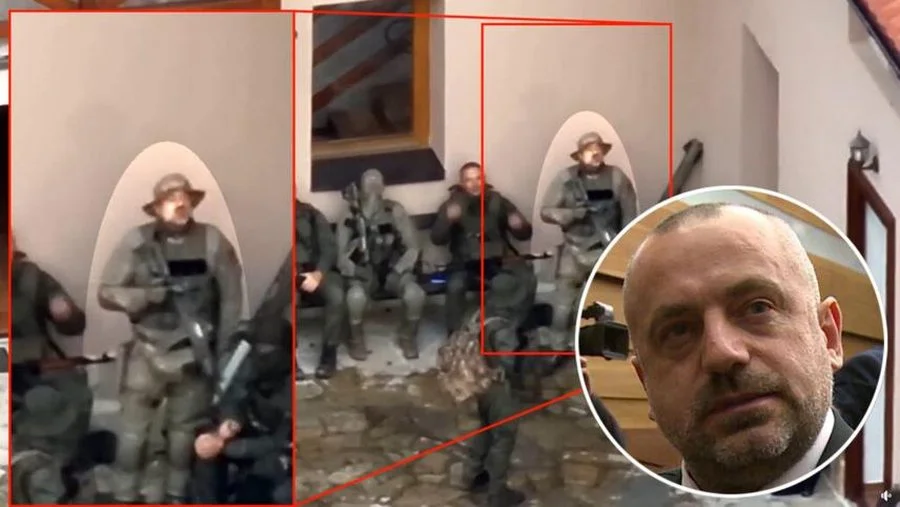
On the anniversary of the Banjska attack, the objectives behind this violent act are being refreshed with renewed intensity. Maria Zakharova, the spokesperson for the Russian Ministry of Foreign Affairs, has expressed strong support for the Serbian President, Aleksandar Vucic, promoting the return of Serbian forces to Kosovo in accordance with UN Resolution 1244. This project, recently endorsed by the Great All-Serbian Assembly, is gaining increasing traction in Western diplomacy, driven by the Serbian lobby, serving as an instrument to justify Belgrade’s territorial ambitions. Russia, as the primary sponsor of this process, has utilized Serbia’s alignment with the West as a strategic tool in hybrid warfare, aiming to advance its influence in the Western Balkans. This dynamic raises essential questions about regional stability and the challenges that lie ahead in international politics.
Authors:
- Agim Musliu – Director at the Institute for Hybrid Warfare Studies “OCTOPUS”
- Dr. Gurakuç Kuçi – Researcher at the Institute for Hybrid Warfare Studies “OCTOPUS”
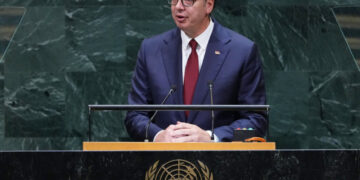
Maria Zakharova, spokesperson for the Russian Ministry of Foreign Affairs, announced that Russia supports Serbian President Aleksandar Vucic’s initiative to reintroduce Serbian forces into Kosovo, in accordance with UN Resolution 1244. This statement from Moscow represents a continued commitment to Serbia’s strategic interests, not merely for the implementation of Vucic’s seven-point plan, published on September 13, 2024, but for a more profound and well-calculated move.
Vucic’s plan contains seven public demands towards Kosovo, which effectively aim to reverse Kosovo’s status in a manner that undermines its sovereignty. Although unacceptable to any rational observer, these demands reveal a deeper goal: creating a pretext for further actions that go beyond the diplomatic stage.
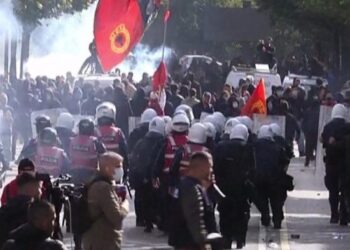
The intent behind these demands is to set the stage for a Russo-Serbian hybrid conflict in Kosovo, which could begin with demonstrative measures such as civil disobedience, terrorist acts, violent protests, and sporadic staged incidents. These well-organized activities aim to destabilize Kosovo and generate a narrative justifying new international intervention. This intervention would involve KFOR forces, the reactivation of the UNMIK mission, and the return of Serbian military forces to northern Kosovo, once again invoking UN Resolution 1244.
This strategic objective became clearer on June 9, when the Great All-Serbian Assembly was convened. In this extraordinary session, Serbia’s President and Government, the government of Republika Srpska, and the Serbian Orthodox Church gathered. The declaration emerging from this assembly is grounded in Articles 4 and 6, as well as Annex 2 of Resolution 1244, laying the “foundations” for a Serbian military return to Kosovo.
Serbia’s Ambitions to Occupy the North of Kosovo and Legitimize it through Resolution 1244
Serbia is attempting to justify its return to Kosovo—whether through hybrid warfare, terrorist acts, or changes in the geopolitical landscape—by relying on the narrative of its rights under United Nations Resolution 1244. This strategic goal was confirmed on June 9 during the Great Serbian Assembly, held between representatives of Serbia, Republika Srpska, and the Serbian Orthodox Church.
At this assembly, a declaration was approved emphasizing Kosovo and the role of Resolution 1244 as a legal basis for Serbia’s claims to reassert its presence. The declaration cites Articles 4 and 6, as well as Annex 2 of the resolution, claiming that these legitimize Serbia’s right to re-establish its presence in Kosovo.
This assembly followed the Russian Orthodox Church’s Council, held on March 27-28 by the Moscow Patriarchate (ROC MP), where an ideological and political document titled “The Present and Future of the Russian World” was approved, addressed to Russian legislative and executive authorities. In this document, the ROC MP proclaimed that Russia is the creator, pillar, and protector of the Russian world, asserting that the boundaries of this spiritual and cultural world extend beyond the current territory of the Russian Federation. This document also sanctified Russia’s war in Ukraine, framing it within the broader context of efforts to preserve a Russian civilizational order.
The Banjska Attack as a Diplomatic-Military Scenario
The Great All-Serbian Assembly was originally scheduled for May 5-6, immediately following President Vucic’s declaration threatening the West that any attempt to admit Kosovo to the Council of Europe would provoke Serbia’s wrath, anticipating geopolitical changes that would enable direct actions against Kosovo. However, this assembly was postponed to June 9 to await the outcome of the Council of Europe’s decision on Kosovo and its enhanced status within NATO, shifting from an observer state to an associate member.
These repeated efforts by Serbia to destabilize Kosovo and its ongoing threats followed the failed plan involving the terrorist act in Banjska, in Zvecan, which did not succeed in sparking a Serbian uprising in northern Kosovo. This premeditated scenario aimed to create a wartime situation that would necessitate international intervention—both diplomatically and militarily through KFOR—to impose the partition of the North, similar to the developments of 1999.
In detail, Serbia’s strategy was designed to respond to Kosovo’s efforts to extend its sovereignty in the North and dismantle the illegal structures functioning there. As the international community took no concrete steps to protect the interests of the criminal groups linked to Vucic in northern Kosovo, Serbia’s alternative plan was to use force and manipulate “grievances” through acts of terror. This option was deemed the most appropriate to achieve Serbia’s regional objectives.
What was Serbia’s Plan in Banjska to Trigger the Partition of Kosovo?
On September 24, 2023, Serbia executed a well-coordinated action in northern Kosovo through a well-trained and armed group. The objective of this operation was to incite the indignation of Serbian citizens against Kosovo’s institutions, leading to an armed clash. This scenario was designed to produce casualties on both sides, forcing Kosovo authorities to react with harsh measures and disproportionate use of force to suppress the rebellion.
In this context, international intervention—both diplomatic and military—would become inevitable. EULEX would engage as the second responder, while KFOR would act as the third force to prevent the escalation of violence. This intervention would lead to the creation of a sanitary cordon along the dividing line, similar to 1999. This zone would then fall under the administration of the United Nations, with UNMIK as the governing authority, which, due to its lack of effective capacities, would be forced to cooperate with the criminal structures linked to Serbia.
In this way, the terrorist acts of the group led by Milan Radoicic would be transformed into actions legitimized as “liberation”. This would pave the way for the powerful reactivation of Resolution 1244. Serbia would fully exploit this circumstance to restore its military presence in Kosovo, referring to Articles 4 and 6, as well as Annex 2 of the resolution. This document, which once called for the withdrawal of Yugoslav-Serbian forces from Kosovo, contains a provision allowing for the return of Serbian personnel for specific tasks—guarding border crossings, protecting Serbian monuments, and assisting in demining—with the approval of the international presence, namely KFOR.
By crafting a fictional narrative of international law and taking advantage of geopolitical circumstances and the West’s appeasement politics, Serbia would successfully occupy the north of Kosovo.
How Russia Manipulated the West with a “Pro-Western” Serbia
The implementation of this plan would strike at the very foundations of Kosovo’s statehood. A Kosovo reduced in its state functionality, constrained by international pressure to refrain from using force against Serbs in the north, deprived of its natural resources, and unable to generate its own electricity, would face existential challenges. In such a situation, Kosovo would be forced to seek a survival solution. Faced with such a crisis, the most likely scenario would be a return to some form of international administration rather than unification with Albania, as the latter would provoke dissatisfaction and further destabilization in the Western Balkans.
The failure of the action on September 24, 2023, forced Serbia and Russia to temporarily halt the implementation of these schemes, but they realized that a new diplomatic approach was necessary to achieve their objectives. With Russia’s support, Serbia adopted a new strategy, improving its image on the international stage through carefully curated moves: offering military aid to Ukraine and Israel, participating in peacekeeping forces in Lebanon, and selling lithium to Europeans. These actions were aimed at deceiving international opinion and creating a moderate facade for Serbia. After achieving a certain level of credibility on the international scene, Serbia and Russia resumed plans to return Serbian forces to Kosovo.
Throughout this period, Serbia has consistently raised the issue of Resolution 1244 at the diplomatic table, emphasizing the protection of its rights and the victimization of Serbs. This narrative has not only served as a diplomatic tool to consolidate Serbia’s claims, but has also influenced international opinion, even within certain segments of the opinion in Kosovo itself. Through this manipulation, Serbia has reinforced the notion that Kosovo is dependent on Resolution 1244, bypassing the International Court of Justice’s ruling and ignoring the inclusion of this resolution in Kosovo’s Constitution.
It is no coincidence that at this moment, Zakharova made her statement in support of the return of Serbian troops to Kosovo. This move would not only escalate the situation on the ground but also give Russia the opportunity to distract the West and intensify its hybrid warfare in the Western Balkans. Serbia, by exploiting this situation, would benefit from the chaos and seek to advance its geopolitical agenda in the region.
Conclusions:
The armed attack in Banjska on September 24, 2023, Russia’s support for the return of Serbian troops to Kosovo based on Resolution 1244, and Serbia’s “pro-Western” positioning aimed at lobbying for its rights under the same resolution are elements of a well-planned Russian-Serbian strategy. This strategy aims to deceive international actors and create the conditions for the territorial partition of Kosovo and eventually its dissolution as a state. Among other things, this would pave the way for the strong return of Russian influence in the Western Balkans, where Russia has already expanded its presence through hybrid warfare in most countries in the region.
Serbia’s claims of a “pro-Western” rapprochement and its commitment to European integration are, in fact, part of a sophisticated diplomatic game within the framework of a hybrid warfare orchestrated by Russia. This manipulation seeks to undermine the structures of the European Union and NATO from inside, creating divisions and institutional weaknesses in confronting authoritarian influences.
These Russian-Serbian plans, which are becoming increasingly clear, should serve as an alarm for politicians, diplomats, and the public, both in Kosovo and in the West. Stronger engagement from these actors is essential to counter this destabilizing strategy and to protect Kosovo’’s sovereignty and the stability of the region.
(CC BY-NC 4.0) This article is licensed to you under a Creative Commons Attribution 4.0 International License. When you copy and redistribute this paper in full or in part, you need to provide proper attribution to it to ensure that others can later locate this work (and to ensure that others do not accuse you of plagiarism)./ Institute for Hybrid Warfare Studies “OCTOPUS”
/Argumentum.al