














• SHQIPËRI
  • KOSOVË
  • MAQEDONIA E VERIUT
  • MALI I ZI
  • Revista në PDF
5 June, 2026
  • Home
  • OP/ED

    Pierre Nora and the institution of memory we lack in Eastern Europe

    The Blueprint of a Diplomatic Debacle: Analyzing Germany’s Historic UNSC Loss

    Cyber Attribution, Corruption, and the False-Flag Question in Albania’s 2022 Alleged Iranian Cyberattack

    Between Russia, Iran and Europe: Azerbaijan as a balancing power in the South Caucasus

    The Zero-Tariff Gate: Sovereignty as a Service in the Sino-African Corridor

    Albania vs. the Sea/ Marginal Notes on A. Leka’s Novel The Hidden Side of the Albanian Socialist Garden

    May 9 and the long shadow of a Letter: Is Europe still Schuman’s Project?

    The Arbnesh of Zadar: A living memory of Albanian identity on the Adriatic coast

    Science Diplomacy and Academic Freedom: A strategic nexus for contemporary diplomacy

  • Interview

    Exclusive Interview with Oleksandr Tyshchenko: A 40-Year Legacy of Chernobyl, Nuclear Risks, and Global Responsibility

    INTERVIEW: ZLATKO KRAMARIĆ – THOUGHTS ON THE OLD CONTINENT

    EXCLUSIVE / Ukrainian Ambassador to Albania, Volodymyr Shkurov: “Ukraine wants peace, but not at the expense of its freedom and independence”

    EXCLUSIVE| Ambassador Tayyar Kagan Atay: Türkiye and Albania, a Strategic Partnership Rooted in Shared Heritage and a Common Vision for the Future

    “Diplomacy, Not War”: Palestinian Ambassador to Albania Calls for Justice, Peace, and Global Action for Gaza

    Exclusive: “Even After Tito – Tito”/ Ambassador Zlatko Kramarić on Authoritarian Legacies and Democracy’s Future in the Balkans

    The Conclusion of the Diplomatic Mission / Ambassador Dancho Markovski: Strengthening Albania-North Macedonia Relations for a Shared European Future

    A Century of Diplomatic Relations Between Albania and Russia: Exclusive Interview with the Russian Ambassador to Albania, H.E. Alexey Zaytsev

    Exclusive/ The chairman of the Freedom Party, Ilir Meta: “The will of the citizens will triumph in Albania, as it did in North Macedonia”

  • Realpolitik

    IBAR? ”Sufficiently! Much ado about nothing! Shart contrasts in Beijing! Where is the exit?!

    Neither peace nor war! Peace with bombs?! IBAR in autumn?! Not another Hormuz in Taivan! 

    IBAR – a springing board or an obstacle? Can we catch the EU Negotiation train 2027? When the dress makes the news!  EU electoral April  ends in a draw 1:1!  

    The European Parliament building in Strasbourg, France with flags waving calmly celebrating peace of the Europe. July 12, 2020.

    EU 2027 or 2037! Even half membership failed! No exit strategy!     

    What next?

    “With diplomatic velvet“! Major question marks! In Washington yes, but  in the White House NO! A strange dinner in Brussels!

    From a great ‘apple of disaccord’ to a  point of  cooperation! A bad start! The strange absence in Davos!

    5 lessons from the American 3 January! Don’t count the chicken before they are hatched! Will NATO freeze in Greenland? Wrong diplomatic messages!

    German Chancellor Friedrich Merz, European Commission President Ursula von der Leyen, Ukraine's President Volodymyr Zelenskiy, U.S. Special Envoy Steve Witkoff and Jared Kushner, son-in-law of U.S. President Donald Trump line up for a family photo opportunity at the Chancellery in Berlin, Germany, December 15, 2025.    REUTERS/Lisi Niesner/Pool

    A Strategy that could change the world! Europe in Berlin! Why an historic compromise? Only charm diplomacy in Athens!

  • Current Events

    Rama alleges ‘hybrid war’ behind protests against Kushner-linked coastal development

    BELGRADE, SERBIA - JUNE 18. 2020: Russian and Serbian flags on display during Russian Foreign Minister Sergei Lavrov's visit to the Liberators of Belgrade Memorial. Valery Sharifulin/TASS,Image: 533095429, License: Rights-managed, Restrictions: UWAGA! Zdjęcia zawierają oryginalny opis dostawcy (ITAR-TASS). Szczególnie w związku z agresją Rosji na Ukrainę mogą zawierać przekaz niezgodny z faktami. Zweryfikuj go przed publikacją, Model Release: no, Credit line: Valery Sharifulin / TASS / Forum

    Balkan Maskirovka: Why Moscow’s “Distancing” Is Only an Operation for the Survival of Vučić’s Regime

    Serbia – China 2026: Technological partnership, geopolitical positioning and a new phase of the Chinese presence in the Western Balkans

    The Digital Protectorate: How the EU AI Act Codified Silicon Valley’s Monopoly

    The 28th MFC Annual Conference in Durrës / Sulaj: Microfinance remains a key instrument for financial inclusion

    Serbia at the Crossroads of EU Integration and Geopolitical Balancing: IFIMES Analysis

    Tirana – €20 Million EU–Banking Agreement Boosts Albanian SMEs

    The Myth of Independence: How Chinese Efficiency is Rewriting the Constitution of Modern Geopolitics!

    Europe Yesterday and Today: Why 9 May Still Matters

  • Top News

    Rama alleges ‘hybrid war’ behind protests against Kushner-linked coastal development

    No End in Sight: Trump, Netanyahu and the Expanding Middle East War

    Tirana – €20 Million EU–Banking Agreement Boosts Albanian SMEs

    “EU4Municipalities II” Project, a Strategic Investment for Strengthening Municipalities and Accelerating Albania’s Path towards the EU

    Albania, Italy deepen defence ties with naval shipbuilding deal

    U.S. Embassy: Iran-Linked Groups May Target Americans and Iranian Opposition in Albania

    The Council of Albanian Ambassadors disappointed with the voting of the draft law on the foreign service in the parliamentary committees.

    Prime Minister Edi Rama Addresses Israel’s Knesset in Historic Special Session

    Kazakhstan’s Strategic Reform Agenda: Stability, Modern Governance, and Responsible Diplomacy

  • YOUR VOICE
  • Shqip
No Result
View All Result
Argumentum
  • Home
  • OP/ED

    Pierre Nora and the institution of memory we lack in Eastern Europe

    The Blueprint of a Diplomatic Debacle: Analyzing Germany’s Historic UNSC Loss

    Cyber Attribution, Corruption, and the False-Flag Question in Albania’s 2022 Alleged Iranian Cyberattack

    Between Russia, Iran and Europe: Azerbaijan as a balancing power in the South Caucasus

    The Zero-Tariff Gate: Sovereignty as a Service in the Sino-African Corridor

    Albania vs. the Sea/ Marginal Notes on A. Leka’s Novel The Hidden Side of the Albanian Socialist Garden

    May 9 and the long shadow of a Letter: Is Europe still Schuman’s Project?

    The Arbnesh of Zadar: A living memory of Albanian identity on the Adriatic coast

    Science Diplomacy and Academic Freedom: A strategic nexus for contemporary diplomacy

  • Interview

    Exclusive Interview with Oleksandr Tyshchenko: A 40-Year Legacy of Chernobyl, Nuclear Risks, and Global Responsibility

    INTERVIEW: ZLATKO KRAMARIĆ – THOUGHTS ON THE OLD CONTINENT

    EXCLUSIVE / Ukrainian Ambassador to Albania, Volodymyr Shkurov: “Ukraine wants peace, but not at the expense of its freedom and independence”

    EXCLUSIVE| Ambassador Tayyar Kagan Atay: Türkiye and Albania, a Strategic Partnership Rooted in Shared Heritage and a Common Vision for the Future

    “Diplomacy, Not War”: Palestinian Ambassador to Albania Calls for Justice, Peace, and Global Action for Gaza

    Exclusive: “Even After Tito – Tito”/ Ambassador Zlatko Kramarić on Authoritarian Legacies and Democracy’s Future in the Balkans

    The Conclusion of the Diplomatic Mission / Ambassador Dancho Markovski: Strengthening Albania-North Macedonia Relations for a Shared European Future

    A Century of Diplomatic Relations Between Albania and Russia: Exclusive Interview with the Russian Ambassador to Albania, H.E. Alexey Zaytsev

    Exclusive/ The chairman of the Freedom Party, Ilir Meta: “The will of the citizens will triumph in Albania, as it did in North Macedonia”

  • Realpolitik

    IBAR? ”Sufficiently! Much ado about nothing! Shart contrasts in Beijing! Where is the exit?!

    Neither peace nor war! Peace with bombs?! IBAR in autumn?! Not another Hormuz in Taivan! 

    IBAR – a springing board or an obstacle? Can we catch the EU Negotiation train 2027? When the dress makes the news!  EU electoral April  ends in a draw 1:1!  

    The European Parliament building in Strasbourg, France with flags waving calmly celebrating peace of the Europe. July 12, 2020.

    EU 2027 or 2037! Even half membership failed! No exit strategy!     

    What next?

    “With diplomatic velvet“! Major question marks! In Washington yes, but  in the White House NO! A strange dinner in Brussels!

    From a great ‘apple of disaccord’ to a  point of  cooperation! A bad start! The strange absence in Davos!

    5 lessons from the American 3 January! Don’t count the chicken before they are hatched! Will NATO freeze in Greenland? Wrong diplomatic messages!

    German Chancellor Friedrich Merz, European Commission President Ursula von der Leyen, Ukraine's President Volodymyr Zelenskiy, U.S. Special Envoy Steve Witkoff and Jared Kushner, son-in-law of U.S. President Donald Trump line up for a family photo opportunity at the Chancellery in Berlin, Germany, December 15, 2025.    REUTERS/Lisi Niesner/Pool

    A Strategy that could change the world! Europe in Berlin! Why an historic compromise? Only charm diplomacy in Athens!

  • Current Events

    Rama alleges ‘hybrid war’ behind protests against Kushner-linked coastal development

    BELGRADE, SERBIA - JUNE 18. 2020: Russian and Serbian flags on display during Russian Foreign Minister Sergei Lavrov's visit to the Liberators of Belgrade Memorial. Valery Sharifulin/TASS,Image: 533095429, License: Rights-managed, Restrictions: UWAGA! Zdjęcia zawierają oryginalny opis dostawcy (ITAR-TASS). Szczególnie w związku z agresją Rosji na Ukrainę mogą zawierać przekaz niezgodny z faktami. Zweryfikuj go przed publikacją, Model Release: no, Credit line: Valery Sharifulin / TASS / Forum

    Balkan Maskirovka: Why Moscow’s “Distancing” Is Only an Operation for the Survival of Vučić’s Regime

    Serbia – China 2026: Technological partnership, geopolitical positioning and a new phase of the Chinese presence in the Western Balkans

    The Digital Protectorate: How the EU AI Act Codified Silicon Valley’s Monopoly

    The 28th MFC Annual Conference in Durrës / Sulaj: Microfinance remains a key instrument for financial inclusion

    Serbia at the Crossroads of EU Integration and Geopolitical Balancing: IFIMES Analysis

    Tirana – €20 Million EU–Banking Agreement Boosts Albanian SMEs

    The Myth of Independence: How Chinese Efficiency is Rewriting the Constitution of Modern Geopolitics!

    Europe Yesterday and Today: Why 9 May Still Matters

  • Top News

    Rama alleges ‘hybrid war’ behind protests against Kushner-linked coastal development

    No End in Sight: Trump, Netanyahu and the Expanding Middle East War

    Tirana – €20 Million EU–Banking Agreement Boosts Albanian SMEs

    “EU4Municipalities II” Project, a Strategic Investment for Strengthening Municipalities and Accelerating Albania’s Path towards the EU

    Albania, Italy deepen defence ties with naval shipbuilding deal

    U.S. Embassy: Iran-Linked Groups May Target Americans and Iranian Opposition in Albania

    The Council of Albanian Ambassadors disappointed with the voting of the draft law on the foreign service in the parliamentary committees.

    Prime Minister Edi Rama Addresses Israel’s Knesset in Historic Special Session

    Kazakhstan’s Strategic Reform Agenda: Stability, Modern Governance, and Responsible Diplomacy

  • YOUR VOICE
  • Shqip
No Result
View All Result
Argumentum
No Result
View All Result
Home Current Events

The Americans In, the Russians Down, and the Iranians Out: The Regional Impact of the Armenia- Azerbaijan Peace Agreement

19 August, 2025
in Current Events, ENGLISH, In Focus
A A
Share on FacebookShare on Twitter

By Philip Acey*

Exclusively for Argumentum,

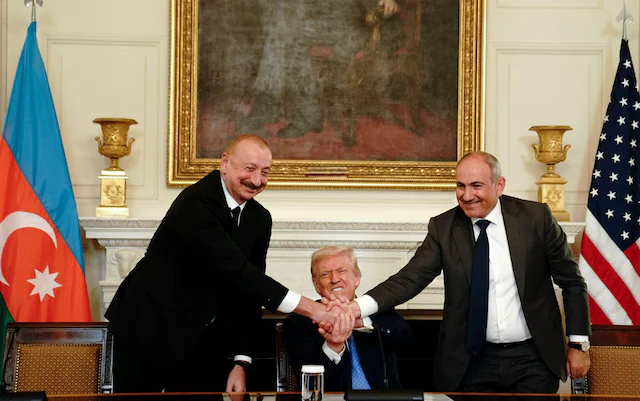
On August 8, Armenia and Azerbaijan signed a historic peace deal in the White House, in the presence of President Trump. The agreement, which envisions an end to three decades of hostility and the opening of a corridor linking Azerbaijan to its Nakhchivan exclave, is remarkable not only for the deal itself but for setting in which it was signed: in the White House, with Trump in charge, direct U.S.-Armenian management over the corridor, and no mention by Armenia or Azerbaijan of any Russian role.

For the first time since the Soviet Union’s dissolution, it was not Russia but the United States that brought Armenia and Azerbaijan together. That shift signals a new era in the South Caucasus, which worries leaders in Russia, Iran, and local nationalist factions.

The deal was made possible by Russia’s recent and dramatic loss of credibility in both countries. In 2023, Azerbaijan seized Nagorno-Karabakh by force, while Russian peacekeepers did little to stop it. Armenians, then reliant on Russian peacekeepers to maintain the status quo in Nagorno Karabakh, felt abandoned. As a result, Armenia froze its participation in the Russia-led Collective Security Treaty Organization (CSTO) and turned to France, Greece, and Cyprus for defence cooperation.

At the same time, Azerbaijan’s trust in Russia collapsed after a Russian surface-to-air missile shot down an Azerbaijan Airlines flight in December 2024 over Russian airspace, killing dozens. Moscow has refused to acknowledge responsibility, heightening tensions, while Baku is preparing to take Russia to international courts to reach a settlement.

Both Armenia and Azerbaijan, once solidly within Russia’s sphere of influence, were suddenly looking for alternatives. That created an opening. The United States, backed by European partners, stepped in to mediate – something unthinkable just a few years earlier.

The symbolism of the White House signing was amplified when Armenia and Azerbaijan announced the name of their new corridor connecting Azerbaijan with its Nakhchivan exclave: the “Trump Route for International Peace and Prosperity.” Trump insisted he had not asked for it; this was a strategic gesture by both Armenia and Azerbaijan. By attaching his name to the corridor, they consider that Trump will feel personally invested in the deal’s survival while sending a clear message to Moscow: Russia does not deserve credit for this rapprochement and no longer has a monopoly on peacemaking in the South Caucasus.

Russia’s response to the agreement was telling. The Foreign Ministry claimed the “current stage of normalization began with the direct assistance and central role of Russia.” As such, Moscow has been reduced to putting on a positive spin on this rapprochement, refusing to acknowledge that it was directly its own strategic miscalculations that drove both Armenia and Azerbaijan into the arms of the United States and Europe. Russia was sidelined from a process it once dominated but failed to finalize into a peace deal. Russia’s perceived unwillingness to protect Armenia, its denial over the downed Azerbaijani aircraft, and its preoccupation with the conflict in Ukraine created a strategic vacuum that Trump and European allies were able to exploit at Russia’s expense.

But Russia is not the only regional power that is annoyed at the proposed U.S-Armenia controlled corridor that is likely to traverse within a few kilometres of the Armenia-Iran border. As part of the deal, U.S. security actors are poised to manage the Trump Route for International Peace and Prosperity. Iranian leaders fear Armenia could become a new bastion of American influence in the region and the corridor itself become a staging ground for intelligence- gathering and armed intervention into Iranian territory. This fear is compounded by Azerbaijan’s deepening engagement with Israel in the defence and economic spheres, when much of the Muslim world is severely criticizing Israel for its actions in the Gaza conflict.

Therefore, Iran worries that an expanded American, Israeli, and European presence in the South Caucasus could destabilize the region. Iran’s foreign minister has already warned that “foreign presence” in the Caucasus threatens regional stability. For Tehran, the deal looks less like peace and more like encirclement. In this case, it resembles the early 2000s – albeit on a much smaller scale – when the U.S. had significant military forces deployed in two of Iran’s neighbours: Iraq and Afghanistan, besides its typical NATO-tied personnel in Turkey and special forces in Pakistan.

But not all regional powers are frustrated with this deal. Turkey is positioning itself to be the economic winner. In late- July, Turkey secured $2.8 billion in investment to connect Turkey’s rail network with the Nakhchivan region of Azerbaijan.

By connecting its rail network to the Nakhchivan region, Ankara aims to turn the proposed Trump Route into a backbone of east-west trade to enhance Turkish influence in the wider region. The corridor could significantly strengthen the Lapis Lazuli trade route, which links Central Asia through the South Caucasus to Europe, shorten existing transit times, strengthen Turkish influence in Central Asia, and revitalize Nakhchivan and eastern Turkey – at a time when the militant Kurdistan Workers’ Party (PKK) dissolved itself in May 2025.

For Armenia and Azerbaijan, this peace deal – with its potential to dramatically increase trade – offers a chance at prosperity after decades of frozen and hot conflict. If the corridor and expanded trade are realized, it could pave the way for long-term peace.

All of this explains why this peace deal matters: it reflects not only a shift in Armenian and Azerbaijani loyalties but also Trump’s astuteness to seize a geopolitical opportunity and have it branded as his own. In doing so, he has reshaped the strategic map of the South Caucasus, displacing Russia, unsettling Iran, and gaining leverage with Turkey to transform the region in its national interest at a time when Syria’s allegiances are still being determined.

But can the peace hold? Nationalists in both Armenia and Azerbaijan are skeptical and their voices are loud. Armenia is undergoing a tense crisis between the government and the Armenian Apostolic Church. This crisis threatens state unity and the survival of the Pashinyan presidency, a vulnerability that foreign powers are actively exploiting. Iran has already voiced its strong opposition to the existence of this U.S.-managed corridor and therefore may seek to disrupt it. Russia, while concerned with growing Western influence in the South Caucasus is likely to play a wait and see approach to see how it can best advance its interest in a changing region. U.S. and European investment and pressure will be key in ensuring this peace.

The August 8 signing marked a turning point. For the first time in decades, the U.S. is driving events in a region long thought to firmly belong in Moscow’s sphere. Armenia and Azerbaijan have made their choice based on Moscow’s behaviour. Trump recognized the opportunity, negotiated a deal, and secured a diplomatic victory. The agreement also strengthens America’s presence, with broader implications for its strategic interests in Turkey and the Middle East. This is yet another example of alliances changing at a pace not seen since the onset of the Global War on Terrorism in 2001.

*Philip Acey is a PhD candidate from Canada and an independent political researcher and analyst who has worked for over a decade across Europe, Asia, Africa, and South America, visiting more than 50 countries. His research has been used worldwide to advise the UN Security Council, UN agencies, diplomats, and humanitarian organizations. Connect with him on X: @Philipfficial

/Argumentum.al

© 2025 Argumentum

Related Posts

Current Events

Rama alleges ‘hybrid war’ behind protests against Kushner-linked coastal development

5 June, 2026
ENGLISH

Pierre Nora and the institution of memory we lack in Eastern Europe

5 June, 2026
BELGRADE, SERBIA - JUNE 18. 2020: Russian and Serbian flags on display during Russian Foreign Minister Sergei Lavrov's visit to the Liberators of Belgrade Memorial. Valery Sharifulin/TASS,Image: 533095429, License: Rights-managed, Restrictions: UWAGA! Zdjęcia zawierają oryginalny opis dostawcy (ITAR-TASS). Szczególnie w związku z agresją Rosji na Ukrainę mogą zawierać przekaz niezgodny z faktami. Zweryfikuj go przed publikacją, Model Release: no, Credit line: Valery Sharifulin / TASS / Forum
Current Events

Balkan Maskirovka: Why Moscow’s “Distancing” Is Only an Operation for the Survival of Vučić’s Regime

5 June, 2026

Follow US

Subscribe

Receive Argumentum Magazine by Email

Last Posts

Rama alleges ‘hybrid war’ behind protests against Kushner-linked coastal development

5 June, 2026

Pierre Nora and the institution of memory we lack in Eastern Europe

5 June, 2026
BELGRADE, SERBIA - JUNE 18. 2020: Russian and Serbian flags on display during Russian Foreign Minister Sergei Lavrov's visit to the Liberators of Belgrade Memorial. Valery Sharifulin/TASS,Image: 533095429, License: Rights-managed, Restrictions: UWAGA! Zdjęcia zawierają oryginalny opis dostawcy (ITAR-TASS). Szczególnie w związku z agresją Rosji na Ukrainę mogą zawierać przekaz niezgodny z faktami. Zweryfikuj go przed publikacją, Model Release: no, Credit line: Valery Sharifulin / TASS / Forum

Balkan Maskirovka: Why Moscow’s “Distancing” Is Only an Operation for the Survival of Vučić’s Regime

5 June, 2026

The Blueprint of a Diplomatic Debacle: Analyzing Germany’s Historic UNSC Loss

4 June, 2026

Serbia – China 2026: Technological partnership, geopolitical positioning and a new phase of the Chinese presence in the Western Balkans

1 June, 2026
Argumentum

“Argumentum”, një proces intelektual …

Contact Us

[email protected]
[email protected]
[email protected]

Follow Us

Media Partner

Register

Receive Argumentum Magazine by Email
  • Home
  • Privacy Policy
  • About Us
  • Contact

© 2022 Argumentum. All Rights Reserved. | NUIS: L91415033Q

Welcome Back!

Login to your account below

Forgotten Password? Sign Up

Create New Account!

Fill the forms bellow to register

*By registering into our website, you agree to the Terms & Conditions and Privacy Policy.
All fields are required. Log In

Retrieve your password

Please enter your username or email address to reset your password.

Log In

Add New Playlist

No Result
View All Result
  • Home
  • OP/ED
  • Interview
  • Realpolitik
  • Current Events
  • Top News
  • YOUR VOICE
  • Shqip

© 2022 Argumentum. All Rights Reserved. | NUIS: L91415033Q

This website uses cookies. By continuing to use this website you are giving consent to cookies being used. Visit our Privacy and Cookie Policy.