




















• SHQIPËRI
  • KOSOVË
  • MAQEDONIA E VERIUT
  • MALI I ZI
  • Revista në PDF
4 June, 2026
  • Home
  • OP/ED

    Cyber Attribution, Corruption, and the False-Flag Question in Albania’s 2022 Alleged Iranian Cyberattack

    Between Russia, Iran and Europe: Azerbaijan as a balancing power in the South Caucasus

    The Zero-Tariff Gate: Sovereignty as a Service in the Sino-African Corridor

    Albania vs. the Sea/ Marginal Notes on A. Leka’s Novel The Hidden Side of the Albanian Socialist Garden

    May 9 and the long shadow of a Letter: Is Europe still Schuman’s Project?

    The Arbnesh of Zadar: A living memory of Albanian identity on the Adriatic coast

    Science Diplomacy and Academic Freedom: A strategic nexus for contemporary diplomacy

    Serbia and Kosovo between new regional alliances and old geopolitical patterns

    Hungarian Writers and the European Spirit: Between Central Europe, Auschwitz, and Inner Exile

  • Interview

    Exclusive Interview with Oleksandr Tyshchenko: A 40-Year Legacy of Chernobyl, Nuclear Risks, and Global Responsibility

    INTERVIEW: ZLATKO KRAMARIĆ – THOUGHTS ON THE OLD CONTINENT

    EXCLUSIVE / Ukrainian Ambassador to Albania, Volodymyr Shkurov: “Ukraine wants peace, but not at the expense of its freedom and independence”

    EXCLUSIVE| Ambassador Tayyar Kagan Atay: Türkiye and Albania, a Strategic Partnership Rooted in Shared Heritage and a Common Vision for the Future

    “Diplomacy, Not War”: Palestinian Ambassador to Albania Calls for Justice, Peace, and Global Action for Gaza

    Exclusive: “Even After Tito – Tito”/ Ambassador Zlatko Kramarić on Authoritarian Legacies and Democracy’s Future in the Balkans

    The Conclusion of the Diplomatic Mission / Ambassador Dancho Markovski: Strengthening Albania-North Macedonia Relations for a Shared European Future

    A Century of Diplomatic Relations Between Albania and Russia: Exclusive Interview with the Russian Ambassador to Albania, H.E. Alexey Zaytsev

    Exclusive/ The chairman of the Freedom Party, Ilir Meta: “The will of the citizens will triumph in Albania, as it did in North Macedonia”

  • Realpolitik

    IBAR? ”Sufficiently! Much ado about nothing! Shart contrasts in Beijing! Where is the exit?!

    Neither peace nor war! Peace with bombs?! IBAR in autumn?! Not another Hormuz in Taivan! 

    IBAR – a springing board or an obstacle? Can we catch the EU Negotiation train 2027? When the dress makes the news!  EU electoral April  ends in a draw 1:1!  

    The European Parliament building in Strasbourg, France with flags waving calmly celebrating peace of the Europe. July 12, 2020.

    EU 2027 or 2037! Even half membership failed! No exit strategy!     

    What next?

    “With diplomatic velvet“! Major question marks! In Washington yes, but  in the White House NO! A strange dinner in Brussels!

    From a great ‘apple of disaccord’ to a  point of  cooperation! A bad start! The strange absence in Davos!

    5 lessons from the American 3 January! Don’t count the chicken before they are hatched! Will NATO freeze in Greenland? Wrong diplomatic messages!

    German Chancellor Friedrich Merz, European Commission President Ursula von der Leyen, Ukraine's President Volodymyr Zelenskiy, U.S. Special Envoy Steve Witkoff and Jared Kushner, son-in-law of U.S. President Donald Trump line up for a family photo opportunity at the Chancellery in Berlin, Germany, December 15, 2025.    REUTERS/Lisi Niesner/Pool

    A Strategy that could change the world! Europe in Berlin! Why an historic compromise? Only charm diplomacy in Athens!

  • Current Events

    Serbia – China 2026: Technological partnership, geopolitical positioning and a new phase of the Chinese presence in the Western Balkans

    The Digital Protectorate: How the EU AI Act Codified Silicon Valley’s Monopoly

    The 28th MFC Annual Conference in Durrës / Sulaj: Microfinance remains a key instrument for financial inclusion

    Serbia at the Crossroads of EU Integration and Geopolitical Balancing: IFIMES Analysis

    Tirana – €20 Million EU–Banking Agreement Boosts Albanian SMEs

    The Myth of Independence: How Chinese Efficiency is Rewriting the Constitution of Modern Geopolitics!

    Europe Yesterday and Today: Why 9 May Still Matters

    “EU4Municipalities II” Project, a Strategic Investment for Strengthening Municipalities and Accelerating Albania’s Path towards the EU

    Eight Years in the Service of Identity: The Journey of the Montenegrin Community in Albania

  • Top News

    No End in Sight: Trump, Netanyahu and the Expanding Middle East War

    Tirana – €20 Million EU–Banking Agreement Boosts Albanian SMEs

    “EU4Municipalities II” Project, a Strategic Investment for Strengthening Municipalities and Accelerating Albania’s Path towards the EU

    Albania, Italy deepen defence ties with naval shipbuilding deal

    U.S. Embassy: Iran-Linked Groups May Target Americans and Iranian Opposition in Albania

    The Council of Albanian Ambassadors disappointed with the voting of the draft law on the foreign service in the parliamentary committees.

    Prime Minister Edi Rama Addresses Israel’s Knesset in Historic Special Session

    Kazakhstan’s Strategic Reform Agenda: Stability, Modern Governance, and Responsible Diplomacy

    Trump Invites Rama to Peace Board, Prime Minister: Proud of Albania

  • YOUR VOICE
  • Shqip
No Result
View All Result
Argumentum
  • Home
  • OP/ED

    Cyber Attribution, Corruption, and the False-Flag Question in Albania’s 2022 Alleged Iranian Cyberattack

    Between Russia, Iran and Europe: Azerbaijan as a balancing power in the South Caucasus

    The Zero-Tariff Gate: Sovereignty as a Service in the Sino-African Corridor

    Albania vs. the Sea/ Marginal Notes on A. Leka’s Novel The Hidden Side of the Albanian Socialist Garden

    May 9 and the long shadow of a Letter: Is Europe still Schuman’s Project?

    The Arbnesh of Zadar: A living memory of Albanian identity on the Adriatic coast

    Science Diplomacy and Academic Freedom: A strategic nexus for contemporary diplomacy

    Serbia and Kosovo between new regional alliances and old geopolitical patterns

    Hungarian Writers and the European Spirit: Between Central Europe, Auschwitz, and Inner Exile

  • Interview

    Exclusive Interview with Oleksandr Tyshchenko: A 40-Year Legacy of Chernobyl, Nuclear Risks, and Global Responsibility

    INTERVIEW: ZLATKO KRAMARIĆ – THOUGHTS ON THE OLD CONTINENT

    EXCLUSIVE / Ukrainian Ambassador to Albania, Volodymyr Shkurov: “Ukraine wants peace, but not at the expense of its freedom and independence”

    EXCLUSIVE| Ambassador Tayyar Kagan Atay: Türkiye and Albania, a Strategic Partnership Rooted in Shared Heritage and a Common Vision for the Future

    “Diplomacy, Not War”: Palestinian Ambassador to Albania Calls for Justice, Peace, and Global Action for Gaza

    Exclusive: “Even After Tito – Tito”/ Ambassador Zlatko Kramarić on Authoritarian Legacies and Democracy’s Future in the Balkans

    The Conclusion of the Diplomatic Mission / Ambassador Dancho Markovski: Strengthening Albania-North Macedonia Relations for a Shared European Future

    A Century of Diplomatic Relations Between Albania and Russia: Exclusive Interview with the Russian Ambassador to Albania, H.E. Alexey Zaytsev

    Exclusive/ The chairman of the Freedom Party, Ilir Meta: “The will of the citizens will triumph in Albania, as it did in North Macedonia”

  • Realpolitik

    IBAR? ”Sufficiently! Much ado about nothing! Shart contrasts in Beijing! Where is the exit?!

    Neither peace nor war! Peace with bombs?! IBAR in autumn?! Not another Hormuz in Taivan! 

    IBAR – a springing board or an obstacle? Can we catch the EU Negotiation train 2027? When the dress makes the news!  EU electoral April  ends in a draw 1:1!  

    The European Parliament building in Strasbourg, France with flags waving calmly celebrating peace of the Europe. July 12, 2020.

    EU 2027 or 2037! Even half membership failed! No exit strategy!     

    What next?

    “With diplomatic velvet“! Major question marks! In Washington yes, but  in the White House NO! A strange dinner in Brussels!

    From a great ‘apple of disaccord’ to a  point of  cooperation! A bad start! The strange absence in Davos!

    5 lessons from the American 3 January! Don’t count the chicken before they are hatched! Will NATO freeze in Greenland? Wrong diplomatic messages!

    German Chancellor Friedrich Merz, European Commission President Ursula von der Leyen, Ukraine's President Volodymyr Zelenskiy, U.S. Special Envoy Steve Witkoff and Jared Kushner, son-in-law of U.S. President Donald Trump line up for a family photo opportunity at the Chancellery in Berlin, Germany, December 15, 2025.    REUTERS/Lisi Niesner/Pool

    A Strategy that could change the world! Europe in Berlin! Why an historic compromise? Only charm diplomacy in Athens!

  • Current Events

    Serbia – China 2026: Technological partnership, geopolitical positioning and a new phase of the Chinese presence in the Western Balkans

    The Digital Protectorate: How the EU AI Act Codified Silicon Valley’s Monopoly

    The 28th MFC Annual Conference in Durrës / Sulaj: Microfinance remains a key instrument for financial inclusion

    Serbia at the Crossroads of EU Integration and Geopolitical Balancing: IFIMES Analysis

    Tirana – €20 Million EU–Banking Agreement Boosts Albanian SMEs

    The Myth of Independence: How Chinese Efficiency is Rewriting the Constitution of Modern Geopolitics!

    Europe Yesterday and Today: Why 9 May Still Matters

    “EU4Municipalities II” Project, a Strategic Investment for Strengthening Municipalities and Accelerating Albania’s Path towards the EU

    Eight Years in the Service of Identity: The Journey of the Montenegrin Community in Albania

  • Top News

    No End in Sight: Trump, Netanyahu and the Expanding Middle East War

    Tirana – €20 Million EU–Banking Agreement Boosts Albanian SMEs

    “EU4Municipalities II” Project, a Strategic Investment for Strengthening Municipalities and Accelerating Albania’s Path towards the EU

    Albania, Italy deepen defence ties with naval shipbuilding deal

    U.S. Embassy: Iran-Linked Groups May Target Americans and Iranian Opposition in Albania

    The Council of Albanian Ambassadors disappointed with the voting of the draft law on the foreign service in the parliamentary committees.

    Prime Minister Edi Rama Addresses Israel’s Knesset in Historic Special Session

    Kazakhstan’s Strategic Reform Agenda: Stability, Modern Governance, and Responsible Diplomacy

    Trump Invites Rama to Peace Board, Prime Minister: Proud of Albania

  • YOUR VOICE
  • Shqip
No Result
View All Result
Argumentum
No Result
View All Result
Home ENGLISH

Trump’s 2020 Peace Plan/ Between International Law and Reality

13 February, 2020
in ENGLISH, English OP/ED
A A
Share on FacebookShare on Twitter

On January 28, 2020, U.S. President Donald Trump (R) unveiled his long-anticipated plan for the creation of the State of Palestine with the capital in the east of Jerusalem (but not in East Jerusalem). The development of the plan had lasted three years.

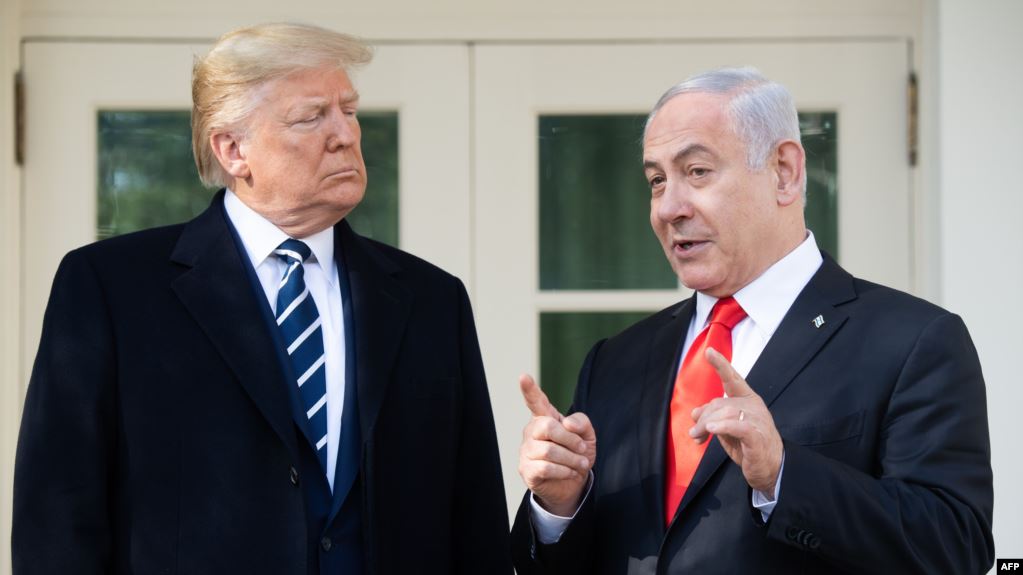
AVision to Improve the Lives of the Palestinian and Israeli People, commonly known as the Trump peace plan or the deal of the century, was formally unveiled by Donald Trump at a White House press conference alongside Israeli Prime Minister Benjamin Netanyahu on January 28, 2020. Palestinian representatives were not invited to the unveiling of Trump’s peace plan. 

The plan was authored by a team led by Trump’s son-in-law and senior advisor Jared Kushner, and Jason Greenblatt, special adviser to the U.S. President for international negotiations. Both the highly influential West Bank settlers’ Yesha Council, which enjoys support of the right-wing parties in Knesset, and the Palestinian leadership, rejected the plan immediately. The former because it envisaged a Palestinian state in Judea and Samaria (Biblical term for the West Bank), and the latter arguing it is too biased in favor of Israel. The plan is divided into two parts, an economic portion and a political portion. On June 22, 2019, the Trump administration released the economic portion of the plan, titled “Peace to Prosperity“, at a conference held in Manama, Bahrain. The political portion was released in Washington D.C. on January 28, 2020. 

The administration of U.S. President Donald Trump claims that it proposes a holistic solution to the 73-year long Israeli-Palestinian conflict. Although Trump continues to criticize previous administrations’ failed efforts, his team in fact relied on the concepts, principles, and even formulations upon which earlier plans had been built.

Previous U.S. mediators tried to set the stage for a deal by solving various lighter and initial issues between the two parties, whereas it appears that Trump’s team simply opted for resolving the final and difficult status issues – border, security, status of Jerusalem, refugees, international recognition – even prior to the commencement of the talks. 

Sovereignty of Jerusalem

Earlier negotiators endeavored to reconcile conflicting demands concerning the sovereignty over Jerusalem, especially the holly places including the Old City and the Christian, Islamic and Jewish sacred sites located there. In the past, the negotiators attempted to resolve the issue of sovereignty with the joint administration of the Old City. As opposed to that, Trump’s team solved this matter by permanently granting the sovereignty over the entire Jerusalem to Israel, including the Christian and Muslim quarters and the Al-Aqsa mosque complex. On December 6, 2017, Trump recognized Jerusalem as the undivided capital of Israel.

Trump’s peace plans ignores other formulas of hard and arduous negotiations in favor of ambiguous and imbalanced viewpoints. The Clinton administration, for example, based all U.S. propositions on the notion that the Arabic quarters in East Jerusalem must be placed under Palestinian sovereignty and, likewise, the Jewish ones must remain under Israeli sovereignty. 

Trump’s peace plan places almost all the Arabic neighbuorhoods in East Jerusalem under Israeli sovereignty, leaving the Palestinians with the villages of Kafr Aqab, Abu Dis and the Shuafat refugee camp. These neighbourhoods are located on the eastern side of the Israeli Wall, which separates Israel from the occupied West Bank. It is in this part in the east of Jerusalem (but not in East Jerusalem) that the Palestinians have been told to build their own capital to be named Al-Quds (Arabic name for Jerusalem). The new capital would thus be separated from the Al-Aqsa mosque and from the 300,000 Palestinians currently living in East Jerusalem.

A 1400 km-long Israeli-Palestinian border?

As for the Israeli settlements in the occupied West Bank, Israeli and Palestinian negotiators previously considered the option of adding larger settlements located along the 1967 border between Israel and West Bank to the state of Israel. The Palestinians would get an equivalent land from Israel as a compensation for those settlements. Based on this arrangement, 85% of the settlers would remain on 3 – 5% of the West Bank territory, which would be annexed by Israel. Smaller and remote settlements in the West Bank would be evacuated.

One of the security factors is the length of the border between Israel and the Palestinian state.  Instead of the 311 kilometers-long 1967 border, Trump’s peace plan envisages a border of nearly 1,400 kilometers! There are serious hurdles associated with defense of a border that long and Israeli forces would probably have a difficult job executing this task.

The international community regards the policy of building settlements on the occupied territories as illegal. Israeli settlements in East Jerusalem and the Golan, the areas formally annexed by Israel, are also considered illegal. The United Nations (UN) have on several occasions stated that Israel’s construction of Jewish settlements in the Palestinian areas constitute a violation of the Geneva Convention. The International Court of Justice (ICJ) has also labeled the settlements outside Israel as illegal.

Trump’s team embraced the idea of exchange of territory, but the plan itself gives Palestinians a barren land on the Egyptian border in exchange for the integration of all settlements in the West Bank with Israel, including remote settlements. The result would be an isolated and disconnected Palestinian state, made up of at least six enclaves with no possibility of direct contact. To address that, Trump’s peace plan proposes communication via tunnels and bridges which would interconnect the enclaves under Palestinian sovereignty. However, those tunnels and bridges would remain under Israeli control.

Trump’s peace plan was presented as a final decision.  Trump’s team is discoursing as if everything has been arranged between Trump and Israel’s Prime Minister Benjamin Netanyahu, and the rest is up to the U.S.-Israeli team (rather than Israeli-Palestinian) to precisely define borders on Trump’s predetermined maps.

This will apparently be the task of the new Israeli government following the elections scheduled for March 2, 2020.  Israel is on the course of annexation of the Jordan River Valley and all Jewish settlements regardless of the start of Israeli-Palestinian talks. Israel will get everything in exchange for mere acceptance of the idea of a Palestinian state and relinquishment of 30% of the West Bank. Palestinians can hence rightfully ask: What is even left to negotiate at all? 

Trump’s blessing for annexation?

However, there is nothing Palestinians can do at the moment. Their rejection of Trump’s peace plan, which seems inevitable given the proposed conditions, will serve as a justification for Netanyahu to move forward with the annexation, which has already received Trump’s blessing.

Palestinian leadership must be brave and make a decision to accept Trump’s peace plan and declare their readiness for direct negotiations with the new Israeli government following the elections on March 2, 2020, and they need to do that on the basis of previously adopted resolutions of the UN Security Council, which envisage a two-state solution and exchange of land for peace.

Palestinian negotiators may refer to all the UN resolutions as well as the 2002 Arab League Initiative, which sets the stage for normalization of relations between 22 Arab countries and Israel after an Israeli-Palestinian deal has been brokered. This move could strengthen the fragile Arab support and generate support in the international community. Palestinian decision to enter direct talks with Trump and Israel might push Trump to abandon his one-sided peace plan and try to find a more balanced and realistic approach to the resolution of this century-long conflict.

Between international law and reality

International politics, especially nowadays, is rooted in political realism governed by interests of great powers and the balance of force, notably for the superpowers which do not adhere to the tenets of international law, international legitimacy or moral values, unless those serve their interests, and in many cases realpolitik overlap with aggressive politics.

If we take a look at current events in the world, we will discover that international political realism or the language and interest of power dominate international relations.

Realpolitik, which stands in opposition to international law, international legitimacy and human morality, is hardly exclusive to Israel and countries of the West. It is true that the political realism U.S. President Trump bases his actions on and on which he relies in his effort to end the long-standing conflict in the Middle East is excessively in violation of international law, international legitimacy and Palestinians’ historical national rights. However, other countries practice realpolitik, too and violate international law, even if in a less provocative manner. When Russia, Turkey and Iran interfere with internal affairs of other countries, do they show regard for international law and legality? Is Saudi Arabia with its interventions in the Gulf, Yemen, Libya and Syria aligned with international legality and resolutions?

The first president of Israel, David Ben-Gurion, accepted the United Nations Partition Plan for Mandatory Palestine based on the 1947 UN Resolution, which granted him a part of Palestine without Jerusalem, which was to remain under international administration. Palestinians and the Arab states rejected the plan and, one day after the establishment of Israel on May 15, 1948, the armed forces of six Arab states attacked the young state of Israel. Ben-Gurion made history as a visionary and a great statesman; he created a respected and one of the most developed countries in the world on 56% of the territory of the historical or mandatory Palestine. Today, Palestinians should be guided by the same idea, occupy the same position, and use negotiations to try to correct the principles of the peace plan they are not satisfied with.

Before they can do that, Palestinians must hold the long-delayed elections, unify the two governments in Ramallah and Gaza, and strive to build a pro-Western type of democracy, step-up counter-corruption efforts, and work to disarm militant groups. 

Ljubljana/Washington/Jerusalem, February 13, 2020   

  • Link (ENG): https://www.ifimes.org/en/9768   (Research – Trump’s 2020 Peace Plan: Between International Law and Reality)

Related Posts

Current Events

Serbia – China 2026: Technological partnership, geopolitical positioning and a new phase of the Chinese presence in the Western Balkans

1 June, 2026
ENGLISH

IBAR? ”Sufficiently! Much ado about nothing! Shart contrasts in Beijing! Where is the exit?!

1 June, 2026
ENGLISH

How Alkida Lushaj is redefining democratic inclusion globally

31 May, 2026

Follow US

Subscribe

Receive Argumentum Magazine by Email

Last Posts

Serbia – China 2026: Technological partnership, geopolitical positioning and a new phase of the Chinese presence in the Western Balkans

1 June, 2026

IBAR? ”Sufficiently! Much ado about nothing! Shart contrasts in Beijing! Where is the exit?!

1 June, 2026

How Alkida Lushaj is redefining democratic inclusion globally

31 May, 2026

Cyber Attribution, Corruption, and the False-Flag Question in Albania’s 2022 Alleged Iranian Cyberattack

30 May, 2026

The Digital Protectorate: How the EU AI Act Codified Silicon Valley’s Monopoly

30 May, 2026
Argumentum

“Argumentum”, një proces intelektual …

Contact Us

[email protected]
[email protected]
[email protected]

Follow Us

Media Partner

Register

Receive Argumentum Magazine by Email
  • Home
  • Privacy Policy
  • About Us
  • Contact

© 2022 Argumentum. All Rights Reserved. | NUIS: L91415033Q

Welcome Back!

Login to your account below

Forgotten Password? Sign Up

Create New Account!

Fill the forms bellow to register

*By registering into our website, you agree to the Terms & Conditions and Privacy Policy.
All fields are required. Log In

Retrieve your password

Please enter your username or email address to reset your password.

Log In

Add New Playlist

No Result
View All Result
  • Home
  • OP/ED
  • Interview
  • Realpolitik
  • Current Events
  • Top News
  • YOUR VOICE
  • Shqip

© 2022 Argumentum. All Rights Reserved. | NUIS: L91415033Q

This website uses cookies. By continuing to use this website you are giving consent to cookies being used. Visit our Privacy and Cookie Policy.