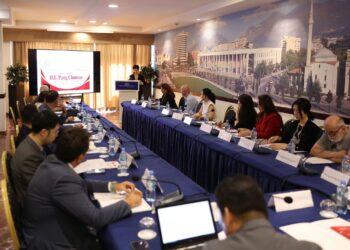



























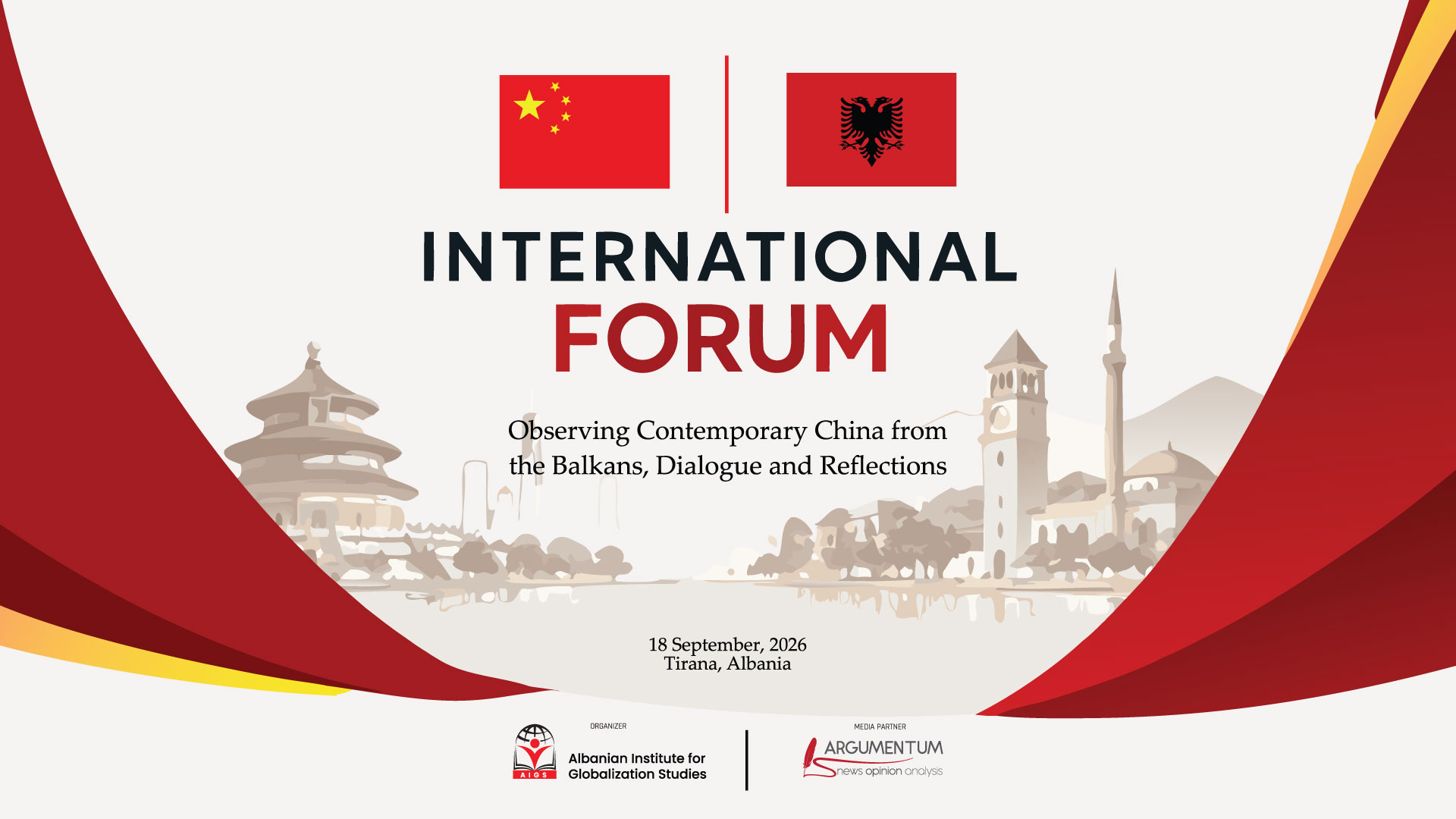
Researchers, professors, diplomats and experts from China, Albania, North Macedonia and Italy gathered in Tirana for the international forum “Observing Contemporary China from the Balkans: Dialogue and Reflections”, to discuss contemporary China, perceptions of the country in the Balkans, and opportunities for cooperation amid a changing international order.
The forum was organized by the Albanian Institute for Globalization Studies (AIGS), in cooperation with the Embassy of the People’s Republic of China in Tirana, creating a space for different perspectives on a country playing an increasingly important role in international developments.
Argumentum.al, a specialized media outlet covering geopolitics and international affairs, served as the forum’s media partner.
In her opening remarks, Musabelliu stressed the need for a more open and multidimensional approach to China, at a time when the country is changing rapidly while its relations with Europe, the global economy and technology are also evolving.
“The idea is simple: to create a space where we can discuss contemporary China from different perspectives, openly and seriously, without reducing such a complex country to a single narrative,” she said.
According to Musabelliu, for Albania and the Western Balkans, it is becoming increasingly important that discussions about China be based on knowledge and analysis rather than perceptions alone.
“We are not here to present a single interpretation of China. We are here to listen, compare perspectives, ask questions and perhaps reconsider some of the assumptions we have about a country that is becoming increasingly important to the world around us,” she said.
One of the forum’s central messages was the need to distinguish between information and understanding.
“To understand does not necessarily mean to agree; it means having the opportunity to listen, examine and reflect,” Musabelliu stressed.
Ambassador of the People’s Republic of China to Albania, Pang Chunxue, placed the discussion within the broader context of transformations in the international order.
In her remarks, the ambassador presented China’s four global initiatives: the Global Development Initiative, Global Security Initiative, Global Civilization Initiative and Global Governance Initiative.
She linked these initiatives to issues including multilateralism, sovereign equality, the peaceful settlement of disputes and respect for the diversity of civilizations.
Pang Chunxue also underlined the importance of international cooperation at a time when countries of the Global South are seeking a greater role in the international system. In this context, she highlighted the development of China–Albania relations and opportunities to expand cooperation between China and the countries of the Balkans.
From the perspective of Chinese academia, Prof. Kong Fanjun, Professor of International Relations at Peking University, focused on how China is perceived in the Balkans.
He noted that perceptions vary according to academic, social and political environments, while the information available about China does not always translate into a comprehensive understanding of its reality.
Kong referred to a Chinese proverb: “A leaf before the eyes can block the view of Mount Tai,” using it as a metaphor for the risks of a partial perspective. China, he argued, is a multidimensional reality that requires analysis from more than one perspective.
A significant part of the forum was devoted to the history of Albania–China relations.
Prof. Liang Zhanjun, Professor of History and Director of the Center for Global and Regional Studies at Capital Normal University, presented an analysis of the development of these relations across different periods.
He addressed the years 1949–1955, a period of consolidation of relations, the intensification of political, economic and ideological cooperation after 1955, and the weakening of relations during the period 1978–1990.
Following the end of the Cold War, Liang said, renewed interest emerged in restoring and developing cooperation. Today, Albania–China relations are developing in a completely different context, shaped by changes in the international system and Albania’s foreign policy orientation. Liang described the relationship as “delicate and complex.”
Another dimension of the relationship was addressed by Prof. Dr. Biljana Vankovska, from the “Ss. Cyril and Methodius” University in Skopje and president of Synergia Orbi: Institute for Global Analysis.
In her presentation on China–Balkans academic cooperation, Vankovska stressed that academic exchange is not simply a transfer of information, but also a way of understanding how knowledge about the “other” is produced.
She emphasized intellectual reciprocity and the role of young researchers, who will shape the next generation of studies on China and the Balkans. According to her, academic traditions and historical experiences influence what we see, what we overlook and what we may misunderstand.
A concrete European perspective was offered by Prof. Gianpaolo Camaggio, Scientific Director of the Master’s Programme in International Business in China at LUM – Giuseppe Degennaro University in Bari and founder of Sinoglobal Investments Advisory.
Camaggio presented the 40-year experience of relations between Bari and Guangzhou, two port cities that established a twinning relationship in 1986.
According to him, the relationship developed beyond institutional cooperation, encompassing universities, cultural institutions, media and local communities.
The relationship, Camaggio said, moved “from a relationship between institutions to a relationship between people.”
The Bari–Guangzhou experience, he argued, shows that city-to-city diplomacy can create bridges of communication and contribute to building more direct mutual understanding between communities.
“Relations between cities can make an important contribution to mutual understanding between peoples,” he stressed, highlighting the role of culture, education, media and people-to-people exchanges.
Historian Ylber Marku, from the Institute of History of the Academy of Sciences of Albania, placed the discussion within the perspective of a small state.
Referring to the history of Albania–China relations, Marku argued that changes in the international system require Albania to prepare for new scenarios and think strategically about its relations with different powers.
In this context, he linked cooperation with China to the idea of diversifying Albania’s economic and diplomatic relations.
“Diversification is not hostility. It is a form of security,” Marku said, stressing that contemporary cooperation can be built around concrete interests in the fields of the economy, education, scientific research, culture, tourism and infrastructure.
Marjana Doda, Editor-in-Chief of Argumentum.al and a geopolitical analyst, addressed China–Albania relations in the context of changes in the international order. Her presentation focused on bilateral relations, perceptions of China in Albanian society, and opportunities for cooperation across several sectors.
She stressed that the relationship requires a strategic approach based on knowledge, dialogue and concrete interests.
Referring to the historical development of bilateral relations, Doda discussed the political, economic and social rapprochement that characterized part of the 20th century, followed by a period of interruption and later a renewed process of rapprochement after political transformations.
Doda raised the question of the extent to which Albania has made use of the potential of its relations with China. She referred to economic and regional cooperation initiatives, including the Belt and Road Initiative and China–Central and Eastern Europe cooperation mechanisms, while noting Albania’s relatively cautious approach.
In her presentation, she identified logistics, transport, technology, renewable energy, education, scientific research, tourism and culture as areas with potential for expanding cooperation. She also highlighted Albania’s geographical position at the crossroads of the Western Balkans, the Mediterranean and Europe.
Doda also underlined the role of the media in shaping public understanding and international relations. According to her, media cooperation goes beyond the transmission of messages and influences the way societies learn about and understand one another.
In conclusion, she stressed that sustainable cooperation requires direct contacts among institutions, universities, businesses, media organizations and professional communities.
The technological dimension was addressed by Dr. Ermir I. Hajdini, a strategist specializing in cyber policy and law.
In his presentation on artificial intelligence and the transformation of the digital order, Hajdini argued that middle-income and developing economies are seeking greater infrastructural and technological autonomy.
He placed China at the center of this transformation through its development of artificial intelligence, open-source models and technological capabilities that could create alternatives for smaller countries.
For the Western Balkans, Hajdini raised the question of how the European integration process, regulatory requirements and the need to develop local technological capacities can be brought together.
In the closing discussion, the forum returned to the challenges facing small states in a changing international system.
For Albania, relations with major powers create both opportunities and strategic dilemmas. In this context, relations with China were examined not only through their history, but also through new developments in the economy, technology, education, culture and international relations.
The academic and diplomatic dialogue held in Tirana placed China–Balkans relations within a broader framework in which history, politics, economics, technology, culture and people-to-people contacts intersect with the transformations of the international order.

© 2026 Argumentum