







• SHQIPËRI
  • KOSOVË
  • MAQEDONIA E VERIUT
  • MALI I ZI
  • Revista në PDF
4 June, 2026
  • Home
  • OP/ED

    Cyber Attribution, Corruption, and the False-Flag Question in Albania’s 2022 Alleged Iranian Cyberattack

    Between Russia, Iran and Europe: Azerbaijan as a balancing power in the South Caucasus

    The Zero-Tariff Gate: Sovereignty as a Service in the Sino-African Corridor

    Albania vs. the Sea/ Marginal Notes on A. Leka’s Novel The Hidden Side of the Albanian Socialist Garden

    May 9 and the long shadow of a Letter: Is Europe still Schuman’s Project?

    The Arbnesh of Zadar: A living memory of Albanian identity on the Adriatic coast

    Science Diplomacy and Academic Freedom: A strategic nexus for contemporary diplomacy

    Serbia and Kosovo between new regional alliances and old geopolitical patterns

    Hungarian Writers and the European Spirit: Between Central Europe, Auschwitz, and Inner Exile

  • Interview

    Exclusive Interview with Oleksandr Tyshchenko: A 40-Year Legacy of Chernobyl, Nuclear Risks, and Global Responsibility

    INTERVIEW: ZLATKO KRAMARIĆ – THOUGHTS ON THE OLD CONTINENT

    EXCLUSIVE / Ukrainian Ambassador to Albania, Volodymyr Shkurov: “Ukraine wants peace, but not at the expense of its freedom and independence”

    EXCLUSIVE| Ambassador Tayyar Kagan Atay: Türkiye and Albania, a Strategic Partnership Rooted in Shared Heritage and a Common Vision for the Future

    “Diplomacy, Not War”: Palestinian Ambassador to Albania Calls for Justice, Peace, and Global Action for Gaza

    Exclusive: “Even After Tito – Tito”/ Ambassador Zlatko Kramarić on Authoritarian Legacies and Democracy’s Future in the Balkans

    The Conclusion of the Diplomatic Mission / Ambassador Dancho Markovski: Strengthening Albania-North Macedonia Relations for a Shared European Future

    A Century of Diplomatic Relations Between Albania and Russia: Exclusive Interview with the Russian Ambassador to Albania, H.E. Alexey Zaytsev

    Exclusive/ The chairman of the Freedom Party, Ilir Meta: “The will of the citizens will triumph in Albania, as it did in North Macedonia”

  • Realpolitik

    IBAR? ”Sufficiently! Much ado about nothing! Shart contrasts in Beijing! Where is the exit?!

    Neither peace nor war! Peace with bombs?! IBAR in autumn?! Not another Hormuz in Taivan! 

    IBAR – a springing board or an obstacle? Can we catch the EU Negotiation train 2027? When the dress makes the news!  EU electoral April  ends in a draw 1:1!  

    The European Parliament building in Strasbourg, France with flags waving calmly celebrating peace of the Europe. July 12, 2020.

    EU 2027 or 2037! Even half membership failed! No exit strategy!     

    What next?

    “With diplomatic velvet“! Major question marks! In Washington yes, but  in the White House NO! A strange dinner in Brussels!

    From a great ‘apple of disaccord’ to a  point of  cooperation! A bad start! The strange absence in Davos!

    5 lessons from the American 3 January! Don’t count the chicken before they are hatched! Will NATO freeze in Greenland? Wrong diplomatic messages!

    German Chancellor Friedrich Merz, European Commission President Ursula von der Leyen, Ukraine's President Volodymyr Zelenskiy, U.S. Special Envoy Steve Witkoff and Jared Kushner, son-in-law of U.S. President Donald Trump line up for a family photo opportunity at the Chancellery in Berlin, Germany, December 15, 2025.    REUTERS/Lisi Niesner/Pool

    A Strategy that could change the world! Europe in Berlin! Why an historic compromise? Only charm diplomacy in Athens!

  • Current Events

    Serbia – China 2026: Technological partnership, geopolitical positioning and a new phase of the Chinese presence in the Western Balkans

    The Digital Protectorate: How the EU AI Act Codified Silicon Valley’s Monopoly

    The 28th MFC Annual Conference in Durrës / Sulaj: Microfinance remains a key instrument for financial inclusion

    Serbia at the Crossroads of EU Integration and Geopolitical Balancing: IFIMES Analysis

    Tirana – €20 Million EU–Banking Agreement Boosts Albanian SMEs

    The Myth of Independence: How Chinese Efficiency is Rewriting the Constitution of Modern Geopolitics!

    Europe Yesterday and Today: Why 9 May Still Matters

    “EU4Municipalities II” Project, a Strategic Investment for Strengthening Municipalities and Accelerating Albania’s Path towards the EU

    Eight Years in the Service of Identity: The Journey of the Montenegrin Community in Albania

  • Top News

    No End in Sight: Trump, Netanyahu and the Expanding Middle East War

    Tirana – €20 Million EU–Banking Agreement Boosts Albanian SMEs

    “EU4Municipalities II” Project, a Strategic Investment for Strengthening Municipalities and Accelerating Albania’s Path towards the EU

    Albania, Italy deepen defence ties with naval shipbuilding deal

    U.S. Embassy: Iran-Linked Groups May Target Americans and Iranian Opposition in Albania

    The Council of Albanian Ambassadors disappointed with the voting of the draft law on the foreign service in the parliamentary committees.

    Prime Minister Edi Rama Addresses Israel’s Knesset in Historic Special Session

    Kazakhstan’s Strategic Reform Agenda: Stability, Modern Governance, and Responsible Diplomacy

    Trump Invites Rama to Peace Board, Prime Minister: Proud of Albania

  • YOUR VOICE
  • Shqip
No Result
View All Result
Argumentum
  • Home
  • OP/ED

    Cyber Attribution, Corruption, and the False-Flag Question in Albania’s 2022 Alleged Iranian Cyberattack

    Between Russia, Iran and Europe: Azerbaijan as a balancing power in the South Caucasus

    The Zero-Tariff Gate: Sovereignty as a Service in the Sino-African Corridor

    Albania vs. the Sea/ Marginal Notes on A. Leka’s Novel The Hidden Side of the Albanian Socialist Garden

    May 9 and the long shadow of a Letter: Is Europe still Schuman’s Project?

    The Arbnesh of Zadar: A living memory of Albanian identity on the Adriatic coast

    Science Diplomacy and Academic Freedom: A strategic nexus for contemporary diplomacy

    Serbia and Kosovo between new regional alliances and old geopolitical patterns

    Hungarian Writers and the European Spirit: Between Central Europe, Auschwitz, and Inner Exile

  • Interview

    Exclusive Interview with Oleksandr Tyshchenko: A 40-Year Legacy of Chernobyl, Nuclear Risks, and Global Responsibility

    INTERVIEW: ZLATKO KRAMARIĆ – THOUGHTS ON THE OLD CONTINENT

    EXCLUSIVE / Ukrainian Ambassador to Albania, Volodymyr Shkurov: “Ukraine wants peace, but not at the expense of its freedom and independence”

    EXCLUSIVE| Ambassador Tayyar Kagan Atay: Türkiye and Albania, a Strategic Partnership Rooted in Shared Heritage and a Common Vision for the Future

    “Diplomacy, Not War”: Palestinian Ambassador to Albania Calls for Justice, Peace, and Global Action for Gaza

    Exclusive: “Even After Tito – Tito”/ Ambassador Zlatko Kramarić on Authoritarian Legacies and Democracy’s Future in the Balkans

    The Conclusion of the Diplomatic Mission / Ambassador Dancho Markovski: Strengthening Albania-North Macedonia Relations for a Shared European Future

    A Century of Diplomatic Relations Between Albania and Russia: Exclusive Interview with the Russian Ambassador to Albania, H.E. Alexey Zaytsev

    Exclusive/ The chairman of the Freedom Party, Ilir Meta: “The will of the citizens will triumph in Albania, as it did in North Macedonia”

  • Realpolitik

    IBAR? ”Sufficiently! Much ado about nothing! Shart contrasts in Beijing! Where is the exit?!

    Neither peace nor war! Peace with bombs?! IBAR in autumn?! Not another Hormuz in Taivan! 

    IBAR – a springing board or an obstacle? Can we catch the EU Negotiation train 2027? When the dress makes the news!  EU electoral April  ends in a draw 1:1!  

    The European Parliament building in Strasbourg, France with flags waving calmly celebrating peace of the Europe. July 12, 2020.

    EU 2027 or 2037! Even half membership failed! No exit strategy!     

    What next?

    “With diplomatic velvet“! Major question marks! In Washington yes, but  in the White House NO! A strange dinner in Brussels!

    From a great ‘apple of disaccord’ to a  point of  cooperation! A bad start! The strange absence in Davos!

    5 lessons from the American 3 January! Don’t count the chicken before they are hatched! Will NATO freeze in Greenland? Wrong diplomatic messages!

    German Chancellor Friedrich Merz, European Commission President Ursula von der Leyen, Ukraine's President Volodymyr Zelenskiy, U.S. Special Envoy Steve Witkoff and Jared Kushner, son-in-law of U.S. President Donald Trump line up for a family photo opportunity at the Chancellery in Berlin, Germany, December 15, 2025.    REUTERS/Lisi Niesner/Pool

    A Strategy that could change the world! Europe in Berlin! Why an historic compromise? Only charm diplomacy in Athens!

  • Current Events

    Serbia – China 2026: Technological partnership, geopolitical positioning and a new phase of the Chinese presence in the Western Balkans

    The Digital Protectorate: How the EU AI Act Codified Silicon Valley’s Monopoly

    The 28th MFC Annual Conference in Durrës / Sulaj: Microfinance remains a key instrument for financial inclusion

    Serbia at the Crossroads of EU Integration and Geopolitical Balancing: IFIMES Analysis

    Tirana – €20 Million EU–Banking Agreement Boosts Albanian SMEs

    The Myth of Independence: How Chinese Efficiency is Rewriting the Constitution of Modern Geopolitics!

    Europe Yesterday and Today: Why 9 May Still Matters

    “EU4Municipalities II” Project, a Strategic Investment for Strengthening Municipalities and Accelerating Albania’s Path towards the EU

    Eight Years in the Service of Identity: The Journey of the Montenegrin Community in Albania

  • Top News

    No End in Sight: Trump, Netanyahu and the Expanding Middle East War

    Tirana – €20 Million EU–Banking Agreement Boosts Albanian SMEs

    “EU4Municipalities II” Project, a Strategic Investment for Strengthening Municipalities and Accelerating Albania’s Path towards the EU

    Albania, Italy deepen defence ties with naval shipbuilding deal

    U.S. Embassy: Iran-Linked Groups May Target Americans and Iranian Opposition in Albania

    The Council of Albanian Ambassadors disappointed with the voting of the draft law on the foreign service in the parliamentary committees.

    Prime Minister Edi Rama Addresses Israel’s Knesset in Historic Special Session

    Kazakhstan’s Strategic Reform Agenda: Stability, Modern Governance, and Responsible Diplomacy

    Trump Invites Rama to Peace Board, Prime Minister: Proud of Albania

  • YOUR VOICE
  • Shqip
No Result
View All Result
Argumentum
No Result
View All Result
Home ENGLISH

Child Friendly Cities in Albania Soon

18 June, 2019
in ENGLISH, English Top News
A A
Share on FacebookShare on Twitter

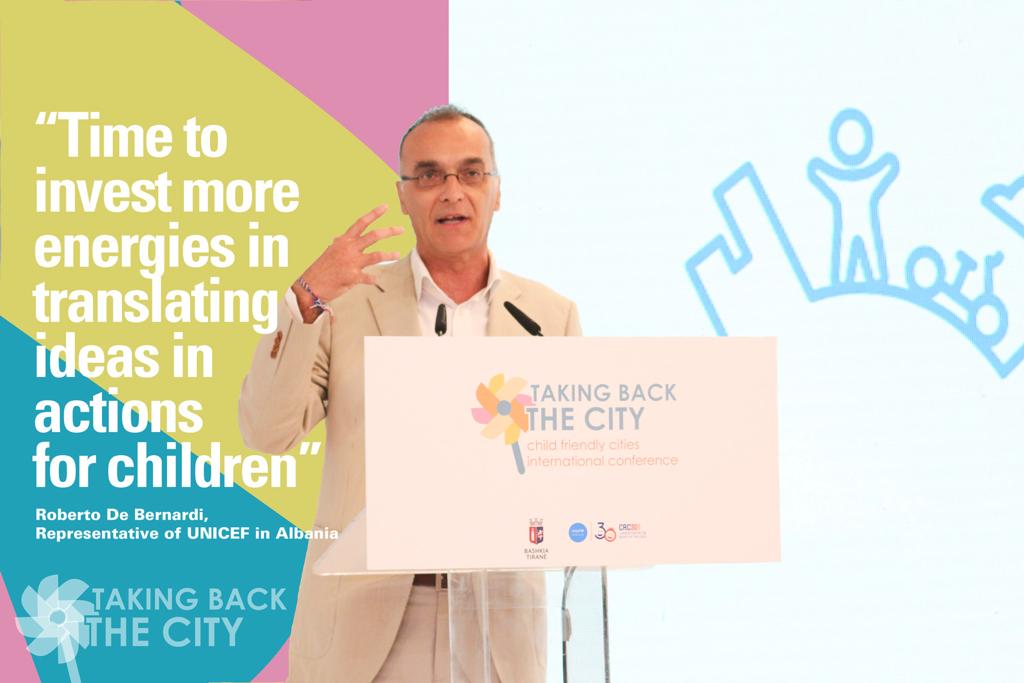
“The involvement of civil society, especially child-focused and youth-led organizations, is crucial to avoid that the initiative becomes technocratic and loses sight of the concerns and needs of communities, families and children themselves. The balance in power is important to ensure the initiative does not become a victim of shifting political priorities in local governments, which makes building long-term change for children difficult,” says representative of UNICEF in Tirana Roberto de Bernardi

By Genc Mlloja 

Senior Diplomatic Editor 

“If I attempt to encapsulate the description of the Child Friendly Cities in one sentence, it would be that: ‘the child friendly city makes it possible for children to flourish in their lives as new citizens and provides for every child’s needs’.” 

The representative of UNICEF in Tirana, Roberto de Bernardi made that description in an exclusive interview with Albanian Daily News explaining the Initiative on Child Friendly Cities which was first launched in 1996. 

UNICEF has tried to give an answer to the questions and challenges confronting the worldwide attempt to promote children’s rights. 

“A child friendly city is a place where every child and their families thrive and enjoy vibrant, prosperous and healthy lives,” said Mr. Bernardi in his explanation on the benefits of such an outstanding endeavor. 

In addition he said that nowadays investments to create Child Friendly Cities would require politicians and policymakers willing to invest in children to receive long-term benefits, therefore, it calls for decisions that are forward looking. “Planning for a child friendly city begins with the understanding of how such a city could enhance the experience of childhood and provide benefits for the years to follow. The benefits spill over to all generations living today and tomorrow, since the children of the today are the youth and the adults of the future.”

Albania has not yet joined such an Initiative even though it is part of the Convention on the Right of the Child. 

But, the UNICEF senior envoy to Tirana was fully aware that there is much to be done by all actors to transform communities/neighborhoods and cities child friendlier in Albania. “While this work is ongoing, UNICEF will advocate to establish the governance mechanism that would recognize positive efforts in this regard and certify officially child friendly cities in Albania,” said the representative of UNICEF in Tirana, Roberto de Bernardi in the following interview: 

-It is a great pleasure to having this opportunity to learn something in detail on different aspects about what a child-friendly city is. Please can you share with ADN’s readers some opinions on this? 

-Globally, the Child Friendly Cities Initiative was launched in 1996 by UNICEF to respond to the challenge of realizing the rights of children in an increasingly urbanized and decentralized world. Since then it has been adapted to suit different cultures and contexts, but always maintaining its interconnection with the Convention on the Rights of the Child, and later, when introduced, with the Sustainable Development Goals.

At UNICEF, we define Child Friendly City/Community as a local system of good governance committed to fulfilling children’s rights. It is a city/community where the voices, needs, priorities and rights of children are an integral part of public policies, programmes and decisions.

Various recurrent themes characterize Child Friendly Cities, mostly related to child-friendly urban design; natural environment; independent mobility; health and well-being; open spaces and recreation; children’s participation; education and learning.

If I attempt to encapsulate the description in one sentence, it would be that: ‘the child friendly city makes it possible for children to flourish in their lives as new citizens and provides for every child’s needs’

-To speak in concrete terms which are some of the benefits for children living in a Child Friendly City?

–

To start with, a city friendly for children, is friendly to all. That is the prime benefit of planning the city having the youngest in the focus.

In a child friendly city, children are safe and protected from exploitation, violence and abuse; they have a good start in life and grow up healthy and cared for; have access to essential services; experience quality, inclusive and participatory education and skills development; live in a clean, unpolluted and safe environment with access to green spaces; meet friends and have places to play and enjoy themselves; have a fair chance at life regardless of their ethnic origin, religion, income, gender or ability.

A child friendly city is a place where every child and their families thrive and enjoy vibrant, prosperous and healthy lives.

-How is UNICEF going to help local government to introduce the concept of Child Friendly City in Albania?

-UNICEF will continue to support the state at national and local level through the ongoing implemented strategies / approaches, including: Child-friendly policies and legal frameworks; Cross-sectorial coordination and partnerships; Communication, awareness raising and advocacy; Inclusive child participatory mechanisms and processes; Collection of data and evidence generation; Capacity building to create sustainable results for children.

The Child-Friendly Cities initiative has to be institutionalized, through various mechanisms at national and local level. The accreditation system of Child-Friendly cities would require municipalities, to start with, the conduct of situation analysis of children, training of various professionals with the principles of child-responsive policies, development, implementation and monitoring of actions plans with clear objectives, activities, indicators and budget allocation for key areas/components; whilst all of these activities need to include the voices of children.

UNICEF intends to be an advocate and support of relevant stakeholders along all these processes, upholding the child-rights approach.

– Why, in your opinion, should politicians and policymakers invest in Child Friendly Cities?  

-Nowadays investments to create Child Friendly Cities would require politicians and policymakers willing to invest in children to receive long-term benefits, therefore, it calls for decisions that are forward looking.


Planning for a child friendly city begins with the understanding of how such a city could enhance the experience of childhood and provide benefits for the years to follow. The benefits spill over to all generations living today and tomorrow, since the children of the today are the youth and the adults of the future.

I would like to minimally outline five benefits or positive outcome components if we invest today for child friendly cities:

Child-friendly cities support children to grow healthy and strong.

Child-friendly cities ensure children are safe and risk-prepared.

Child-friendly cities ensure a decent standard of living with access to education and learning opportunities.

Child-friendly cities empower children to participate in decision-making to encourage civic trust, engagement and connectivity.

Child-friendly cities ensure children live in a sustainable and climate-resilient environment

Each of these benefits reflect the mutual interaction between a child and the built environment: a child as a receiver of a service and required support, but also as a participant who learns to takes action. These benefits, and guidance on how to achieve them, help cities to make children’s rights and children’s needs a central tenet of their work.

Image

–Could you please unveil the ‘map’ of the location of such cities if there is any in Albania? 

-There is not yet such a ‘map’. We are fully aware that there is much to be done by all actors to transform our communities/neighborhoods and cities child friendlier.

While this work is ongoing, UNICEF will advocate to establish the governance mechanism that would recognize positive efforts in this regard and certify officially child friendly cities in Albania.

–Does the civil society and media have a role to play in this endeavor, that is what contribution can they play? 

-The media constitute important partners in promoting and advocating for Child Friendly Cities. The media are also important platforms for engaging children in local TV and radio programmes, newspapers and social media. They can make significant contributions to promoting and spreading information, gathering feedback and organizing local campaigns through social media.

Partnering with civil society organizations (and the public) has the advantage that it allows concerned citizens to advocate for improvements for children with the local government, just as citizens can help implement child rights through their daily interactions with children in the city.

The involvement of civil society, especially child-focused and youth-led organizations, is crucial to avoid that the initiative becomes technocratic and loses sight of the concerns and needs of communities, families and children themselves. 

The balance in power is important to ensure the initiative does not become a victim of shifting political priorities in local governments, which makes building long-term change for children difficult./ADN
Related Posts

Current Events

Serbia – China 2026: Technological partnership, geopolitical positioning and a new phase of the Chinese presence in the Western Balkans

1 June, 2026
ENGLISH

IBAR? ”Sufficiently! Much ado about nothing! Shart contrasts in Beijing! Where is the exit?!

1 June, 2026
ENGLISH

How Alkida Lushaj is redefining democratic inclusion globally

31 May, 2026

Follow US

Subscribe

Receive Argumentum Magazine by Email

Last Posts

Serbia – China 2026: Technological partnership, geopolitical positioning and a new phase of the Chinese presence in the Western Balkans

1 June, 2026

IBAR? ”Sufficiently! Much ado about nothing! Shart contrasts in Beijing! Where is the exit?!

1 June, 2026

How Alkida Lushaj is redefining democratic inclusion globally

31 May, 2026

Cyber Attribution, Corruption, and the False-Flag Question in Albania’s 2022 Alleged Iranian Cyberattack

30 May, 2026

The Digital Protectorate: How the EU AI Act Codified Silicon Valley’s Monopoly

30 May, 2026
Argumentum

“Argumentum”, një proces intelektual …

Contact Us

[email protected]
[email protected]
[email protected]

Follow Us

Media Partner

Register

Receive Argumentum Magazine by Email
  • Home
  • Privacy Policy
  • About Us
  • Contact

© 2022 Argumentum. All Rights Reserved. | NUIS: L91415033Q

Welcome Back!

Login to your account below

Forgotten Password? Sign Up

Create New Account!

Fill the forms bellow to register

*By registering into our website, you agree to the Terms & Conditions and Privacy Policy.
All fields are required. Log In

Retrieve your password

Please enter your username or email address to reset your password.

Log In

Add New Playlist

No Result
View All Result
  • Home
  • OP/ED
  • Interview
  • Realpolitik
  • Current Events
  • Top News
  • YOUR VOICE
  • Shqip

© 2022 Argumentum. All Rights Reserved. | NUIS: L91415033Q

This website uses cookies. By continuing to use this website you are giving consent to cookies being used. Visit our Privacy and Cookie Policy.