










































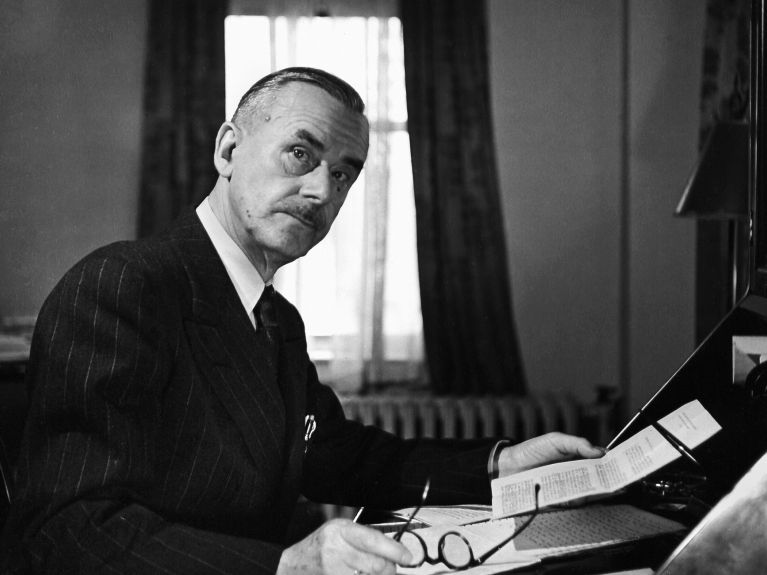
Europe Between Humanism, Decadence, and Totalitarian Threat
By Zlatko Kramarić*|ARGUMENTUM
Thomas Mann (1875–1955) explored the tension between Europe’s humanistic tradition and its destructive tendencies. His concept of the “European spirit” is critical and reflective; Europe is a space of high culture, moral responsibility, and ongoing struggle with inner demons, manifested as decadence and totalitarianism.
1. Europe as the Home of Humanistic Tradition
In early works such as Buddenbrooks (1901), Mann depicts Europe as a space of civic humanism, ethical discipline, and cultural sophistication. The Buddenbrook family saga symbolizes civilizational decline through internal decadence and alienation from cultural roots.^1
The European spirit encompasses:
German and Central European classical tradition – Goethe, Schiller;
Greek and Christian humanist foundations;
The value of art, reason, and freedom of thought.
Civilization based on art and knowledge survives only if critically aware of its vulnerabilities.^2,^3
2. Decadence in Mann’s Prose
In Death in Venice (1912) and The Magic Mountain (1924), decadence is a civilizational symptom, not merely an aesthetic motif.
Death in Venice: Aschenbach’s obsession with young Tadzio symbolizes fascination with beauty that becomes destructive.^4
The Magic Mountain: the Davos sanatorium acts as a laboratory of Europe, where reason and passion, modernism and tradition intersect, showing decadence as precursor to catastrophe.^5
Societies losing internal discipline and critical awareness become fertile ground for totalitarian ideologies.
3. Totalitarianism as a Threat
Mann’s stance evolved with his personal and intellectual journey. The rise of Hitler made him a consistent intellectual opponent of fascism and Nazism.
Totalitarianism is:
1. A perversion of the spirit;
2. An aestheticization of politics;
3. A collectivist cult of death;
4. Barbarism in rational form.
In Doctor Faustus (1947), Mann links Adrian Leverkühn’s musical modernism to Nazism. Leverkühn’s genius and moral crisis reflect the German spirit: fascinating yet destructive if detached from ethics.^6,^7
4. The European Spirit: Critical Awareness
Mann’s European spirit includes:
Self-critique and reflection;
Defense of the individual and art;
Opposition to autocratic ideologies;
Responsibility of intellectuals.^8
Europe is a continent balancing creation and destruction, learning from its catastrophes.
5. Reception and Influence
Influenced writers:
Miroslav Krleža – social and cultural realism;
Danilo Kiš – critique of historical memory;
Milan Kundera – ironic reflection on Europe and freedom;
W. G. Sebald and Claudio Magris – postmodern reflection through ruins and memory.^9,^10
Adam Michnik emphasizes Mann’s anti-totalitarian message and Europe as a space of critical self-awareness.^11
6. Selected Quotes from Mann’s Essays and Lectures
“Europe is a civilization that must not lose critical consciousness; every illusion and decadence leads to barbarism.” (Essays on European Culture, 1926)^12
“Culture and freedom of thought are the only shields against tyranny and ideologies of death.” (Reflections of a Nonpolitical Man, 1918)^13
“Totalitarianism begins where art and morality are separated, where aesthetics outweigh ethics.” (Doctor Faustus, 1947)^14
Conclusion
Thomas Mann sees Europe as a continent in perpetual struggle between humanism and destructive impulses, culture and decadence. His “European spirit” rests on:
critical awareness;
defense of freedom and art;
moral responsibility of intellectuals.
Mann’s work is a prophetic compass, warning against totalitarianism and decadence, offering a model of Europe learning from its history and vulnerabilities.
1. Mann, Thomas. Buddenbrooks. Frankfurt: S. Fischer Verlag, 1901.
2. Mann, Thomas. Reflections of a Nonpolitical Man. London: George Allen & Unwin, 1918.
3. Broch, Hermann. The Crisis of European Culture. New York: Viking Press, 1930.
4. Mann, Thomas. Death in Venice. Berlin: S. Fischer Verlag, 1912.
5. Mann, Thomas. The Magic Mountain. Berlin: S. Fischer Verlag, 1924.
6. Mann, Thomas. Doctor Faustus. Zurich: S. Fischer Verlag, 1947.
7. Steiner, George. Language and Silence: Essays on Language, Literature and the Inhuman. London: Faber & Faber, 1998.
8. Mann, Thomas. Essays on European Culture. Frankfurt: S. Fischer, 1925–1940.
9. Kiš, Danilo. A Tomb for Boris Davidovich. London: Harvill, 1976.
10. Sebald, W. G. Austerlitz. London: Hamish Hamilton, 2001; Magris, Claudio. Microcosms. London: Harvill, 1997.
11. Michnik, Adam. „Europe as a Moral Space.“ Gazeta Wyborcza, 1981.
12. Mann, Thomas. Essays on European Culture, 1926, 45.
13 Mann, Thomas. Reflections of a Nonpolitical Man, 1918, 112.
14. Mann, Thomas. Doctor Faustus, 1947, 233.
*Zlatko Kramarić is a Croatian publicist, author, and diplomat, currently serving as Ambassador to Albania. Formerly a university professor and politician, he is known for his work in literature, cultural studies, and regional history.
© 2025 Argumentum