

































Altin Gjeta
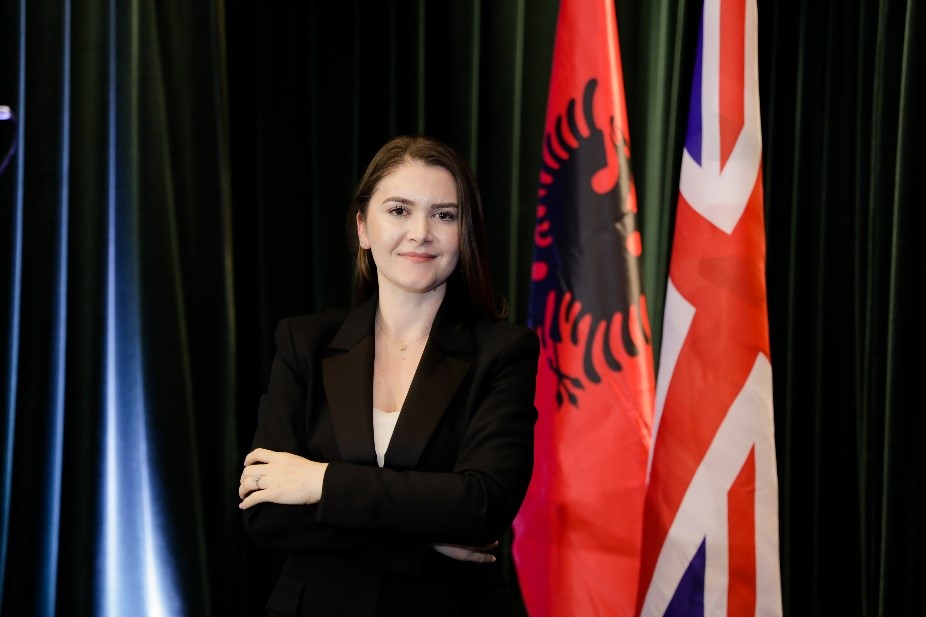
Democracy has been in retreat for decades. What seemed like the natural direction towards inclusion, accountability and openness has become a nemesis for many liberal democratic minded people. Yet there are people who defy the downward trend of democracy. This is Alkida Lushaj, a young democracy promotion professional working across countries and programs
Alkida started from scratch. She has had many firsts in her career, establishing the first Parliamentary Youth Club in Albania, first platform for reporting violence against women in Albanian politics and first scholarship-to-employment pipeline connecting Albanian university students directly to the country’s banking sector. She is one of very few people from the entire Western Balkans region, to receive the Westminster Foundation for Democracy’s Impact and Innovation Award.
She worked as Program Manager at the Westminster Foundation for Democracy in Albania, where she overseeing a portfolio of governance reform initiatives that span parliamentary strengthening, youth civic engagement, and women’s political participation. But titles and portfolios tell only a fraction of the story. What matters more is what she has actually built.
The Parliamentary Youth Club is an illustration of success. When Lushaj first proposed creating a formal dialogue mechanism between Albania’s parliament and its young citizens, the idea was not universally welcomed. Parliaments are conservative institutions by nature. Getting 24 Members of Parliament to commit to structured, regular engagement with young people required the kind of persistent, politically sophisticated negotiation that most development professionals never attempt. She attempted it. She succeeded. And when the club was launched in 2022, it worked not just as an event or a pilot project, but as a permanent institutional structure embedded in Albania’s national parliament. Hundreds of young Albanians, many of whom had never set foot in a parliamentary building, found themselves sitting across a table from their elected representatives, debating actual policy.
North Macedonia saw what was happening in Albania and built their own version. Then the Maldives called in.
Alkida’s work on gender and politics has been equally tangible. The StopVAWP platform she launched, designed to give women in Albanian political life a formal way to report election-period harassment and violence, addressed a problem everyone acknowledged, but nobody had guts to tackle it. Albania now has institutional infrastructure for protecting women’s political participation that many older wealthier democracies still lack.
The professional achievements are driven by Alkida’s academic credentials. She holds degrees in political science from the University of Tirana and the University of Istanbul and has contributed to internationally supported research on Albania’s communist past, specifically the regime’s construction of the so-called “New Communist Man” published with support from the Czech Ministry of Foreign Affairs and the Institute for Political Studies. She has lectured at the University of New York Tirana and presented her work at forums across Europe, USA and beyond.
And yet what defines Alkida professionally is not what she has studied or where she has presented her work. The real cruck is what she has built, and the fact that what she built keeps being replicated in countries she has never lived in. Alkida has made a change in Albania, in North Macedonia, and remarkably in the far-flung pristine island of Maldives.
© 2026 Argumentum