












• SHQIPËRI
  • KOSOVË
  • MAQEDONIA E VERIUT
  • MALI I ZI
  • Revista në PDF
2 September, 2026
 
  • Home
  • OP/ED

    The Reconfiguration of Maritime Governance: Structural Hegemonic Decline and the Arctic Pivot

    Between Political Calculation and Retreat: Croatian Communists at the End of an Era

    The West is buying time, but to whom is it giving it?

    27 July 1941 – A Site of Memory Between War, Revolution and Europe

    The cult of Saint Veneranda / Saint Pren(d)a / Saint Premte / Saint Paraskeva among Albanians

    The Self-Inflicted Decoupling: How U.S. Immigration Policy Is Ceding the Tech Edge to China

    The Blueprint Does Not Stop at the Drina

    The Underlying Logic behind China’s Economic Success

    Do Not Misuse the U.S. Declaration of Independence to Justify the Narrative of Insurrection in Albania

  • Interview

    Exclusive Interview with Oleksandr Tyshchenko: A 40-Year Legacy of Chernobyl, Nuclear Risks, and Global Responsibility

    INTERVIEW: ZLATKO KRAMARIĆ – THOUGHTS ON THE OLD CONTINENT

    EXCLUSIVE / Ukrainian Ambassador to Albania, Volodymyr Shkurov: “Ukraine wants peace, but not at the expense of its freedom and independence”

    EXCLUSIVE| Ambassador Tayyar Kagan Atay: Türkiye and Albania, a Strategic Partnership Rooted in Shared Heritage and a Common Vision for the Future

    “Diplomacy, Not War”: Palestinian Ambassador to Albania Calls for Justice, Peace, and Global Action for Gaza

    Exclusive: “Even After Tito – Tito”/ Ambassador Zlatko Kramarić on Authoritarian Legacies and Democracy’s Future in the Balkans

    The Conclusion of the Diplomatic Mission / Ambassador Dancho Markovski: Strengthening Albania-North Macedonia Relations for a Shared European Future

    A Century of Diplomatic Relations Between Albania and Russia: Exclusive Interview with the Russian Ambassador to Albania, H.E. Alexey Zaytsev

    Exclusive/ The chairman of the Freedom Party, Ilir Meta: “The will of the citizens will triumph in Albania, as it did in North Macedonia”

  • Realpolitik

    Belgrade, Zelensky and the Consulates! The European Pact takes water! Drone in Leipzig and hybrid war! Why a  ceasefire is needed in September

    The Summit of Unity! Think of peace and prepare for war! It’s only the start to the end! Just a pause between two wars!

    Peace with war diplomacy! The protest,  image and tourism! Why this silence from the EU Commission and Council? A deal or a pause?

    Just kind words  in Tivat! Where is the peace!? A deal yes, peace No!What is happening with USA and  EU?  5 elections but no solution!

    IBAR? ”Sufficiently! Much ado about nothing! Shart contrasts in Beijing! Where is the exit?!

    Neither peace nor war! Peace with bombs?! IBAR in autumn?! Not another Hormuz in Taivan! 

    IBAR – a springing board or an obstacle? Can we catch the EU Negotiation train 2027? When the dress makes the news!  EU electoral April  ends in a draw 1:1!  

    The European Parliament building in Strasbourg, France with flags waving calmly celebrating peace of the Europe. July 12, 2020.

    EU 2027 or 2037! Even half membership failed! No exit strategy!     

    What next?

  • Current Events

    Albanian Opposition Leader Sali Berisha to Return to U.S. Five Years After Entry Ban

    Bekim Sejdiu Named Consensus Candidate for Kosovo Presidency

    President Begaj Receives New Dutch Ambassador Marleen Monster

    Albania on Alert: Bomb Threats Target Several Institutions

    Belgium Opens First-Ever Embassy in Tirana, Strengthening Bilateral Ties

    MEFA: Albania Successfully Repatriates Five Citizens, Including Women and Children, from Syria

    Hoxha: A Modern Diplomacy for a European Albania

    The Delayed Awakening: Realpolitik and the Structural Causes of European Stagnation

    Democracy Cannot Be Governed by Noise

  • Top News

    Albania Plans Distribution of 17,000 Textbooks to Albanian Diaspora for 2026–2027 School Year

    Belgium Opens First-Ever Embassy in Tirana, Strengthening Bilateral Ties

    US Launches Economic Offensive Against Iran, Bessent Warns Countries to Cut Tehran’s Lifelines

    Rama, Vučić, Zelensky: Where Is Albania’s National Interest?

    Council of Albanian Ambassadors Raises Concern Over Serbian Plan to Alter the Ibër River

    Rama: Foreign Information Manipulation Has Become One of the Greatest Threats to Democracy and European Security

    The Council of Albanian Ambassadors condemns chauvinistic rhetoric by Serbian officials and calls for diplomatic action

    NATO at Ankara 2026: Strategic Rebalancing Between Russia Deterrence, Turkey’s Rise, and National Interests

    Daniel Serwer: A Bad War Ending Badly May Still Be Good News

  • YOUR VOICE
  • ARGUMENTUM MAGAZINE
  • Shqip
No Result
View All Result
Argumentum
  • Home
  • OP/ED

    The Reconfiguration of Maritime Governance: Structural Hegemonic Decline and the Arctic Pivot

    Between Political Calculation and Retreat: Croatian Communists at the End of an Era

    The West is buying time, but to whom is it giving it?

    27 July 1941 – A Site of Memory Between War, Revolution and Europe

    The cult of Saint Veneranda / Saint Pren(d)a / Saint Premte / Saint Paraskeva among Albanians

    The Self-Inflicted Decoupling: How U.S. Immigration Policy Is Ceding the Tech Edge to China

    The Blueprint Does Not Stop at the Drina

    The Underlying Logic behind China’s Economic Success

    Do Not Misuse the U.S. Declaration of Independence to Justify the Narrative of Insurrection in Albania

  • Interview

    Exclusive Interview with Oleksandr Tyshchenko: A 40-Year Legacy of Chernobyl, Nuclear Risks, and Global Responsibility

    INTERVIEW: ZLATKO KRAMARIĆ – THOUGHTS ON THE OLD CONTINENT

    EXCLUSIVE / Ukrainian Ambassador to Albania, Volodymyr Shkurov: “Ukraine wants peace, but not at the expense of its freedom and independence”

    EXCLUSIVE| Ambassador Tayyar Kagan Atay: Türkiye and Albania, a Strategic Partnership Rooted in Shared Heritage and a Common Vision for the Future

    “Diplomacy, Not War”: Palestinian Ambassador to Albania Calls for Justice, Peace, and Global Action for Gaza

    Exclusive: “Even After Tito – Tito”/ Ambassador Zlatko Kramarić on Authoritarian Legacies and Democracy’s Future in the Balkans

    The Conclusion of the Diplomatic Mission / Ambassador Dancho Markovski: Strengthening Albania-North Macedonia Relations for a Shared European Future

    A Century of Diplomatic Relations Between Albania and Russia: Exclusive Interview with the Russian Ambassador to Albania, H.E. Alexey Zaytsev

    Exclusive/ The chairman of the Freedom Party, Ilir Meta: “The will of the citizens will triumph in Albania, as it did in North Macedonia”

  • Realpolitik

    Belgrade, Zelensky and the Consulates! The European Pact takes water! Drone in Leipzig and hybrid war! Why a  ceasefire is needed in September

    The Summit of Unity! Think of peace and prepare for war! It’s only the start to the end! Just a pause between two wars!

    Peace with war diplomacy! The protest,  image and tourism! Why this silence from the EU Commission and Council? A deal or a pause?

    Just kind words  in Tivat! Where is the peace!? A deal yes, peace No!What is happening with USA and  EU?  5 elections but no solution!

    IBAR? ”Sufficiently! Much ado about nothing! Shart contrasts in Beijing! Where is the exit?!

    Neither peace nor war! Peace with bombs?! IBAR in autumn?! Not another Hormuz in Taivan! 

    IBAR – a springing board or an obstacle? Can we catch the EU Negotiation train 2027? When the dress makes the news!  EU electoral April  ends in a draw 1:1!  

    The European Parliament building in Strasbourg, France with flags waving calmly celebrating peace of the Europe. July 12, 2020.

    EU 2027 or 2037! Even half membership failed! No exit strategy!     

    What next?

  • Current Events

    Albanian Opposition Leader Sali Berisha to Return to U.S. Five Years After Entry Ban

    Bekim Sejdiu Named Consensus Candidate for Kosovo Presidency

    President Begaj Receives New Dutch Ambassador Marleen Monster

    Albania on Alert: Bomb Threats Target Several Institutions

    Belgium Opens First-Ever Embassy in Tirana, Strengthening Bilateral Ties

    MEFA: Albania Successfully Repatriates Five Citizens, Including Women and Children, from Syria

    Hoxha: A Modern Diplomacy for a European Albania

    The Delayed Awakening: Realpolitik and the Structural Causes of European Stagnation

    Democracy Cannot Be Governed by Noise

  • Top News

    Albania Plans Distribution of 17,000 Textbooks to Albanian Diaspora for 2026–2027 School Year

    Belgium Opens First-Ever Embassy in Tirana, Strengthening Bilateral Ties

    US Launches Economic Offensive Against Iran, Bessent Warns Countries to Cut Tehran’s Lifelines

    Rama, Vučić, Zelensky: Where Is Albania’s National Interest?

    Council of Albanian Ambassadors Raises Concern Over Serbian Plan to Alter the Ibër River

    Rama: Foreign Information Manipulation Has Become One of the Greatest Threats to Democracy and European Security

    The Council of Albanian Ambassadors condemns chauvinistic rhetoric by Serbian officials and calls for diplomatic action

    NATO at Ankara 2026: Strategic Rebalancing Between Russia Deterrence, Turkey’s Rise, and National Interests

    Daniel Serwer: A Bad War Ending Badly May Still Be Good News

  • YOUR VOICE
  • ARGUMENTUM MAGAZINE
  • Shqip
No Result
View All Result
Argumentum
No Result
View All Result
Home ENGLISH

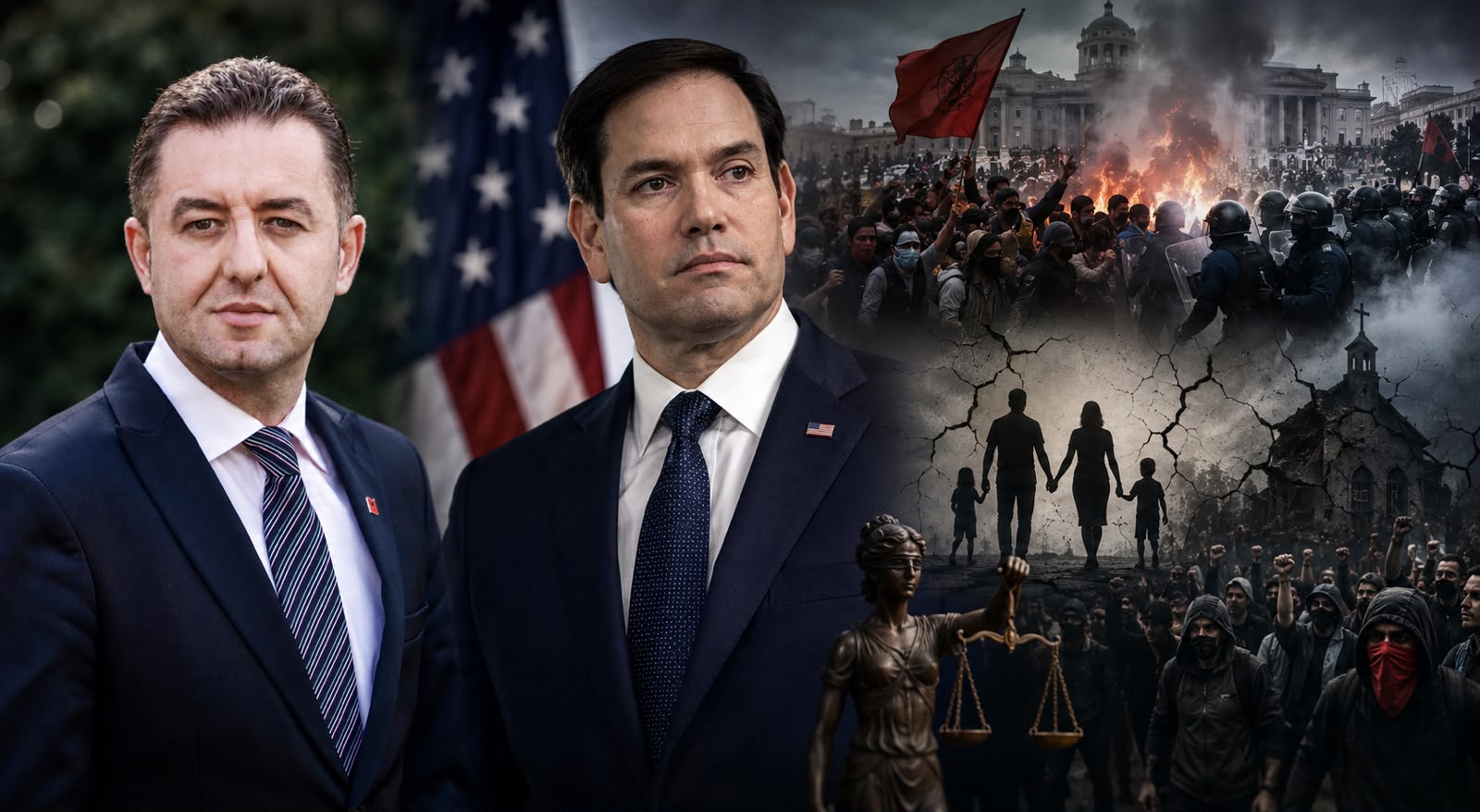
Marco Rubio’s Speech and the Danger of Political Extremism

18 July, 2026
in ENGLISH, In Focus
A A
Share on FacebookShare on Twitter

By Prof. Assoc. Dr. Bledar Kurti

“Today we are facing a new wave of this old evil in the United States. The scale of attacks and terrorist plots from the extreme left has risen to levels not seen in decades… This is a global evil. It has always been fueled by hatred—above all, hatred toward civilization itself. It is the revolt of the worst against the best, the revolt of the weak and the cowardly against the strong and the good.”

These recent remarks by Marco Rubio, the United States Secretary of State, have once again brought to the forefront a question that extends far beyond America: Is Western democracy entering a new era of political polarization and extremism?

The events of recent years suggest that polarization is no longer merely a clash of ideas. In many instances, it has evolved into the demonization of political opponents, the spread of hateful rhetoric, intimidation, and, at times, outright violence. Protests that descend into vandalism, attacks on public institutions, threats against public officials, pressure on universities, and attempts to silence opposing viewpoints have become part of the political landscape across many democracies.

In the United States, debates over race, identity, immigration, abortion, education, and the conflict in the Middle East have created an atmosphere in which dialogue and compromise have often given way to confrontation. In some cases, demonstrations organized by radical groups have crossed the line from civil disobedience into acts of violence and the destruction of public and private property. At the same time, American authorities have repeatedly warned that threats to homeland security may originate from various forms of extremism, regardless of ideological orientation.

The radically inhumane comments made by some Western individuals following the assassination attempt on President Donald Trump and the murder of activist Charlie Kirk were unprecedented and, in many respects, resembled the rhetoric commonly associated with terrorist groups or extremist regimes in distant parts of the world. This type of radicalization threatens public security, social cohesion, and democracy itself.

Europe is by no means immune to this phenomenon. In Germany, France, Italy, Greece, Spain, and elsewhere, political tensions have intensified due to immigration, economic uncertainty, the war in Ukraine, and conflicts in the Middle East. Universities and public spaces have witnessed demonstrations where, alongside the legitimate exercise of freedom of expression, extremist slogans, acts of vandalism, and efforts to silence opposing voices have also emerged.

Democracy is not weakened by debate; it is weakened when debate is replaced by fear and intimidation.

The Balkans are no exception. Our region has a long history of political and ideological polarization. Rather than viewing political opponents as legitimate competitors in a democratic contest, they are often treated as sworn enemies. This mentality fosters a culture of division that leaves societies increasingly vulnerable to extremism of every kind.

One of the most visible consequences of ideological radicalization is the growing tension surrounding society’s foundational institutions. Across many Western countries, debates over the family, children’s education, gender identity, and the role of religion have become increasingly confrontational. Some radical currents on the left have viewed religion and the traditional family as institutions that should be fundamentally challenged or transformed. Conversely, radical movements on the right have responded with exclusionary and nationalist rhetoric, further deepening societal divisions.

In both cases, dialogue becomes the casualty.

Democratic societies are not built by dismantling institutions but by reforming and strengthening them. The family remains the primary institution where responsibility, solidarity, and respect for others are learned. Religious faith, for millions of people, continues to serve as a source of hope, moral guidance, and social cohesion. Attacking and demonizing these institutions does not create a more just society. On the contrary, it contributes to social fragmentation and decline.

It is essential to distinguish clearly between political convictions and political extremism. Democracy needs both the left and the right.

Historically, the political left has made significant contributions to the protection of social rights, workers’ rights, equality before the law, and the welfare of society’s most vulnerable members. Without the left, many of the social reforms that are now taken for granted would never have occurred.

The political right, on the other hand, has defended the importance of individual liberty, the free-market economy, constitutional order, personal responsibility, and the preservation of traditions that provide continuity and stability within society.

Democracy functions precisely because these two visions compete peacefully, correct one another, and create balance. It is a balance achieved through the competition of ideas—not through confrontation, polarization, or demonization. The problem arises when either side loses the ability to recognize the legitimacy of the other.

History teaches us that extremism never builds lasting societies. It first destroys trust, then institutions, and ultimately the very freedom it claims to defend. When political opponents are no longer regarded as fellow citizens with differing opinions, but as enemies to be eliminated, democracy begins to lose its meaning.

The greatest challenge of our time, therefore, is not the triumph of the left over the right or the right over the left. The real challenge is the triumph of reason over fanaticism, dialogue over hatred, and democratic institutions over extremism.

A free society does not require uniformity of thought. It requires pluralism, mutual respect, and the ability to coexist despite differences. Only under these conditions can politics remain a means of building the future rather than a weapon for destroying it.

History also teaches us that totalitarianism does not arise from a single ideology alone. It emerges whenever any ideology becomes convinced that it alone has the right to speak. The twentieth century demonstrated this through both communism and fascism. The democracies of the twenty-first century must ensure that the same logic does not return under new labels.

“The time has come for the peoples of the civilized world to defend themselves—to stand united against this advancing darkness and fight for what is rightfully theirs,” Secretary Rubio concluded. It is a powerful appeal, one that must be accompanied by concrete policies from governments around the world to confront political extremism in all its forms.

/Argumentum.al

© 2026 Argumentum

Related Posts

Current Events

Albanian Opposition Leader Sali Berisha to Return to U.S. Five Years After Entry Ban

1 September, 2026
ENGLISH

The Illyrians, Skanderbeg and Religion: Anatomy of an Identity War

1 September, 2026
ENGLISH

Council of Albanian Ambassadors, supports the candidacy of Ambassador Bekim Sejdiu for President of the Republic of Kosova.

31 August, 2026

Follow US

Subscribe

Receive Argumentum Magazine by Email

Last Posts

Albanian Opposition Leader Sali Berisha to Return to U.S. Five Years After Entry Ban

1 September, 2026

The Illyrians, Skanderbeg and Religion: Anatomy of an Identity War

1 September, 2026

Council of Albanian Ambassadors, supports the candidacy of Ambassador Bekim Sejdiu for President of the Republic of Kosova.

31 August, 2026

Bekim Sejdiu Named Consensus Candidate for Kosovo Presidency

31 August, 2026

Germany Reacts to Iceland’s Rejection of EU Talks: “The EU Must Become More Attractive”

31 August, 2026
Argumentum

“Argumentum”, një proces intelektual …

Contact Us

[email protected]
[email protected]
[email protected]

Follow Us

Media Partner

Register

Receive Argumentum Magazine by Email
  • Home
  • Privacy Policy
  • About Us
  • Contact

© 2022 Argumentum. All Rights Reserved. | NUIS: L91415033Q

Welcome Back!

Login to your account below

Forgotten Password?

Retrieve your password

Please enter your username or email address to reset your password.

Log In

Add New Playlist

No Result
View All Result
  • Home
  • OP/ED
  • Interview
  • Realpolitik
  • Current Events
  • Top News
  • YOUR VOICE
  • ARGUMENTUM MAGAZINE
  • Shqip

© 2022 Argumentum. All Rights Reserved. | NUIS: L91415033Q

This website uses cookies. By continuing to use this website you are giving consent to cookies being used. Visit our Privacy and Cookie Policy.