











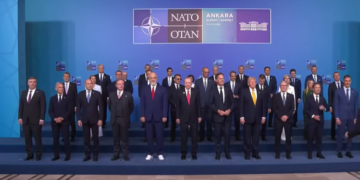










G7 leaders concluded their summit in Évian with a wide-ranging geopolitical declaration addressing the war in Ukraine, tensions in the Middle East, security in the Indo-Pacific, energy resilience, and global economic stability. The statement reflected a common effort by the world’s leading industrialized democracies to respond to a series of interconnected international crises while reinforcing support for partners and defending the rules-based international order.
Stronger Support for Ukraine
Ukraine remained at the center of the summit’s geopolitical agenda. G7 leaders reaffirmed their unwavering support for Ukraine’s freedom, sovereignty, and territorial integrity and expressed solidarity with the Ukrainian population, particularly those affected by attacks on critical infrastructure and cultural heritage.
The leaders praised Ukraine’s resilience and recent progress on the battlefield, arguing that a new momentum has emerged in the conflict. To reinforce this momentum, they agreed to increase the delivery of air-defense capabilities, additional military systems and interceptors, and long-range capabilities. The declaration also signaled openness to expanding licensing arrangements that would enable greater military production within Ukraine itself.
Energy security was identified as another key priority. Leaders committed to supporting Ukraine’s energy resilience and helping the country meet its needs through the coming winter. At the same time, the G7 pledged to intensify pressure on Russia’s war economy through strengthened sanctions, including measures targeting the Russian oil and gas sectors.
Middle East Diplomacy and Security
The summit declaration devoted significant attention to the Middle East, where leaders highlighted what they described as a new diplomatic opportunity following an agreement between the United States and Iran.
G7 members welcomed the announcement of a deal intended to prevent Iran from acquiring nuclear weapons and to address concerns regarding its ballistic missile program and regional activities. Leaders expressed their readiness to support the implementation of the agreement and emphasized that Iran must never obtain a nuclear weapon.
The declaration also underscored the strategic importance of the Strait of Hormuz, one of the world’s most critical maritime trade corridors. Leaders reaffirmed that unrestricted transit passage is fundamental to international commerce and supported a multinational maritime initiative led by France and the United Kingdom to help restore confidence in commercial shipping, protect merchant vessels, and verify the removal of any threats to navigation.
Beyond the immediate agreement, G7 leaders called for a broader diplomatic process capable of delivering lasting peace and security across the region. They emphasized the importance of involving regional and international partners, including the International Atomic Energy Agency, in future negotiations aimed at addressing Iran’s nuclear ambitions and regional influence.
Lebanon, Gaza and the West Bank
The declaration also addressed ongoing instability elsewhere in the Middle East.
In Lebanon, G7 leaders supported efforts by Lebanese authorities to strengthen state institutions and establish a monopoly over the use of force. They called for an immediate and robust ceasefire and backed measures aimed at achieving the disarmament of Hezbollah while preserving Lebanon’s territorial integrity and sovereignty through appropriate international security guarantees.
Regarding Gaza, leaders pledged to accelerate humanitarian assistance and reconstruction efforts while supporting the rapid implementation of political and security measures intended to stabilize the situation. They also called for an end to violence in the West Bank, emphasizing the need to prevent further escalation.
Energy Security Beyond Hormuz
Recognizing the vulnerability of global energy markets to disruptions in the Strait of Hormuz, the G7 committed to accelerating efforts to diversify energy supply routes and increase strategic energy reserves.
Leaders stressed the importance of reducing dependence on any single transit corridor and welcomed the prospect of additional energy exports from Canada in the coming years. The commitment reflects broader concerns about energy security following years of geopolitical disruptions affecting global supply chains and commodity markets.
Commitment to a Free and Open Indo-Pacific
The Indo-Pacific region featured prominently in the declaration, with leaders reaffirming their support for a free and open regional order grounded in international law.
The G7 expressed opposition to any unilateral attempts to alter the status quo through force or coercion, particularly in the East and South China Seas and across the Taiwan Strait. Leaders reiterated that disputes in these areas should be resolved peacefully through dialogue and diplomacy.
The language reflects continuing concerns among Western democracies regarding maritime security, freedom of navigation, and growing geopolitical competition in Asia.
Concerns Over North Korea
The declaration also highlighted persistent concerns regarding North Korea’s nuclear and ballistic missile programs.
G7 leaders reaffirmed their commitment to the complete denuclearization of North Korea in accordance with United Nations Security Council resolutions and urged Pyongyang to address the long-standing issue of foreign nationals abducted by the regime.
In addition to traditional security concerns, leaders called for greater international cooperation to counter North Korean cybercrime activities, including cryptocurrency thefts that have increasingly become a source of funding for the country’s sanctioned programs.
Economic Cooperation and Relations with China
Beyond traditional security issues, leaders emphasized the importance of addressing large and persistent global economic imbalances.
The declaration welcomed the Global Convergence for Growth Summit convened by French President Emmanuel Macron and noted the participation of China in discussions aimed at promoting greater economic coordination among major economies.
G7 members stressed their shared interest in reducing economic distortions, improving policy coordination, and preventing the emergence of conditions that could trigger future trade disputes or financial instability. Leaders pledged to continue these discussions within the framework of the G20 during the United States’ upcoming host year and in other international forums.
A Declaration of Strategic Coordination
Taken together, the Évian declaration presents a broad vision of international cooperation spanning security, diplomacy, energy, and economic governance. From Ukraine and the Middle East to the Indo-Pacific and global economic stability, G7 leaders sought to demonstrate unity in confronting a rapidly evolving geopolitical landscape.
The statement reflects an effort not only to respond to immediate crises but also to shape longer-term international cooperation on issues that increasingly connect regional security, economic resilience, energy supplies, and technological change. As conflicts and strategic rivalries continue to reshape global politics, the declaration signals the G7’s intention to remain a central forum for coordinating responses to the challenges facing the international community.
© 2026 Argumentum