









































By Prof. Assoc. Dr. Bledar Kurti
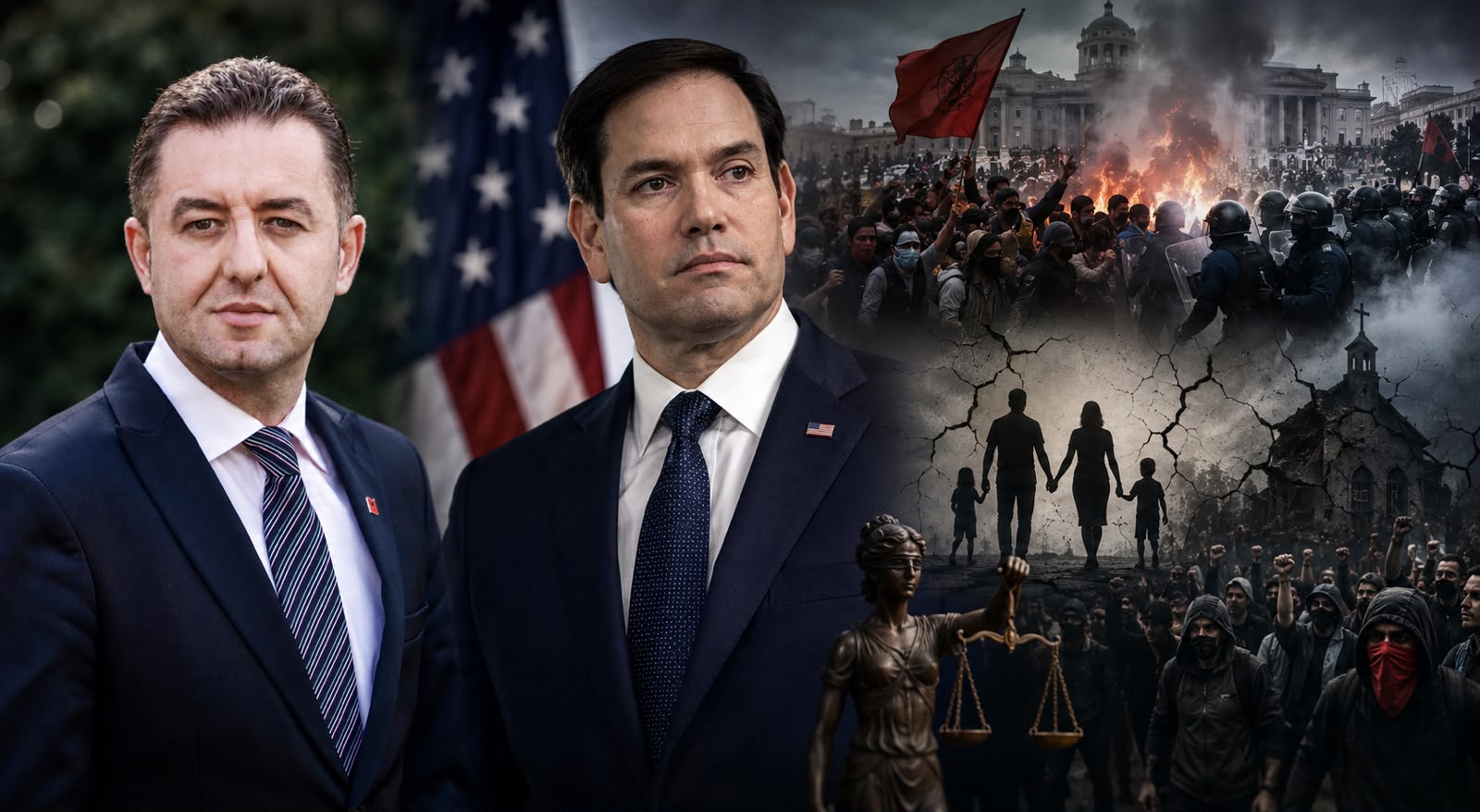
“Today we are facing a new wave of this old evil in the United States. The scale of attacks and terrorist plots from the extreme left has risen to levels not seen in decades… This is a global evil. It has always been fueled by hatred—above all, hatred toward civilization itself. It is the revolt of the worst against the best, the revolt of the weak and the cowardly against the strong and the good.”
These recent remarks by Marco Rubio, the United States Secretary of State, have once again brought to the forefront a question that extends far beyond America: Is Western democracy entering a new era of political polarization and extremism?
The events of recent years suggest that polarization is no longer merely a clash of ideas. In many instances, it has evolved into the demonization of political opponents, the spread of hateful rhetoric, intimidation, and, at times, outright violence. Protests that descend into vandalism, attacks on public institutions, threats against public officials, pressure on universities, and attempts to silence opposing viewpoints have become part of the political landscape across many democracies.
In the United States, debates over race, identity, immigration, abortion, education, and the conflict in the Middle East have created an atmosphere in which dialogue and compromise have often given way to confrontation. In some cases, demonstrations organized by radical groups have crossed the line from civil disobedience into acts of violence and the destruction of public and private property. At the same time, American authorities have repeatedly warned that threats to homeland security may originate from various forms of extremism, regardless of ideological orientation.
The radically inhumane comments made by some Western individuals following the assassination attempt on President Donald Trump and the murder of activist Charlie Kirk were unprecedented and, in many respects, resembled the rhetoric commonly associated with terrorist groups or extremist regimes in distant parts of the world. This type of radicalization threatens public security, social cohesion, and democracy itself.
Europe is by no means immune to this phenomenon. In Germany, France, Italy, Greece, Spain, and elsewhere, political tensions have intensified due to immigration, economic uncertainty, the war in Ukraine, and conflicts in the Middle East. Universities and public spaces have witnessed demonstrations where, alongside the legitimate exercise of freedom of expression, extremist slogans, acts of vandalism, and efforts to silence opposing voices have also emerged.
Democracy is not weakened by debate; it is weakened when debate is replaced by fear and intimidation.
The Balkans are no exception. Our region has a long history of political and ideological polarization. Rather than viewing political opponents as legitimate competitors in a democratic contest, they are often treated as sworn enemies. This mentality fosters a culture of division that leaves societies increasingly vulnerable to extremism of every kind.
One of the most visible consequences of ideological radicalization is the growing tension surrounding society’s foundational institutions. Across many Western countries, debates over the family, children’s education, gender identity, and the role of religion have become increasingly confrontational. Some radical currents on the left have viewed religion and the traditional family as institutions that should be fundamentally challenged or transformed. Conversely, radical movements on the right have responded with exclusionary and nationalist rhetoric, further deepening societal divisions.
In both cases, dialogue becomes the casualty.
Democratic societies are not built by dismantling institutions but by reforming and strengthening them. The family remains the primary institution where responsibility, solidarity, and respect for others are learned. Religious faith, for millions of people, continues to serve as a source of hope, moral guidance, and social cohesion. Attacking and demonizing these institutions does not create a more just society. On the contrary, it contributes to social fragmentation and decline.
It is essential to distinguish clearly between political convictions and political extremism. Democracy needs both the left and the right.
Historically, the political left has made significant contributions to the protection of social rights, workers’ rights, equality before the law, and the welfare of society’s most vulnerable members. Without the left, many of the social reforms that are now taken for granted would never have occurred.
The political right, on the other hand, has defended the importance of individual liberty, the free-market economy, constitutional order, personal responsibility, and the preservation of traditions that provide continuity and stability within society.
Democracy functions precisely because these two visions compete peacefully, correct one another, and create balance. It is a balance achieved through the competition of ideas—not through confrontation, polarization, or demonization. The problem arises when either side loses the ability to recognize the legitimacy of the other.
History teaches us that extremism never builds lasting societies. It first destroys trust, then institutions, and ultimately the very freedom it claims to defend. When political opponents are no longer regarded as fellow citizens with differing opinions, but as enemies to be eliminated, democracy begins to lose its meaning.
The greatest challenge of our time, therefore, is not the triumph of the left over the right or the right over the left. The real challenge is the triumph of reason over fanaticism, dialogue over hatred, and democratic institutions over extremism.
A free society does not require uniformity of thought. It requires pluralism, mutual respect, and the ability to coexist despite differences. Only under these conditions can politics remain a means of building the future rather than a weapon for destroying it.
History also teaches us that totalitarianism does not arise from a single ideology alone. It emerges whenever any ideology becomes convinced that it alone has the right to speak. The twentieth century demonstrated this through both communism and fascism. The democracies of the twenty-first century must ensure that the same logic does not return under new labels.
“The time has come for the peoples of the civilized world to defend themselves—to stand united against this advancing darkness and fight for what is rightfully theirs,” Secretary Rubio concluded. It is a powerful appeal, one that must be accompanied by concrete policies from governments around the world to confront political extremism in all its forms.
© 2026 Argumentum