








































Dr. Ermir I. Hajdini
Legal Analyst & University Lecturer
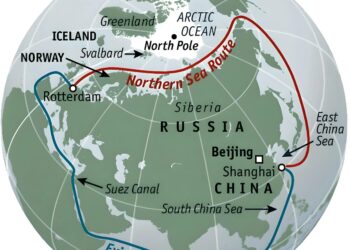
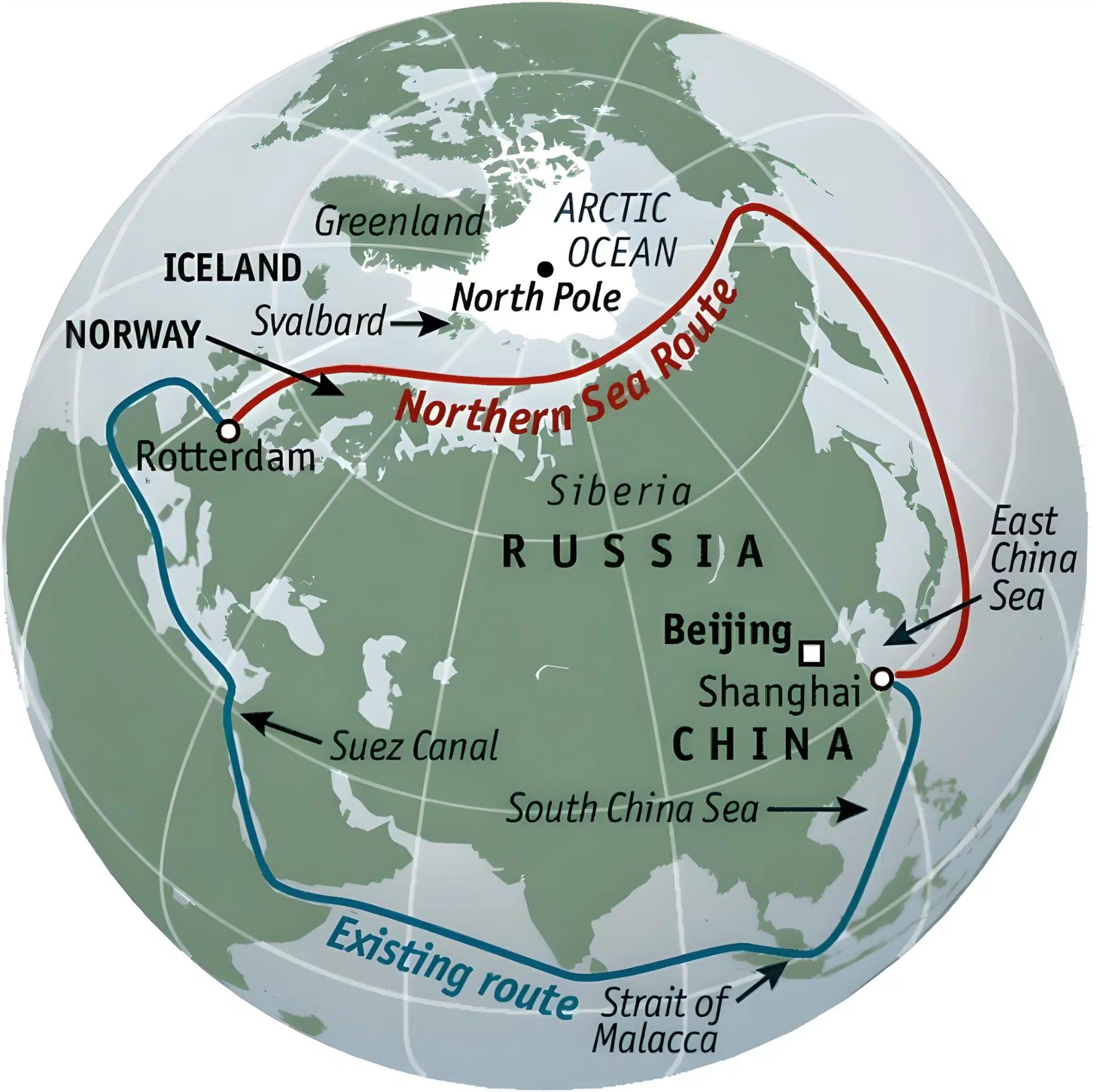
On August 15, 2026, the ice-strengthened container vessel Dubai Tower, operated by Hong Kong-registered carrier Sea Legend Line, departed the Port of Ningbo-Zhoushan to launch the “China-Europe Arctic Express”. Marking the first regularly scheduled, weekly liner service traversing Russia’s Northern Sea Route (NSR) to major Northern European ports—including Felixstowe, Rotterdam, and Hamburg—the voyage represents a critical empirical milestone. By cutting East-West transit times from over 40 days via conventional southern routes down to approximately 18–20 days, this inaugural journey signifies the definitive transition of the Polar Silk Road from a theoretical policy concept into an operationalized commercial reality.
Yet, the commercialization of this Arctic corridor is not merely a story of receding polar ice caps or seasonal supply-chain optimization. Rather, it represents the physical manifestation of a profound geopolitical shift: the structural decay of Pax Americana and the reconfiguration of global maritime governance.
For nearly eight decades, the security architecture underwriting international sea lines of communication (SLOCs) rested on a fundamental paradox. The United States Navy operated as an uncompensated global guarantor of freedom of navigation, policing critical maritime chokepoints—from the Strait of Malacca and the Bab-el-Mandeb to the Strait of Hormuz—while simultaneously retaining absolute power projection capabilities over those same maritime arteries. Under the normative banner of the liberal international order, Washington effectively externalized maritime security costs for global trading states. However, this framework embedded an asymmetric strategic liability for major non-Western powers. By maintaining operational primacy over the primary maritime chokepoints through which East Asian energy imports and industrial exports flow, the United States preserved a structural, default capability for economic interdiction.
This open-commons governance model has entered a period of terminal strain. The material overextension of U.S. naval forces, coupled with domestic political realignments toward strategic retrenchment, has exposed the vulnerabilities of the traditional maritime commons. Recent asymmetric disruptions across Middle Eastern corridors—where non-state actors have repeatedly paralyzed Red Sea transit despite multilateral naval deployments—demonstrate the waning efficacy of traditional blue-water power projection in securing global supply chains. Furthermore, the increasing weaponization of extraterritorial jurisdiction, maritime insurance cartels, and Western financial clearinghouses has transformed reliance on international sea lanes from a low-cost economic convenience into a critical strategic vulnerability. In the event of a high-intensity crisis in the Indo-Pacific, Beijing’s dependence on traditional southern routes creates an acute vulnerability to distant blockades beyond the immediate reach of its anti-access/area-denial (A2/AD) umbrella.
The acceleration of the Polar Silk Road serves as a calculated institutional response to this systemic vulnerability. Rather than functioning merely as an alternative trade lane, the corridor operates as a sovereign, gated transit mechanism engineered to bypass Western maritime jurisdiction and naval interdiction.
This geopolitical shift redefines the institutional parameters of global maritime trade along two primary structural vectors:
- Jurisdictional Enclosure over Open Commons: In contrast to the Pax Americana framework, which operates within open, internationalized waters governed by general principles of freedom of navigation under the UN Convention on the Law of the Sea (UNCLOS), the Northern Sea Route functions as a highly regulated, sovereign corridor. Operating predominantly within Russia’s Exclusive Economic Zone (EEZ) and internal waters, navigation is subject to mandatory domestic regulatory oversight, administrative permitting by state enterprises (such as Rosatom), and specialized icebreaker escort protocols.
- Geostrategic Realignment and Supply Chain Insulation: The institutionalization of scheduled container services along the NSR establishes a physical and administrative sanctuary for Sino-Eurasian trade. By coupling China’s commercial maritime shipping capacity with Russia’s geographic dominance and nuclear icebreaking infrastructure, Beijing and Moscow are insulating high-value, strategic trade—including electric vehicles, green energy infrastructure, and industrial machinery—from potential Western sanctions regimes, maritime blockades, or extra-regional security shocks.
Ultimately, the maiden voyage of the Dubai Tower signals a broader historical pivot: a transition from a unipolar, open-commons model of maritime governance to a multipolar system characterized by sovereign, territorialized trade corridors. As the capacity of traditional maritime guarantors to maintain global order declines, Eurasian powers are actively withdrawing critical logistics nodes from international waters—anchoring strategic trade within sovereign, un-blockadable northern sanctuaries.
A central counter-argument to the viability of the Polar Silk Road has historically rested on its temporal constraint: navigation along the Northern Sea Route was confined to a summer-autumn window (typically July through October). However, the strategic commitments of the Russian state, executed through state atomic energy corporation Rosatom, are systematically dismantling this operational limitation.
Through massive capital deployment into the world’s only nuclear-powered icebreaker fleet—most notably the Project 22220 universal icebreakers (Arktika, Sibir, Ural, Yakutia, and the newly commissioned Chukotka) alongside the super-heavy Project 10510 Leader-class vessels—Moscow is engineering the technical capacity required for year-round commercial transit through thick multi-year ice.
This structural shift from a seasonal alternative to a permanent transport artery alters the economic calculus of global trade in two fundamental ways:
- Freight Cost Amortization and Speed-to-Market: The transition to year-round operational predictability allows shipping lines to build fixed, 52-week liner schedules rather than relying on seasonal charters. When combined with transit times that are 40% to 50% faster than conventional routes via the Malacca Strait and Suez Canal, the route drastically reduces bunker fuel consumption, vessel charter fees, and working capital tied up in transit.
- Consolidation of Chinese Export Primacy: By lowering the landed cost per Twenty-Foot Equivalent Unit (TEU), the Polar Silk Road reinforces the global market dominance of Chinese manufacturing. High-value, time-sensitive, and green-tech exports—such as electric vehicles, lithium-ion battery packs, solar components, and industrial machinery—benefit directly from reduced transit times and lower freight overheads. This price advantage acts as an economic multiplier, ensuring that Chinese goods remain price-competitive in European and Eurasian markets even amidst rising tariff environments.
Consequently, Rosatom’s icebreaking infrastructure functions not merely as an escort service, but as a critical economic subsidy for the Sino-Russian trade axis. By converting a harsh environmental hazard into a predictable logistics corridor, Moscow and Beijing are establishing a permanent trade highway that reinforces China’s export competitiveness outside Western-controlled maritime choke points.
Footnotes & Empirical References
- Inaugural Commercial Journey Data: On the launch of the China-Europe Arctic Express (CAX) by Sea Legend Line, the sailing of the Dubai Tower from Ningbo-Zhoushan on August 15, 2026, and its European port calls (Felixstowe, Rotterdam, Hamburg, Gdynia), see PortNews Shipping Gazette, “Chinese liner Sea Legend launches first weekly Arctic container service to Europe,” August 15, 2026; and China Daily, “New container ship route to Europe halves transit time,” August 16, 2026.
- Hegemonic Security Paradox & Naval Overextension: On the duality of U.S. naval posture as both a public-good guarantor and a structural threat to non-aligned maritime security, see Mahan, A. T., The Influence of Sea Power Upon History, 1660–1783 (Little, Brown and Co., 1890); and Posen, B. R., “Command of the Commons: The Military Foundation of U.S. Hegemony,” International Security, Vol. 28, No. 1 (2003), pp. 5–46.
- Chokepoint Vulnerabilities & Southern Route Fragility: On the “Malacca Dilemma” and naval blockade risks driving China’s northern strategy, see Lanteigne, M., “The Chinese Navy in the Antarctic: Security Implications for Australia and New Zealand,” Australian Journal of International Affairs, Vol. 75, No. 4 (2021); and Kaplan, R. D., Monsoon: The Indian Ocean and the Future of American Power (Random House, 2010).
- Legal Regime of the NSR & State Agency Administration: For analysis of Russia’s national statutory control over the NSR under UNCLOS Article 234 (“Ice-Covered Areas”) and administrative enforcement via Rosatom, see Franckx, E., “The Legal Regime of Navigation in the Russian Arctic,” Journal of Maritime Law and Commerce, Vol. 41, No. 2 (2010); and Stokke, O. S., “Asian States and Arctic Governance: Power, Principles, and Practice,” Global Governance, Vol. 20, No. 4 (2014), pp. 575–598.
- Rosatom Fleet Expansion & Year-Round Navigation Mandate: On Russia’s federal target program for year-round NSR navigation and the commissioning schedule of Project 22220 nuclear icebreakers (Arktika, Sibir, Ural, Yakutia, Chukotka) and Project 10510 (Leader), see Rosatom State Nuclear Energy Corporation, “Development Plan for the Northern Sea Route Infrastructure up to 2035,” Moscow (2025/2026 update); and Nuclear Engineering International, “Russia’s nuclear icebreaker fleet advances: Project 22220 operational deployment,” August 2026.
- Economic Analysis of High-Latitude Freight Dynamics: On transit cost savings, fuel efficiency metrics, and inventory financing advantages along Arctic container routes, see Humpert, M., “The Economic Viability of Arctic Container Shipping: Comparative Freight Rates and Time-Sensitivity,” Polar Geography, Vol. 47, No. 2 (2024), pp. 112–134; and The Guardian, “After Hormuz, China looks to the promise – and peril – of the Arctic’s ‘Ice Silk Road’,” August 2026.
© 2026 Argumentum