



• SHQIPËRI
  • KOSOVË
  • MAQEDONIA E VERIUT
  • MALI I ZI
  • Revista në PDF
13 June, 2026
  • Home
  • OP/ED

    The visit that changed Albania’s strategic future

    Pierre Nora and the institution of memory we lack in Eastern Europe

    The Blueprint of a Diplomatic Debacle: Analyzing Germany’s Historic UNSC Loss

    Between Russia, Iran and Europe: Azerbaijan as a balancing power in the South Caucasus

    The Zero-Tariff Gate: Sovereignty as a Service in the Sino-African Corridor

    Albania vs. the Sea/ Marginal Notes on A. Leka’s Novel The Hidden Side of the Albanian Socialist Garden

    May 9 and the long shadow of a Letter: Is Europe still Schuman’s Project?

    The Arbnesh of Zadar: A living memory of Albanian identity on the Adriatic coast

    Science Diplomacy and Academic Freedom: A strategic nexus for contemporary diplomacy

  • Interview

    Exclusive Interview with Oleksandr Tyshchenko: A 40-Year Legacy of Chernobyl, Nuclear Risks, and Global Responsibility

    INTERVIEW: ZLATKO KRAMARIĆ – THOUGHTS ON THE OLD CONTINENT

    EXCLUSIVE / Ukrainian Ambassador to Albania, Volodymyr Shkurov: “Ukraine wants peace, but not at the expense of its freedom and independence”

    EXCLUSIVE| Ambassador Tayyar Kagan Atay: Türkiye and Albania, a Strategic Partnership Rooted in Shared Heritage and a Common Vision for the Future

    “Diplomacy, Not War”: Palestinian Ambassador to Albania Calls for Justice, Peace, and Global Action for Gaza

    Exclusive: “Even After Tito – Tito”/ Ambassador Zlatko Kramarić on Authoritarian Legacies and Democracy’s Future in the Balkans

    The Conclusion of the Diplomatic Mission / Ambassador Dancho Markovski: Strengthening Albania-North Macedonia Relations for a Shared European Future

    A Century of Diplomatic Relations Between Albania and Russia: Exclusive Interview with the Russian Ambassador to Albania, H.E. Alexey Zaytsev

    Exclusive/ The chairman of the Freedom Party, Ilir Meta: “The will of the citizens will triumph in Albania, as it did in North Macedonia”

  • Realpolitik

    IBAR? ”Sufficiently! Much ado about nothing! Shart contrasts in Beijing! Where is the exit?!

    Neither peace nor war! Peace with bombs?! IBAR in autumn?! Not another Hormuz in Taivan! 

    IBAR – a springing board or an obstacle? Can we catch the EU Negotiation train 2027? When the dress makes the news!  EU electoral April  ends in a draw 1:1!  

    The European Parliament building in Strasbourg, France with flags waving calmly celebrating peace of the Europe. July 12, 2020.

    EU 2027 or 2037! Even half membership failed! No exit strategy!     

    What next?

    “With diplomatic velvet“! Major question marks! In Washington yes, but  in the White House NO! A strange dinner in Brussels!

    From a great ‘apple of disaccord’ to a  point of  cooperation! A bad start! The strange absence in Davos!

    5 lessons from the American 3 January! Don’t count the chicken before they are hatched! Will NATO freeze in Greenland? Wrong diplomatic messages!

    German Chancellor Friedrich Merz, European Commission President Ursula von der Leyen, Ukraine's President Volodymyr Zelenskiy, U.S. Special Envoy Steve Witkoff and Jared Kushner, son-in-law of U.S. President Donald Trump line up for a family photo opportunity at the Chancellery in Berlin, Germany, December 15, 2025.    REUTERS/Lisi Niesner/Pool

    A Strategy that could change the world! Europe in Berlin! Why an historic compromise? Only charm diplomacy in Athens!

  • Current Events

    Council of Albanian Ambassadors Backs Civic Protests, Calls for Transparency and Protection of National Interests

    Russian Ambassador in Tirana: “Without a Strong and Sovereign Russia, the Creation of a Just World Order Is Impossible”

    EU-Western Balkans Summit 2026: New Impetus for the Enlargement Debate?

    “The Flamingo Revolution”: Day 10 of Protests in Albania Draws International Attention

    Rama alleges ‘hybrid war’ behind protests against Kushner-linked coastal development

    BELGRADE, SERBIA - JUNE 18. 2020: Russian and Serbian flags on display during Russian Foreign Minister Sergei Lavrov's visit to the Liberators of Belgrade Memorial. Valery Sharifulin/TASS,Image: 533095429, License: Rights-managed, Restrictions: UWAGA! Zdjęcia zawierają oryginalny opis dostawcy (ITAR-TASS). Szczególnie w związku z agresją Rosji na Ukrainę mogą zawierać przekaz niezgodny z faktami. Zweryfikuj go przed publikacją, Model Release: no, Credit line: Valery Sharifulin / TASS / Forum

    Balkan Maskirovka: Why Moscow’s “Distancing” Is Only an Operation for the Survival of Vučić’s Regime

    Serbia – China 2026: Technological partnership, geopolitical positioning and a new phase of the Chinese presence in the Western Balkans

    The Digital Protectorate: How the EU AI Act Codified Silicon Valley’s Monopoly

    The 28th MFC Annual Conference in Durrës / Sulaj: Microfinance remains a key instrument for financial inclusion

  • Top News

    Russian Ambassador in Tirana: “Without a Strong and Sovereign Russia, the Creation of a Just World Order Is Impossible”

    “The Flamingo Revolution”: Day 10 of Protests in Albania Draws International Attention

    Rama alleges ‘hybrid war’ behind protests against Kushner-linked coastal development

    No End in Sight: Trump, Netanyahu and the Expanding Middle East War

    Tirana – €20 Million EU–Banking Agreement Boosts Albanian SMEs

    “EU4Municipalities II” Project, a Strategic Investment for Strengthening Municipalities and Accelerating Albania’s Path towards the EU

    Albania, Italy deepen defence ties with naval shipbuilding deal

    U.S. Embassy: Iran-Linked Groups May Target Americans and Iranian Opposition in Albania

    The Council of Albanian Ambassadors disappointed with the voting of the draft law on the foreign service in the parliamentary committees.

  • YOUR VOICE
  • Shqip
No Result
View All Result
Argumentum
  • Home
  • OP/ED

    The visit that changed Albania’s strategic future

    Pierre Nora and the institution of memory we lack in Eastern Europe

    The Blueprint of a Diplomatic Debacle: Analyzing Germany’s Historic UNSC Loss

    Between Russia, Iran and Europe: Azerbaijan as a balancing power in the South Caucasus

    The Zero-Tariff Gate: Sovereignty as a Service in the Sino-African Corridor

    Albania vs. the Sea/ Marginal Notes on A. Leka’s Novel The Hidden Side of the Albanian Socialist Garden

    May 9 and the long shadow of a Letter: Is Europe still Schuman’s Project?

    The Arbnesh of Zadar: A living memory of Albanian identity on the Adriatic coast

    Science Diplomacy and Academic Freedom: A strategic nexus for contemporary diplomacy

  • Interview

    Exclusive Interview with Oleksandr Tyshchenko: A 40-Year Legacy of Chernobyl, Nuclear Risks, and Global Responsibility

    INTERVIEW: ZLATKO KRAMARIĆ – THOUGHTS ON THE OLD CONTINENT

    EXCLUSIVE / Ukrainian Ambassador to Albania, Volodymyr Shkurov: “Ukraine wants peace, but not at the expense of its freedom and independence”

    EXCLUSIVE| Ambassador Tayyar Kagan Atay: Türkiye and Albania, a Strategic Partnership Rooted in Shared Heritage and a Common Vision for the Future

    “Diplomacy, Not War”: Palestinian Ambassador to Albania Calls for Justice, Peace, and Global Action for Gaza

    Exclusive: “Even After Tito – Tito”/ Ambassador Zlatko Kramarić on Authoritarian Legacies and Democracy’s Future in the Balkans

    The Conclusion of the Diplomatic Mission / Ambassador Dancho Markovski: Strengthening Albania-North Macedonia Relations for a Shared European Future

    A Century of Diplomatic Relations Between Albania and Russia: Exclusive Interview with the Russian Ambassador to Albania, H.E. Alexey Zaytsev

    Exclusive/ The chairman of the Freedom Party, Ilir Meta: “The will of the citizens will triumph in Albania, as it did in North Macedonia”

  • Realpolitik

    IBAR? ”Sufficiently! Much ado about nothing! Shart contrasts in Beijing! Where is the exit?!

    Neither peace nor war! Peace with bombs?! IBAR in autumn?! Not another Hormuz in Taivan! 

    IBAR – a springing board or an obstacle? Can we catch the EU Negotiation train 2027? When the dress makes the news!  EU electoral April  ends in a draw 1:1!  

    The European Parliament building in Strasbourg, France with flags waving calmly celebrating peace of the Europe. July 12, 2020.

    EU 2027 or 2037! Even half membership failed! No exit strategy!     

    What next?

    “With diplomatic velvet“! Major question marks! In Washington yes, but  in the White House NO! A strange dinner in Brussels!

    From a great ‘apple of disaccord’ to a  point of  cooperation! A bad start! The strange absence in Davos!

    5 lessons from the American 3 January! Don’t count the chicken before they are hatched! Will NATO freeze in Greenland? Wrong diplomatic messages!

    German Chancellor Friedrich Merz, European Commission President Ursula von der Leyen, Ukraine's President Volodymyr Zelenskiy, U.S. Special Envoy Steve Witkoff and Jared Kushner, son-in-law of U.S. President Donald Trump line up for a family photo opportunity at the Chancellery in Berlin, Germany, December 15, 2025.    REUTERS/Lisi Niesner/Pool

    A Strategy that could change the world! Europe in Berlin! Why an historic compromise? Only charm diplomacy in Athens!

  • Current Events

    Council of Albanian Ambassadors Backs Civic Protests, Calls for Transparency and Protection of National Interests

    Russian Ambassador in Tirana: “Without a Strong and Sovereign Russia, the Creation of a Just World Order Is Impossible”

    EU-Western Balkans Summit 2026: New Impetus for the Enlargement Debate?

    “The Flamingo Revolution”: Day 10 of Protests in Albania Draws International Attention

    Rama alleges ‘hybrid war’ behind protests against Kushner-linked coastal development

    BELGRADE, SERBIA - JUNE 18. 2020: Russian and Serbian flags on display during Russian Foreign Minister Sergei Lavrov's visit to the Liberators of Belgrade Memorial. Valery Sharifulin/TASS,Image: 533095429, License: Rights-managed, Restrictions: UWAGA! Zdjęcia zawierają oryginalny opis dostawcy (ITAR-TASS). Szczególnie w związku z agresją Rosji na Ukrainę mogą zawierać przekaz niezgodny z faktami. Zweryfikuj go przed publikacją, Model Release: no, Credit line: Valery Sharifulin / TASS / Forum

    Balkan Maskirovka: Why Moscow’s “Distancing” Is Only an Operation for the Survival of Vučić’s Regime

    Serbia – China 2026: Technological partnership, geopolitical positioning and a new phase of the Chinese presence in the Western Balkans

    The Digital Protectorate: How the EU AI Act Codified Silicon Valley’s Monopoly

    The 28th MFC Annual Conference in Durrës / Sulaj: Microfinance remains a key instrument for financial inclusion

  • Top News

    Russian Ambassador in Tirana: “Without a Strong and Sovereign Russia, the Creation of a Just World Order Is Impossible”

    “The Flamingo Revolution”: Day 10 of Protests in Albania Draws International Attention

    Rama alleges ‘hybrid war’ behind protests against Kushner-linked coastal development

    No End in Sight: Trump, Netanyahu and the Expanding Middle East War

    Tirana – €20 Million EU–Banking Agreement Boosts Albanian SMEs

    “EU4Municipalities II” Project, a Strategic Investment for Strengthening Municipalities and Accelerating Albania’s Path towards the EU

    Albania, Italy deepen defence ties with naval shipbuilding deal

    U.S. Embassy: Iran-Linked Groups May Target Americans and Iranian Opposition in Albania

    The Council of Albanian Ambassadors disappointed with the voting of the draft law on the foreign service in the parliamentary committees.

  • YOUR VOICE
  • Shqip
No Result
View All Result
Argumentum
No Result
View All Result
Home ENGLISH

“OCTOPUS”: Hybrid warfare through graffiti

16 May, 2024
in ENGLISH, English Top News, In Focus
A A
Share on FacebookShare on Twitter

Analysis of the Institute for Hybrid Warfare Studies “OCTOPUS”

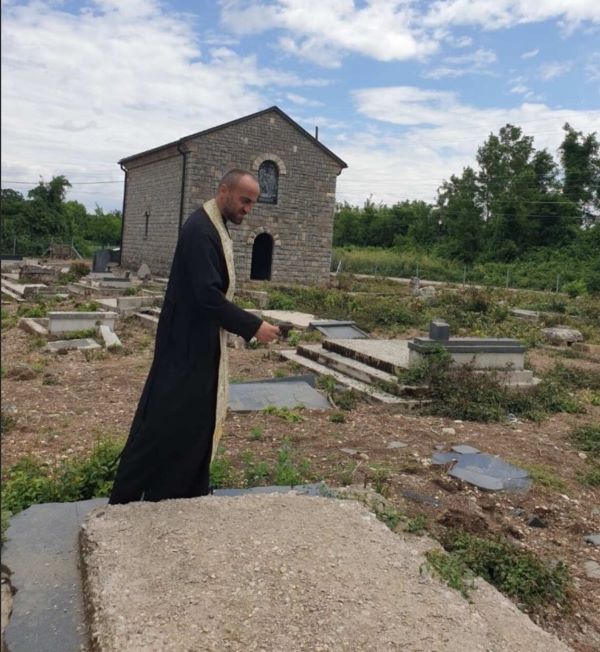
In 2020, construction began on the so-called Holy Trinity Church in Nakëll, Peja, a small church surrounded by several old cemeteries and with an exit to the village’s main street.

The land on which the church is located is not surrounded by impenetrable defenses and can be entered by anyone who wishes to do so.

The building is not easily recognizable as a religious building (there is no Orthodox cross) and until recently it was used as a shelter for drug addicts, transients and the homeless.

Given the escalation of the situation due to the hybrid war, Serbia has undertaken to paint some graffiti on this religious building and to hold the Albanians responsible for these actions.

The OCTOPUS Institute has carefully analyzed the inscriptions on the interior walls of the church and also analyzed in detail the surrounding situation and the security situation between Kosovo and Serbia.

After these analyses, we come to the following conclusions:

According to photo No. 2, when analyzing the word “Allahu Akbar” we find significant spelling errors, which prove that the person who wrote this graffiti has little knowledge of the Albanian language, that is, for the main manuscript he has Serbian language in Cyrillic letters and also, has no knowledge of the Islamic religion.

Muslims do not write the word “AKbar” with capital letters, and even the last letter is still capitalized, which is similar to the psychological learning to write letters in the form of Cyrillic letters. Due to the non-comparison with Allah, Muslims do not capitalize Akbar either, and these two words contradict each other.

The sentence at the top of the same picture has even more problems, as it actually says: “Islani është feju(y) e votme e Vertet”. (“Islam is the true faith”). So it doesn’t say “Islami” but “Islani”, then the author who didn’t know the Albanian language didn’t know how to write the word “religion” and wrote “feju(y)”, so author didn’t know the right word, Author didn’t know how to write the letter “a” at the end. Since the author did not know the Albanian language, author also did not know how to write the word “vetme” and wrote “votme”. In the end, the author also wrote the word “truth” as “vertet”, starting with a capital letter and the same one who put the letter “ë” in the word “is” did not know how to put the same letter in the word “vertet”.

In photo number 3 we can see even more arguments that the people who wrote the graffiti were not Albanians, that they did not know the Albanian language and that his main handwriting is also the Serbian language with Cyrillic letters.

So author started at the beginning of the sentence with the letter “C”, which in Serbian Cyrillic is understood as the letter “S”, then made a renotation and tried to harmonize it with the Albanian letter “S”, but was not successful. Similarly, the letter “j” is written without a dot above the letter, just as the letter “i” is written without a dot above the word “church”. Similarly, the word “we love” begins with a capital “D”, with a “j” without a period, and the word “xhami” is written as “gjami”, and only this last word is known to all Muslims, regardless of their level of education or not, how to spell correctly. So this shows that in photo 3 there is also a second person who writes graffiti on the walls and also has the Serbian language with Cyrillic letters as his main language. The photo also tried to become a symbol of the author’s failure.

In the photo we can also see a working shovel that was placed or restored after the graffiti was written. As you can see, the shovel was not used by the craftsmen working there, as the craftsmen did not leave their tools dirty due to damage.

In photo number 4, we notice a new manuscript in which we can talk about the third person who was involved in writing the graffiti and who also has no knowledge of the Albanian language. They actually wanted to write “Remove this church from here, there are only Muslims here”, but in reality failed and revealed itself and the purpose of the graffiti in the strongest terms.

The person did not know how to write a single word in the correct form, but authors handwriting also betrays them by showing that author can write in Cyrillic letters and very little in Latin letters and even less in the Albanian language. As for the word “church”, author didn’t even know how to spell it correctly in Albanian, but even the letter “s” looked more like Cyrillic letters.

Similarly, the manuscript betrayed the word “ka” by deviating to the second letter in the form of Cyrillic letters.

In photo number 5, we have mistakes in the word “ALLAHU”, because the letter “LL” does not exist in the Serbian language, so the author did not know how to write it correctly, and deviated from the spelling of “II” with two capital letters “I” in the Albanian language or two lowercase letters “l”, which, however, are in contrast to the other capital letters. As for the word “Ekbar”, we also have many testimonies, where in photo number 1 we saw that the same word was written with the letter “A”, in photo number 5 with “E”, which does not resemble the letters in Albanian language, but with these Cyrillic letters and at the end the word ends with a thick, meaningless black line.
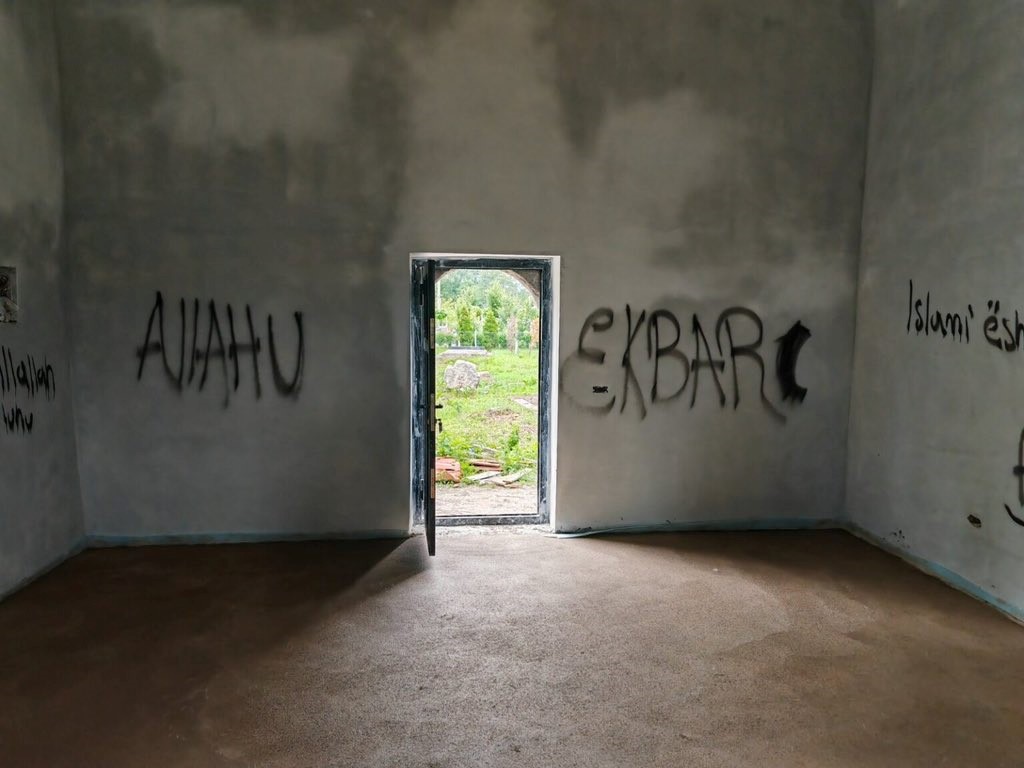
On photo number 5 we also notice that there are keys on the door, that the door can only be opened by responsible persons and that the door was not opened by force but in a normal way.

If it had been written by Albanians, the door would have been opened more forcibly, or the graffiti would have been written outside the walls of the church, as the Albanians have no one to be afraid of when they write such graffiti. But it was written by the Serbs who had the permission and the cels to go and paint the graffiti, along with the instructions on what to do and how to behave, and they could not write the graffiti on the outside walls because otherwise they would be discovered first by the passers-by.

In all the photos we notice that there were at least five people who do not know the Albanian language and do not have it as their main language and also do not know the Albanian script, and we confirm that the authors are from the Serbian community (not necessarily from Kosovo) and four of these people wrote the graffiti and one was the guard.

The purpose of graffiti

This graffiti emerges after the strong Serbian involvement in the hybrid war against Kosovo in the security and political field.

The factors that produced this graffiti for propaganda against Kosovo in the international arena and among the Serbian population are:

Denial of entry of Serbian Patriarch Pofirije to Kosovo.

Campaign against Kosovo for membership in the Council of Europe.

The issue of banning the illegal use of the dinar in Kosovo.

The question of granting the Serbs association, namely autonomy.

Finding weapons in the north of Kosovo.

Serbia has made these issues part of the hybrid war against Kosovo and uses them constantly, now also using the expansion of interethnic tensions and “attacks on Serbs” in other regions of the Republic of Kosovo.

The current President of Serbia, Aleksandar Vucic, at the time when he was Minister of Propaganda in the regime of Slobodan Milosevic, had the task of collecting various cases in which he is also known as Serbian Gebels. Today, he continues this ability even when he himself is running Serbia’s institutions as an autocrat.

It is argued that the graffiti issue is all the more an issue for the Serbian government because in Serbia all but two media outlets are controlled and it would thus succeed in using graffiti to create propaganda to evoke victimization among internationals and chauvinism among the Serbian people. For this reason, it is no coincidence, that the Serbian people elected the Minister of Information, Dejan Ristic, who even before his appointment as Minister had already been responsible for creating a feeling of victimization, genocide and chauvinistic nationalization among Serbs among students, teachers and the Serbian people.

As the world knows, Serbian politicians in the past have made such acts even ruder in collaboration with the Serbian secret service, accusing the Albanians of justifying their actions after the fact.

Worth mentioning is the “Panda” case in Peja, in which several young people of Serbian nationality were killed in a café in 1998. Several Albanians were charged and sentenced by the special police for this case. The paramilitary group “Red Berets” immediately took revenge on other innocent Albanians with murder, torture, violence, imprisonment, looting and various abuses.

In 2013, Aleksandër Vucic himself publicly admitted that this ugly crime was committed by the Serbian security institutions themselves, members of the special police and Serbian criminals who were on duty at the time, but as an action it was planned by the Serbian “UDBA”.

While after the terrorist attack in Banjska in September 2023, it was proven that Vucic’s regime was using Serbian churches in Kosovo to store weapons.

Therefore, from the collection of data, analysis of facts and circumstances, it is clear that these events were not carried out by the Albanians, but by the Serbian government with the aim of escalating the situation in the region and to victimize and justify Serbia’s subsequent actions before the international community is not valid./Octopus/

Related Posts

Current Events

Council of Albanian Ambassadors Backs Civic Protests, Calls for Transparency and Protection of National Interests

12 June, 2026
Current Events

Russian Ambassador in Tirana: “Without a Strong and Sovereign Russia, the Creation of a Just World Order Is Impossible”

11 June, 2026
Balkan Overview

EU-Western Balkans Summit 2026: New Impetus for the Enlargement Debate?

10 June, 2026

Follow US

Subscribe

Receive Argumentum Magazine by Email

Last Posts

Council of Albanian Ambassadors Backs Civic Protests, Calls for Transparency and Protection of National Interests

12 June, 2026

Russian Ambassador in Tirana: “Without a Strong and Sovereign Russia, the Creation of a Just World Order Is Impossible”

11 June, 2026

EU-Western Balkans Summit 2026: New Impetus for the Enlargement Debate?

10 June, 2026

The visit that changed Albania’s strategic future

10 June, 2026

Serbia’s Lost Legal Battle and the Exploitation of Resolution 1244 for Lawfare and Terrorism

10 June, 2026
Argumentum

“Argumentum”, një proces intelektual …

Contact Us

[email protected]
[email protected]
[email protected]

Follow Us

Media Partner

Register

Receive Argumentum Magazine by Email
  • Home
  • Privacy Policy
  • About Us
  • Contact

© 2022 Argumentum. All Rights Reserved. | NUIS: L91415033Q

Welcome Back!

Login to your account below

Forgotten Password? Sign Up

Create New Account!

Fill the forms bellow to register

*By registering into our website, you agree to the Terms & Conditions and Privacy Policy.
All fields are required. Log In

Retrieve your password

Please enter your username or email address to reset your password.

Log In

Add New Playlist

No Result
View All Result
  • Home
  • OP/ED
  • Interview
  • Realpolitik
  • Current Events
  • Top News
  • YOUR VOICE
  • Shqip

© 2022 Argumentum. All Rights Reserved. | NUIS: L91415033Q

This website uses cookies. By continuing to use this website you are giving consent to cookies being used. Visit our Privacy and Cookie Policy.