





















Dr. Ermir I. Hajdini
Legal Advisor & University Lecturer
The United Nations General Assembly vote on June 3, 2026, yielded a stunning result: for the first time in history, Germany, a major UN donator, was soundly defeated in its bid for a non-permanent seat on the UN Security Council (UNSC) [1]. Competing within the Western European and Others Group (WEOG), Berlin failed to reach the required two-thirds majority, securing only 104 votes and losing out to Portugal (134 votes) and Austria (131 votes) [1].
Speaking to reporters at the UN headquarters immediately following the vote, German Minister for Foreign Affairs Johann Wadephul described the result as a “bitter defeat” and a “real disappointment” [2]. While Wadephul pointed to a late campaign entry as a structural disadvantage, the outcome represents a profound geopolitical rebuke. It was driven by a combination of immediate foreign policy alignments—which the Foreign Minister himself openly acknowledged [2]—and a deeper, structural shift in Germany’s domestic defense narrative under Chancellor Friedrich Merz [3].
1. The Acknowledged Catalysts: Gaza, Ukraine, and the Votes of the Global South
In his post-election brief, Foreign Minister Wadephul directly named the primary lightning rods that cost Germany vital support across the 193-member General Assembly, driving a wedge between Berlin and large voting blocs in Africa, the Arab world, and Latin America [2].
- The Israel Policy Realpolitik: Wadephul explicitly acknowledged that Germany’s stance on the Middle East conflict alienated key member states, stating it “may have cost us votes that Germany must always assume a special responsibility for Israel” [2]. Unyielding defense of Israel created an electoral liability that Portugal and Austria did not carry [4].
- The Ukraine Focus and Russian Counter-Lobbying: Wadephul also cited Germany’s “rock-solid support for Ukraine” as a primary target, noting that “Russia does not want such a voice at the table in the Security Council, which campaigned against us” [2]. For many non-aligned nations, Berlin’s intense focus on the war in Ukraine was perceived as a Eurocentric prioritization that has drained UN focus away from global development, climate initiatives, and acute humanitarian crises in the Global South [4].
2. The Unspoken Liability: The “Merz Shift” and the Will to Militarization
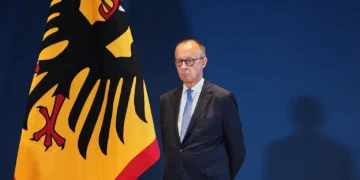
While Wadephul focused his critique on specific conflict alignments, diplomatic observers point to a deeper, systemic shift that transformed Germany from a natural UN consensus-builder into a polarizing candidate: the domestic “will to militarization” championed by Chancellor Friedrich Merz [3, 4].
For decades, Germany’s primary asset in securing UNSC seats was its identity as a Macht der Mitte (a power of the center)—a predictable, soft-power giant whose international credibility was built on development aid, mediation, and strict adherence to a “civilian power” doctrine.
The political shift under Friedrich Merz altered this calculation:
- The Remilitarization Rhetoric: Domestic messaging boasting about a rapid rearmament and turning the Bundeswehr into Europe’s dominant conventional military force signaled a fundamental pivot away from soft diplomacy toward traditional hard-power projection [3].
- The Loss of “Honest Broker” Status: To a General Assembly weary of major-power rivalries, a highly militarized Germany looks less like a neutral peace-broker and more like an aggressive, hawkish anchor of a polarized Western/NATO bloc [4].
This domestic defense narrative made Germany’s competitors highly attractive. Faced with Berlin’s hawkish trajectory, the General Assembly opted for Austria—which successfully leveraged its constitutional neutrality—and Portugal, a nation synonymous with low-friction, consensus-based diplomacy [1, 4].
3. The Strategic Echo: Why This Message Must Be Read Loudly in Tokyo [5]
Germany’s historic defeat carries profound strategic implications far beyond Berlin; it is a case study that needs to be read with absolute clarity in Tokyo and beyond….
Japan shares a nearly identical geopolitical profile with Germany: both are G7 economic powerhouses, both carry complex 20th-century historical baggage[6,7], both have traditionally relied on pacifist or highly restrained defense postures (Yoshida Doctrine in Japan, Civilian Power in Germany), and both are currently pursuing historic remilitarization tracks in response to shifting regional threats.
THE DILEMMA OF REARMING CIVILIAN POWERS
[ Domestic / Regional Driver ] [ Global Assembly Backlash ]
• Push for robust deterrence • Read as polarization & hawkishness
• Rearmament & hard-power rhetoric • Costs vital soft power at the UN
• Tight alignment with Western Bloc • Alienates non-aligned Global South
For Japanese strategists looking to secure future rotational seats or advance their long-standing bid for permanent UNSC reform, the German debacle delivers three critical lessons[8]:
- The Domestic-International Disconnect: Rhetoric designed to signal resolve and military strength to domestic voters and Western allies (Washington/NATO) reads as aggressive, polarizing, and destabilizing to the wider, non-aligned world.
- The Isolation of Tight Blocs: Total, unyielding alignment with Western geopolitical positions—without visible, independent diplomatic bridges to the Global South—creates an electoral ceiling at the United Nations. Hard power cannot substitute for the diplomatic currency needed to lead a multi-polar General Assembly.
- The Pacifist Dividend is Real: The UN General Assembly values the unique “honest broker” status traditionally held by restrained powers. Once a nation sheds that hesitation and embraces conventional military ambitions, it is judged by the unforgiving rules of raw, major-power realpolitik—where votes are easily lost and incredibly difficult to regain.
The Structural Reality: Germany’s defeat demonstrates that a sharp turn toward hard power can systematically hollow out the soft power required for global leadership. For nations like Germany and Japan, rearmament may satisfy regional deterrence, but the geopolitical price is a stark loss of influence within the world’s primary multilateral institutions.
References
- [1] United Nations General Assembly. (2026, June 3). Official Record of the 85th Plenary Meeting: Election of Non-Permanent Members of the Security Council (A/80/PV.85). United Nations Academic Press.
- [2] Wadephul, J. (2026, June 3). Statement by the Federal Minister for Foreign Affairs on the Outcome of the UN Security Council Elections. Federal Foreign Office Press Registry, Berlin.
- [3] Merz, F. (2026, May 12). The New Architecture of European Defense: Rearmament, Deterrence, and Germany’s Role. Address to the German Council on Foreign Relations (DGAP), Berlin.
- [4] Diplomatic Corps New York. (2026, June 4). Analysis of Vote Shifts in the Western European and Others Group (WEOG). UN Delegate Intelligence Briefing.
- [5] Cabinet Secretariat of Japan. (2022, December 16). National Security Strategy (NSS) of Japan. Tokyo: Ministry of Foreign Affairs Registry.
- [6] Tatsumi, Y., & Hosoya, Y. (2024, June 24). Japan as a Member of the Defenders of the Liberal International Order: Reconciling the West with the Global South. Stimson Center Policy Memorandum.
- [7] Ministry of Foreign Affairs of Japan (MOFA). (2025, April). Diplomatic Bluebook 2025: Outlook for Japan’s Diplomacy and Global Governance. Tokyo: International Cooperation Bureau.
- [8] Green, M. J., & Johnstone, C. B. (2024, April). The Yoshida Doctrine in the 21st Century: The Strategic Cost of Rearmament. Center for Strategic and International Studies (CSIS) Briefing Paper.
© 2026 Argumentum