







By Genc Mlloja
Senior Diplomatic Editor
Against the background of a 750bn euro recovery fund intact and the launching of the anti- COVID vaccination in all EU countries, which have created a calmer situation in the Union, Portugal took over from Germany the Presidency of the Council of the European Union on January 1, 2021 which will last until June 30. Nevertheless the Programme for the Portuguese Presidency, which has been unveiled earlier, says that it happens at a particularly difficult time of the impact of the COVID-19 pandemic and its social and economic repercussions.
But in its fourth Presidency of the Council which was preceded by three separate occasions in 1992, 2000, and 2007, the Portuguese Presidency seems to have its hands full of objectives to be accomplished being responsible for the first validations of national recovery and resilience plans as it is shown in its action lines included in the 36-page programme.
The European social model is the distinctive aspect of Europe on the world stage. It was decisive in the post-war period of reconstruction. It has been of vital importance in the way that Europe has confronted this COVID-19 pandemic and must constitute a basis of trust, which is indispensable if we are to mobilize society as a whole for the climate and digital transitions, the Prime Minister of Portugal, Antonio Costa has declared during a conference held at the Universidade Catolica (Catholic University, Lisbon) under the title “The Presidency of the Council of the European Union 2021” last December.
COVID-19 as challenge of Portuguese EU Presidency
The Portuguese EU Presidency is fully aware that the COVID-19 pandemic and its social and economic consequences pose an unprecedented challenge for the Union and its member States, requiring decisive and comprehensive action.
“We will support the creation of a European Health Union, strengthening capacity to respond to public health crises and efforts to produce and distribute safe vaccines accessible throughout Europe and the rest of the world,” said the Portuguese Programme.
COVID-19 has demonstrated even more strongly the importance of the single market and of a robust European industrial strategy. In order to increase European competitiveness, it is essential to strengthen the single market in all its dimensions, with a special focus on SMEs, according to the actions lines. “We will promote the necessary measures to restore and improve the functioning of the single market, in particular with a view to removing unjustified barriers to the free movement of goods and services. We will also prompt a reflection on the functioning of the single market in times of crisis.”
Another target set in the fight against the virus is the search to help ensure greater availability of affordable medicines and vaccines, as well as medical equipment and devices, and in this context, a conference on access to medicines will be held in Lisbon in April.
But rolling out the EU’s mass vaccination programme will be one of Portugal’s top priorities as a new, more infectious strain of coronavirus spreads across Europe. Augusto Santos Silva, foreign minister, has said Lisbon’s socialist government would prioritise “the full development of the EU’s strategy of free, universal vaccination”. Persuading EU citizens that masks and other restrictive measures will remain essential for many more months will be another challenge. The comments came as criticism mounted in many EU countries over the slow pace of mass vaccination, compared with Israel, the UK and the US.
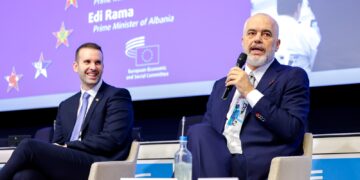
But even Albanian Prime Minister Edi Rama has been harsh towards the EU considering its stance absurd regarding the supply with anti-COVID vaccines of the EU candidate countries like Albania. In a comment on January 1, 2021 announcing the news on securing a contingent of vaccines from Pfizer Company and two unnamed ‘friendly countries’, Rama spoke of extremely unfavorable position from which the country started to secure vaccines calling it a gap that was opened right in the middle of Europe by the absurd decision-making, morally unacceptable, politically incomprehensible and even logically unjustifiable of the European Union.
“As a person I have felt indignant and as a European I have felt ashamed. While as the Prime Minister of Albania I have felt more motivated than ever to not allow Albanians to feel excluded from the opportunity to defend themselves at the same time as other Europeans in this world war full of the risk of death. We entered the sea on foot and managed to touch a small plot of land without any help from the EU and unlike the EU’s bad example to the Balkans, we will not turn our back on Kosovo leaving it in waiting and in torturous anxiety for the start of vaccination,” said Rama. Even before, Albanian PM has been critical of the EU for dragging the launch of the accession talks with the Union.
In the meantime Mr. Zlatko Kramaric, the Ambassador of Croatia, which was at the helm of the EU Presidency during the first half of 2020 when the devastating pandemic broke out hitting hard the entire world including Europe told Albanian Daily News that “The situation related to the pandemic will calm down in the foreseeable future because scientists have managed to create the necessary vaccine. All this gives hope that Portugal will have more luck in realizing its priorities, which are in the function of a better future for the European community.”
Promoting Europe’s Interests and Values in the World
Reinforcement of Europe’s role in the world, based on openness, effective multilateralism and strengthening International partnerships is high on the agenda of Portugal’s Presidency.
For much of the past decade and a half, the EU could generally count on German Chancellor Angela Merkel to come to the rescue. But the coronavirus pandemic, the dragged-out Brexit talks, a budget stalemate, and an array of geopolitical tensions especially in the Eastern Mediterranean have burdened the year 2020 with extremely serious policy problems.
One of these problems were the relations with the US and the Portuguese Presidency will be the first one to be in touch with the new administration of president-elect Joe Biden after January 20, aiming to revitalize what is considered as the most difficult and hectic transatlantic relationship.
“Relations with the United States should be revitalized and geared towards tangible responses to global challenges as the key element in a new alliance of partners with shared interests and values. In this context, security and defense cooperation, as well as the strengthening of multilateralism and international partnerships, should play a central role,” said the Portuguese platform. According to its expectations, sustainable economic recovery and the definition of common goals in relation to the climate agenda will be aided by the USA’s announced return to the Paris Agreement on climate change.
The Portuguese Presidency will support the High Representative of the Union for Foreign Affairs and Security Policy, with a view to strong and coherent external action, enabling the Union to act swiftly and efficiently, in line with the defense of its interests and the projection of its values, in particular through effective multilateralism and a rules-based international order.
“We will encourage the deepening of regional partnerships in the context of the UN and other multilateral organizations, prioritizing the promotion, protection and realization of human rights, particularly in the face of new global challenges,” said the action lines and in this context it is foreseen the promotion of the implementation of the Action Plan on Human Rights and Democracy 2020-2024. “We will also prioritize efforts to abolish the death penalty and to implement the EU Action Plan on Gender Equality and Women’s Empowerment 2021-2025.”
Special attention is shown in seeking to deepen the strategic partnership with the Maghreb region, complementing existing regional dialogue initiatives and it will be worked actively to promote security, stability and development in the Middle East and North Africa region, building on the UN’s dialogue with regional organizations, such as the League of Arab States and the African Union, with a view to finding long-term political solutions.
As regards Ukraine, the efforts of the High Representative to promote a comprehensive political solution will be backed, and according to the platform, the development of the relationship between the EU and Russia will be monitored, based on a clear, consistent and united European position, taking into account the challenges and opportunities. With regard to the future relationship with the United Kingdom the Programme says: “The Portuguese Presidency will prioritize the EU’s future relationship with the United Kingdom, engaging in a comprehensive, fair and balanced partnership that respects the interests of the Union and its Member States.”
Another priority is the framework of EU-NATO cooperation, and in this frame particular attention will be paid to the areas of hybrid threats, cyber defense, maritime security, including capacity-building for partners, military mobility and response to complex emergencies.
So the aspect of security and defense is a more operational orientation of the EU Global Strategy, through the common European Strategic Compass, with a view to defining its level of ambition and strengthening the security and defense dimension by enhancing the coherence and effectiveness of the Common Security and Defense Policy (CSDP) initiatives, complementing NATO.
“The impact of COVID-19 is a test of Member States’ resilience and solidarity, underlining the urgency of improving the EU’s crisis response capacity. We will support the work of the task force set up by the EEAS to assess the response of Member States’ armed forces to the pandemic, identifying gaps, challenges, best practices and ways of improving cooperation and coordination in response to complex emergencies, in particular the use of military capabilities to support the EU Civil Protection Mechanism. We will promote a reflection on the effectiveness of CSDP military missions and operations, incorporating lessons learned,” it is highlighted in the Programme.
Autonomous Europe eying strengthening of EU presence in the world
Strengthening of the strategic autonomy of a Europe that is open to the world has been set as a key objective of the action lines being aimed at the continuation of strengthening of the EU’s presence in the world, promoting multilateralism and diversifying global partnerships, in particular with the European Neighbourhood, Africa, the India-Pacific region and the entire transatlantic area.
“We will defend Europe’s autonomy on the basis of the development of a dynamic industrial strategy that promotes European value chains and pays particular attention to strengthening small and medium-sized enterprises (SMEs), creating cooperation networks in research and innovation (R&I) at European level and ensuring that access to the European market is gained on fair and equitable terms and with respect for the Union’s values,” said the programme.
In the meantime Lisbon is paying special attention to the expected Conference on the Future of Europe seeing it as an opportunity for a discussion involving institutions and citizens on the directions and results of European policies, seeking the best ways to move forward in the process of European integration and meet citizens’ expectations.
Likewise high on its agenda is the target of making the Union a global leader in climate action, increasing capacity to adapt to the effects of climate change and promoting the competitive advantages of a decarbonised and resilient economic model. As it is announced in the Programme to that end, the Presidency will hold a conference on climate change in March and a conference on green hydrogen from renewable energy sources in the energy transition in April, both in Lisbon. “We will prioritize the implementation of the European Green Deal, with a view to a sustainable economic recovery. We will support all efforts to make Europe the first carbon-neutral continent by 2050, the objective of the European Climate Law. In this context, it is essential to secure a joint commitment to reduce CO2 emissions by at least 55% by 2030 compared to 1990 levels,” it is said in the Programme.
Talks with Albania, North Macedonia in Portugal’s dossier
The expected launch of the EU membership talks with Albania and North Macedonia, which was one of the goals of the German and Croatian presidencies, could not be achieved being postponed without any fixed date, and is one of several issues inherited by Portugal.
In a comment on the failure to ‘keep the promise’, German European Affairs Minister Michael Roth has conceded that the stalemate was “a heavy blow to our Western Balkan policy.”
“You may also feel my personal disappointment,” Roth has said before the end of the German EU Presidency. “The German foreign minister, the minister for Europe, the Chancellor herself have been very committed to this dossier. But we were not as successful in the persuading efforts as we would have liked.” He was referring to Bulgaria’s opposition to opening of the talks with North Macedonia, triggered by a historical linguistic dispute.
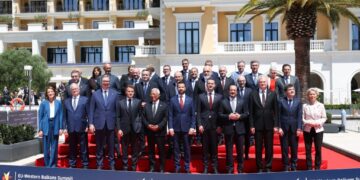
But Portugal’s actions lines include the very important message of its politicians that the process of EU enlargement is one of the most important political priorities for them as well.
“We will continue the process of enlargement to the Western Balkans on the basis of a new, more credible and more effective methodology, as well as the stabilization and integration efforts in the region, supporting the European Commission as regards the ongoing reform processes in those countries,” it is said in Portugal’s EU Presidency Programme.
It was Croatia’s EU presidency which proposed that a decision be made to launch accession talks with Albania and North Macedonia something which happened at the Zagreb Summit on March 24, 2020
But as the Croatian Ambassador to Tirana, Zlatko Kramaric told Albanian Daily News the uncertainty resulting from the emergence of the COVID -19 virus, among other things, significantly affected political processes in Europe slowing them down. “The rhythm of negotiations was lost, so a whole series of ideas and projects had to be given up, which were to be realized during the last year, 2020, when the EU was presided over by Croatia and Germany,” he said.
In a comment on Portugal’s pledge that the process of EU enlargement is one of its political priorities as well Ambassador Kramaric noted: “This is a positive, encouraging message for the countries of the Western Balkans, but now it is the turn of the politicians of those countries to show with their sincere activities on the reform agenda that they also care about Europeanizing their society as soon as possible.”
Generally speaking the Programme is characterized by the confidence of the Portuguese EU Presidency to be active in building consensus, able to adapt to circumstances and driven by results. “We will promote dialogue and the unity of the Member States,” it said, stressing that “only together can we embark on a path of hope, trust and credibility.”
The ‘rich’ package of the Portuguese EU Presidency carries a lot of ideas and projects, which are set to be realized during the first half of 2021, but time will show how much lucky Portugal leaders will be to carry out the lengthy priorities of its ambitious platform during the first half of 2021, a year which is still full of uncertainties most of which due to the challenging repercussions of the worldwide pandemic.