


















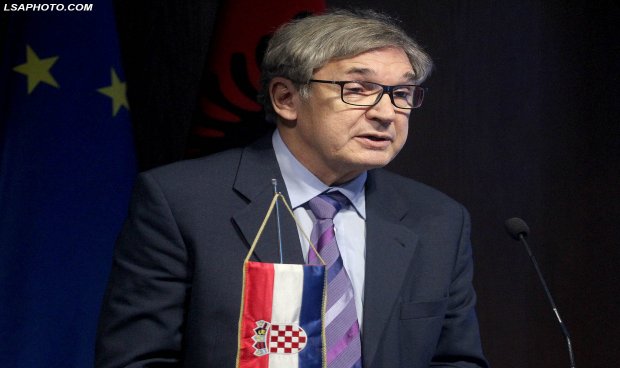
By Zlatko Kramarić*|ARGUMENTUM
Ambassador of Croatia to Albania
Today’s so-called “march against fascism” revived an old question: what do the terms fascism and antifascism actually mean in contemporary Croatia? Croatia is a democratic state with free elections, pluralistic media, and robust protections for minority rights. In such a framework, speaking of “fascism” in a serious historical or scholarly sense is extraordinarily difficult.
Yet the march was framed as a reaction to alleged “fascisation.” Most revealing, however, were not the speeches but the banners, which exposed that the event had little connection to antifascism and much to do with ideological opposition to Croatian statehood and national identity.
1. What Fascism Is—and Is Not
Scholarly literature defines fascism quite precisely. Its core features include:
the authoritarian cult of a leader,
abolition of pluralism,
violent nationalism,
single-party domination,
systematic persecution of internal enemies.¹
None of this describes Croatia. Sharp rhetoric or political polarisation is not fascism; it is a hallmark of every competitive democracy.
Thus, using the word “fascism” to describe Croatian reality is analytically false and morally irresponsible.
2. Antifascism as Rhetorical Shield
Historical antifascism was a real battle against the real evil of Nazism and totalitarianism. Contemporary antifascism, however, often serves as a moral shield for unrelated political agendas.²
In that sense, Churchill’s remark that “the antifascists of the future may themselves become fascists” reads less as prophecy and more as a warning: not of historical fascism, but of the modern imposition of moral hegemony in the name of antifascism.³
3. The Banners That Reveal the True Agenda
“Balkan Federation – Without States or Nations”
This slogan is not antifascist—it is anti-constitutional, anti-Croatian, and politically regressive. Croatian statehood, confirmed internationally and defended in war, is the foundation of its democratic order. The idea of a “federation without states” belongs to outdated revolutionary utopias of the 20th century.
The organisers provided no answers to fundamental questions:
Who governs such a federation?
What is its legitimacy?
Is it a new Yugoslavia?
What institutions does it have?
The vagueness is the message: the banner is not a political programme but an ideological rejection of Croatian statehood.
“One Language – One Struggle”
This slogan disregards well-established linguistic facts: Croatian and Serbian are two standardised political languages with distinct norms and histories.⁴
Calling for “one language” is an attempt to erase one of the pillars of Croatian identity.
Use of Cyrillic
Cyrillic is a legitimate and protected script in Croatia, but when used as a tool of political provocation rather than cultural expression, it serves only ideological theatrics, not minority rights.
4. The Alleged Endangerment of Minorities—Factually Unsupported
Claims that Serbs or other minorities in Croatia are structurally endangered lack any basis in reality or in legal analysis.⁵
Croatia in fact has one of the strongest minority-rights frameworks in the EU.
Incidents occur—as they do anywhere—but they are neither systemic nor state-driven.
5. Pacifism as Ideological Luxury
In an era defined by Russia’s aggression against Ukraine, pacifism may be morally attractive but it is politically untenable. Croatia is part of the European security architecture.
Antifascism divorced from geopolitical realism becomes mere moral posturing.
6. Eco’s “Ur-Fascism” and Croatia
Umberto Eco describes “ur-fascism” as a set of cultural tendencies rather than a political system.⁶
Applied to Croatia, one might find rhetorical excesses or heated identity politics—but not structural ur-fascism.
Croatia has no cult of a leader, no repression of speech, no authoritarian institutions.
7. Conclusion: Anti-Croatian, Not Antifascist
The event we witnessed was not a protest against fascism—because fascism is absent from Croatian political life.
It was a protest against Croatia as a political and national community.
This form of antifascism is not morality; it is political costume-play whose aim is not defending freedom but delegitimising Croatian sovereignty.
Bibliography
1. Robert O. Paxton, The Anatomy of Fascism (New York: Knopf, 2004).
2. Emilio Gentile, The Struggle for Modernity (Palgrave Macmillan, 2003).
3. Discussed in multiple analyses of Churchill’s post-war speeches.
4. Snježana Kordić, Language and Nationalism (Zagreb: Durieux, 2010).
5. European Commission, Country Report: Croatia, various years.
6. Umberto Eco, “Ur-Fascism,” New York Review of Books, 1995.
*Zlatko Kramarić is a Croatian publicist, author, and diplomat, currently serving as Ambassador to Albania. Formerly a university professor and politician, he is known for his work in literature, cultural studies, and regional history.
© 2025 Argumentum