




















By Zlatko Kramarić*|ARGUMENTUM
Introduction: A Congress in a City Under Siege
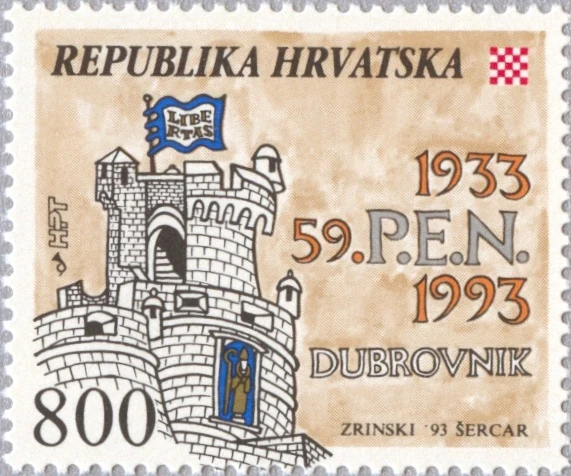
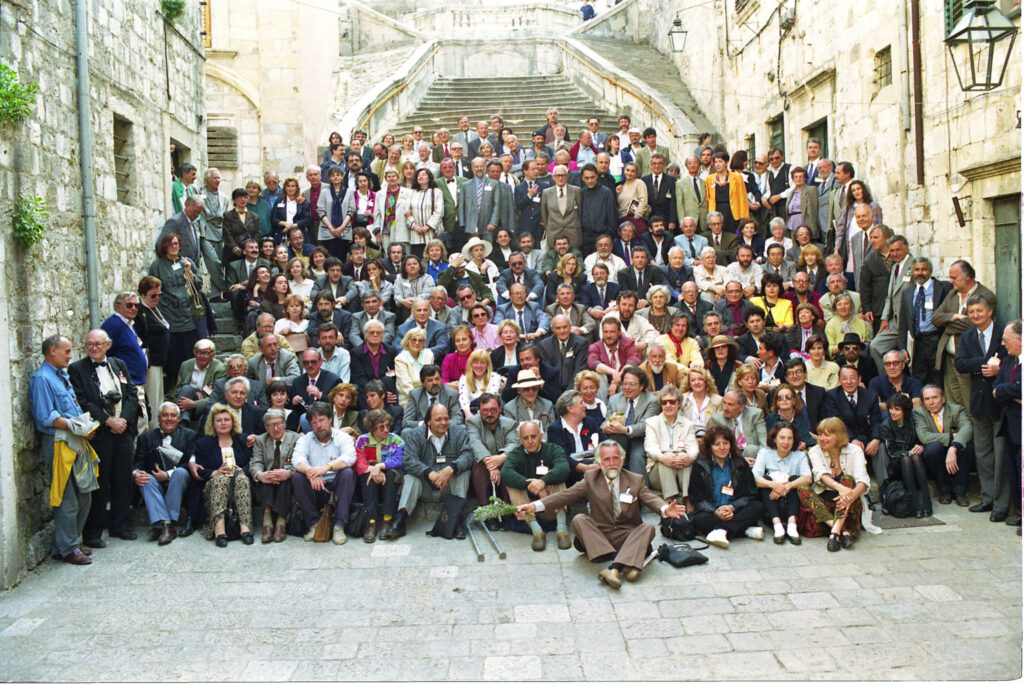
The International PEN Congress held in Dubrovnik from 19 to 23 May 1993 was, in both a literal and historical sense, a congress on the edge of a cliff. While sterile debates about the “Yugoslav dissolution” were still taking place in European capitals, Dubrovnik carried the scars of a siege that had become a global symbol of cultural vulnerability.
The very decision to hold the congress in a city that had only months earlier been exposed to heavy artillery fire carried both moral-political and symbolic weight: it aimed to demonstrate that literature and freedom of speech do not withdraw from spaces devastated by war, nor do they leave the interpretation of war solely to diplomatic or military channels.
At the same time, Dubrovnik in 1993 inevitably evoked memories of Dubrovnik in 1933 — likewise marked by political tension, ideological conflict and the instrumentalization of writers. (We wrote about this in our previous text.)
In both cases — 1933 and 1993 — PEN faced the same question:
Can literature preserve its moral compass at a moment when political and national passions dominate public discourse?
For many members of International PEN, coming to Dubrovnik was also a test of credibility after the controversies of the previous two years, especially within Scandinavian, British, and French circles, where a strong tendency existed to equate “all sides in the conflict” and insist on “neutrality.”
The Croatian Writers’ Association and Croatian PEN insisted that this congress could not be conducted in the same register of cold symmetry, since one city — and one cultural heritage — had been the target of destruction to a degree that simply could not be placed within the concept of a “mutual conflict.”¹
Thus, from the very beginning a matrix of conflict was established that would shape the entire dynamic of the congress:
• between the international demand for neutrality and the Croatian demand for truth,
• between the perception of war from afar and the experience of war from up close,
• between official geopolitical narratives and the testimonies of writers whose cities were burning.
2. The Croatian Delegation: Layers of Unity and Layers of Fracture
The Croatian delegation was large and composed of prominent writers, historians, essayists, and public intellectuals. But despite outward unity, two levels of long-standing disagreements were present:
1. The question of representing Croatia abroad:
One group believed that the congress must present the war in Croatia as clearly as possible, without relativization; another argued that excessive political emphasis could harm the cultural dimension of PEN.²
2. The question of relations with International PEN:
Some believed it was essential to build partnerships even with circles that had shown “cold distance” toward Croatia; others held that yielding to neutralization meant betraying lived experience.³
These conflicts within the Croatian delegation were generational, aesthetic, political, and psychological.
A rift emerged between those who felt the war had swept aside “old Croatian cultural complexes” and that it was finally time to speak in the language of moral fact, and those who feared that too much emotionality might appear unprofessional or “parapolitical.”⁴
It is also significant that the congress took place only months after the most severe phases of the siege of Dubrovnik, when many delegation members had personally been involved in humanitarian, documentary, or informational efforts.
Thus the role of the Croatian delegation was twofold:
• to articulate the Croatian voice, and
• to demonstrate that Croatia, despite the war, maintained democratic internal debate.⁵
3. Thematic Frameworks: War, Responsibility, Freedom of Speech
The main thematic axis of the congress was freedom of speech in wartime, yet discussions quickly turned to concrete political questions:
• What is the writer’s responsibility in war?
• Can literature serve as a moral document?
• How should one approach national narratives?
• May International PEN equate aggressor and victim?
• Is silence a form of wrongdoing?⁶
Croatian participants frequently invoked the experience of 1933, when Dubrovnik had also hosted PEN while European intellectuals were confronted with the rise of fascism — a threat they largely failed to recognize.
The parallels between 1933 and 1993 were more than symbolic: both congresses were held as the European order was collapsing, both took place in the shadow of war, and both served as a test of the international community’s moral courage.⁷
4. Controversies: Where Did It Break?
4.1. The Neutrality of International PEN
The most intense controversy concerned neutrality.
Delegations from several Western countries insisted on the rhetoric of “the conflict in the former Yugoslavia,” while the Croatian side demanded clear acknowledgment that Croatia had been attacked and that cultural monuments, including Dubrovnik, were deliberate targets.⁸
At one point, open disagreement erupted over the phrase “atrocities committed by all sides.”
The Croatian delegation considered it historically untenable and morally unacceptable, given that the attacks on the old city were documented, filmed, and confirmed by UNESCO.⁹
4.2. The “Question of the Serbian Delegation”
Another dispute involved the status of the Serbian delegation. Serbian PEN in 1993 found itself in a highly complex position: International PEN faced pressure to explain why the Serbian section had not been suspended after openly supporting Milošević’s policies, while at the same time some Serbian writers sought to distance themselves from the regime.
To the Croatian delegation, these attempts appeared unconvincing.¹⁰
There was even an incident in which several foreign participants attempted to organize an informal session with Serbian representatives, prompting a sharp reaction from the Croatian hosts.¹¹
4.3. Controversies Around the Final Statement
The congress’s concluding statement became the subject of marathon debate.
The key disputes revolved around three issues:
• Should the aggressor be explicitly named?
• Should Dubrovnik be singled out as an example of destruction of cultural heritage?
• Should the word aggression be used at all?¹²
The Croatian delegation rejected a “balanced” version that reduced events to a “regional tragedy” and insisted on wording that described the attack as an assault on a civilizational space.¹³
5. The Psychological Dimension: Delegates in a City That Still Smelled of Smoke
The congress carried a powerful emotional charge.
Some foreign delegates were seeing war damage before their eyes for the first time. Visits to Stradun, city walls, burned hotels and the surrounding hills with bunkers left them shocked. Several admitted they could not reconcile what they saw with the narrative of a “mutual conflict.”¹⁴
For the Croatian delegation, this emotional contrast was a double burden:
they had to present historical facts while avoiding the impression of “over-emotionalizing.”
In one debate, a Croatian participant remarked with resignation:
**“If even the shell holes in the cathedral aren’t enough for you to see, then words won’t be enough.”**¹⁵
6. Conclusion: Continuity with Dubrovnik 1933
In both 1933 and 1993, Dubrovnik became a stage upon which the European spirit fractured.
In 1933, artists found themselves trapped between fascism, communism, and the collapse of the old liberal world.
In 1993, writers once again confronted the same dilemma: is their primary responsibility to the state, or to universal ethical standards?
In both cases it became clear that whenever politics overpowers conscience, literature loses its autonomy — and thus its historical function.
In the forthcoming text “Dubrovnik 1933–1993 — Two Congresses, One European Question” we will attempt to answer key cultural questions about the relationship between literature, politics, and morality.
*Zlatko Kramarić is a Croatian publicist, author, and diplomat, currently serving as Ambassador to Albania. Formerly a university professor and politician, he is known for his work in literature, cultural studies, and regional history.
© 2025 Argumentum