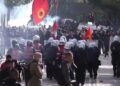



































Tens of thousands of people gathered in Novi Sad on Saturday to honor the victims of a deadly train station disaster that occurred one year ago. The rally, which attracted participants from all across Serbia, was also a powerful demonstration of growing frustration with the government of President Aleksandar Vucic, whose controversial leadership has come under increasing scrutiny.
The tragedy unfolded on November 1, 2024, when a concrete canopy at the renovated Novi Sad railway station collapsed, killing 16 people. The incident sparked widespread outrage, particularly among Serbia’s youth, who launched protests calling for political change. What began as a demand for justice for the victims quickly turned into a nationwide movement challenging corruption, government mismanagement, and the concentration of power under Vucic’s autocratic rule.
Protesters contend that the collapse was not an accident, but the result of systemic corruption and nepotism in state-funded infrastructure projects, particularly those involving Chinese contractors. Critics argue that the disregard for safety regulations and oversight in these projects led directly to the tragedy. Despite 13 individuals being charged in connection with the incident, no one has yet been held accountable, further fueling public anger.
The commemoration began with 16 minutes of silence at 11:52 a.m., marking the exact time of the disaster. Mourners also laid wreaths and lit candles at the site of the tragedy, a somber display of grief and solidarity.
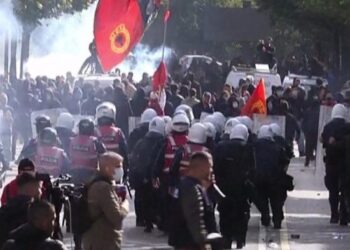
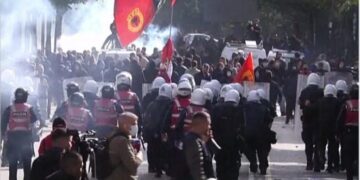
While Vucic’s government has cracked down on protests over the past year, using tear gas, batons, and mass arrests to disperse demonstrators, the turnout in Novi Sad on Saturday showed that opposition to his regime remains strong. On the eve of the anniversary, Vucic offered a public apology to student protesters after previously labeling them as “terrorists” and accusing them of being orchestrated by Western powers to destabilize Serbia.
“I have said some things that I am now sorry for saying,” Vucic admitted in a televised address, calling for dialogue and reconciliation. “All that hatred boiling in our society cannot bring any good. It can only lead to further destruction.”
However, student activists quickly rejected Vucic’s apology, demanding an early parliamentary election to remove the populist government. Authorities attempted to restrict access to Novi Sad by canceling train services, but many protesters found alternative ways to attend, with some walking long distances or traveling by bike and car.
As the anniversary of the tragedy unfolded, Vucic attended a church service in Belgrade in remembrance of the victims, while the Serbian government declared a national day of mourning.
Serbia’s ongoing struggle for European Union membership has also been impacted by the disaster. Despite Vucic’s pivot towards closer ties with Russia and China, his government’s growing crackdown on democratic freedoms has drawn sharp criticism from the EU. European Union Enlargement Commissioner, Marta Kos, commented on the tragedy’s broader significance, saying it had galvanized the Serbian people to demand “accountability, free expression, and inclusive democracy”—values that are central to Serbia’s EU aspirations.
In the days leading up to Saturday’s rally, massive crowds lined the streets of Novi Sad to greet young protesters who had walked hundreds of kilometers in solidarity with the victims. Many were moved to tears as they embraced the students, some of whom had traveled for over two weeks, covering a distance of 400 kilometers (around 240 miles) on foot.
The tragedy at Novi Sad’s train station, and the continuing protests in its aftermath, have become a symbol of the broader struggle for justice, democracy, and political accountability in Serbia. As the country grapples with its future, the demand for change is more urgent than ever.
/Argumentum.al