





































Zlatko Kramarić*|ARGUMENTUM
1. Introduction
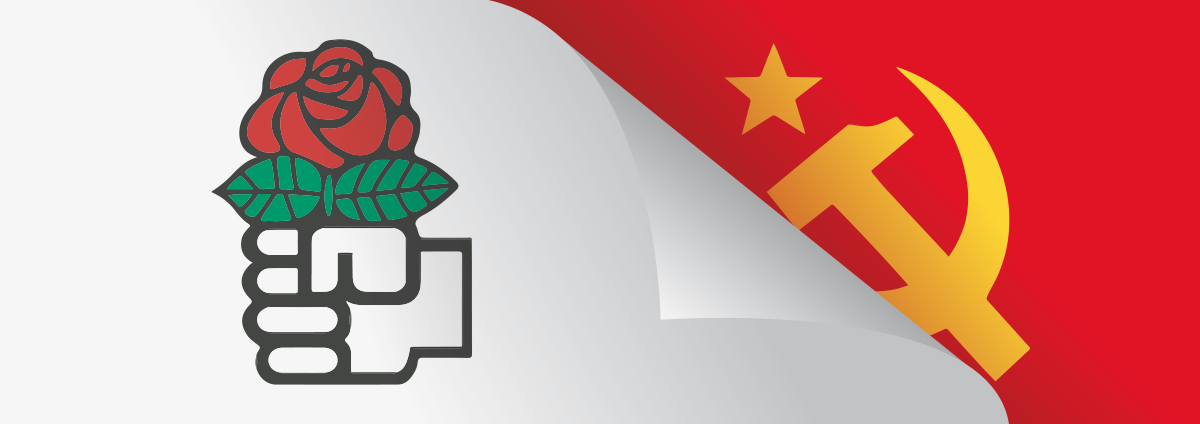
Across Eastern Europe—and notably within the former Yugoslavia—the early 1990s brought a wave of rebranding in which communist parties adopted the name and vocabulary of social democracy. The assumption was that a change in nomenclature would signal a break with Leninist organizational norms and announce the arrival of democratic pluralism. Yet these transformations were, in most cases, purely nominal: a symbolic gesture toward Europe rather than evidence of a substantive ideological shift.
This essay offers a critical analysis of those processes, with special attention to Yugoslav successor states and the distinctive Albanian case. By combining a theoretical framework rooted in sociolinguistics and symbolic power (Labov, Fishman, Bourdieu) with a historical overview of earlier party renamings in socialist and post-socialist contexts, the text argues that these renamings largely failed to deliver democratic renewal. Instead, they contributed to subsequent political marginalization of the renamed parties and the rise of ad hoc political movements across the region.
2. Theoretical Framework: Language, Symbolic Power, and Political Legitimacy
2.1. William Labov: the politics of linguistic shifts
Labov’s work on language change emphasises that linguistic innovation gains legitimacy only when supported by authentic community practice. Applied to politics, a party name—like any symbolic linguistic marker—cannot produce legitimacy if it contradicts real behaviour. Renaming a communist party “social democratic” without changing its internal culture or political habitus represents, in Labov’s terms, a prestige claim without a prestige source.
2.2. Joshua Fishman: language, identity, and functional domains
Fishman’s theory of functional domains explains why linguistic labels must correspond to the social roles institutions actually perform. If a party continues to operate within a one-party logic (centralism, informal hierarchies, ideological rigidity), the domain shift implied by a new name (“social democratic”) collapses. The result is functional incongruence: a mismatch between self-description and real social roles.
2.3. Pierre Bourdieu: symbolic capital, habitus, and misrecognition
Bourdieu’s concept of symbolic power is essential for understanding these renamings. For him, institutional labels work only when supported by social practices that reproduce the symbolic capital they claim. In much of post-communist Europe, renaming was a form of political misrecognition: an attempt to accumulate symbolic capital (Europeanism, democratic credibility) without altering the party habitus formed under communism.
Thus, the renamings were performative acts that lacked performative force.
3. Historical Overview: Renamings Before and After 1989
3.1. Earlier precedents under state socialism
Renaming ruling parties was not new. After the Cominform crisis (1948), Yugoslavia renamed the Communist Party of Yugoslavia into the League of Communists—a manoeuvre meant to distance itself from Stalinism without genuine democratization. Similarly, in the GDR and Poland, linguistic recalibrations were used to mask continuity.
Thus, 1990 was not a moment of rupture, but rather the continuation of a long-standing communist technique: symbolic adaptation to preserve power.
3.2. The 1990s: Yugoslav successor states and the promise of social democracy
In Slovenia, Croatia, Serbia, Montenegro, North Macedonia, and Bosnia and Herzegovina, the ex-communist parties adopted the label “social democratic,” “socialist,” or “social democratic reformist,” hoping to align themselves with European social democracy (SPD, Labour, SAP). However, unlike Western social democratic parties—rooted in labour movements, civic negotiation cultures, and parliamentary pluralism—post-Yugoslav parties lacked:
-internal democracy
-programmatic renewal
-clear ideological realignment
-credible break with past authoritarian practices
The result was a structural deficit of authenticity.
3.3. The Albanian exception
Albania is unique: its ruling Party of Labour was renamed Socialist Party in 1991, but—unlike in the Yugoslav region—the name change was followed by a gradual transformation of internal culture and political organisation. The Albanian Socialist Party (under Nano, then Rama) slowly built a new symbolic and programmatic identity.
Hence, Albania is the regional outlier: four consecutive electoral victories testify that its renaming was not merely symbolic.
4. Political Consequences: Crisis of Trust and the Rise of New Movements
4.1. Why the renamed parties failed
In most post-Yugoslav states, the rebranded former communist parties increasingly suffered electoral decline. The reasons correlate directly with the symbolic nature of the reforms:
Lack of ideological coherence (they invoked social democracy while continuing technocratic or clientelist practices).
Absence of internal democratization (elite continuity and tightly controlled leadership structures).
Inability to articulate a credible reformist vision distinct from nationalist or neoliberal alternatives.
Your central hypothesis is confirmed by the regional pattern: these parties lost because voters gradually recognised the renamings as symbolic manipulations rather than genuine ideological transformations.
4.2. The emergence of ad hoc political movements
This vacuum enabled the rise of new, loosely structured political forces—civic, green, anti-corruption, or activist-based. The Croatian case (Možemo!) is emblematic: a movement that arose precisely because classical “social democrats” failed to embody social democratic values.
Similar phenomena can be observed in Serbia (Ne davimo Beograd / Zajedno), Slovenia (Levica), and North Macedonia (civil society-based political coalitions).
These movements are a direct symptom of the failure of the renamed communist parties to reinvent themselves credibly.
5. Conclusion: Renaming Without Reform as a Failed Post-Communist Strategy
The renamings of communist parties into “social democratic” or “socialist” parties in Eastern Europe and the former Yugoslavia were overwhelmingly symbolic gestures, not substantive ideological transformations.
Using Labov, Fishman, and Bourdieu, we can conclude that:
Linguistic signals cannot produce legitimacy without corresponding practices.
Institutional self-definition must match functional reality.
Symbolic capital cannot be acquired by fiat.
The political consequences were profound: while Albania stands as a partial exception, most renamed parties in the region have been electorally weakened or displaced, opening the field for ad hoc, activist, or NGO-based movements that better captured the democratic and social aspirations once associated with genuine social democracy.
In this sense, the renaming strategy—intended as a shortcut to legitimacy—produced the opposite outcome: a deep crisis of trust that still shapes the political landscape of post-communist Europe.
*Zlatko Kramarić is a Croatian publicist, author, and diplomat, currently serving as Ambassador to Albania. Formerly a university professor and politician, he is known for his work in literature, cultural studies, and regional history.
© 2025 Argumentum