
































'/%3E%3C/svg%3E)

By Redion Luli
International Law Expert | ARGUMENTUM
In recent decades, the dynamics of global trade have entered a new phase of transformation. As geopolitical risks, wars, and economic competition continue to reshape the map of international transportation, countries in Central Asia and the South Caucasus are taking on an increasingly important role in creating new, sustainable, and secure trade routes.
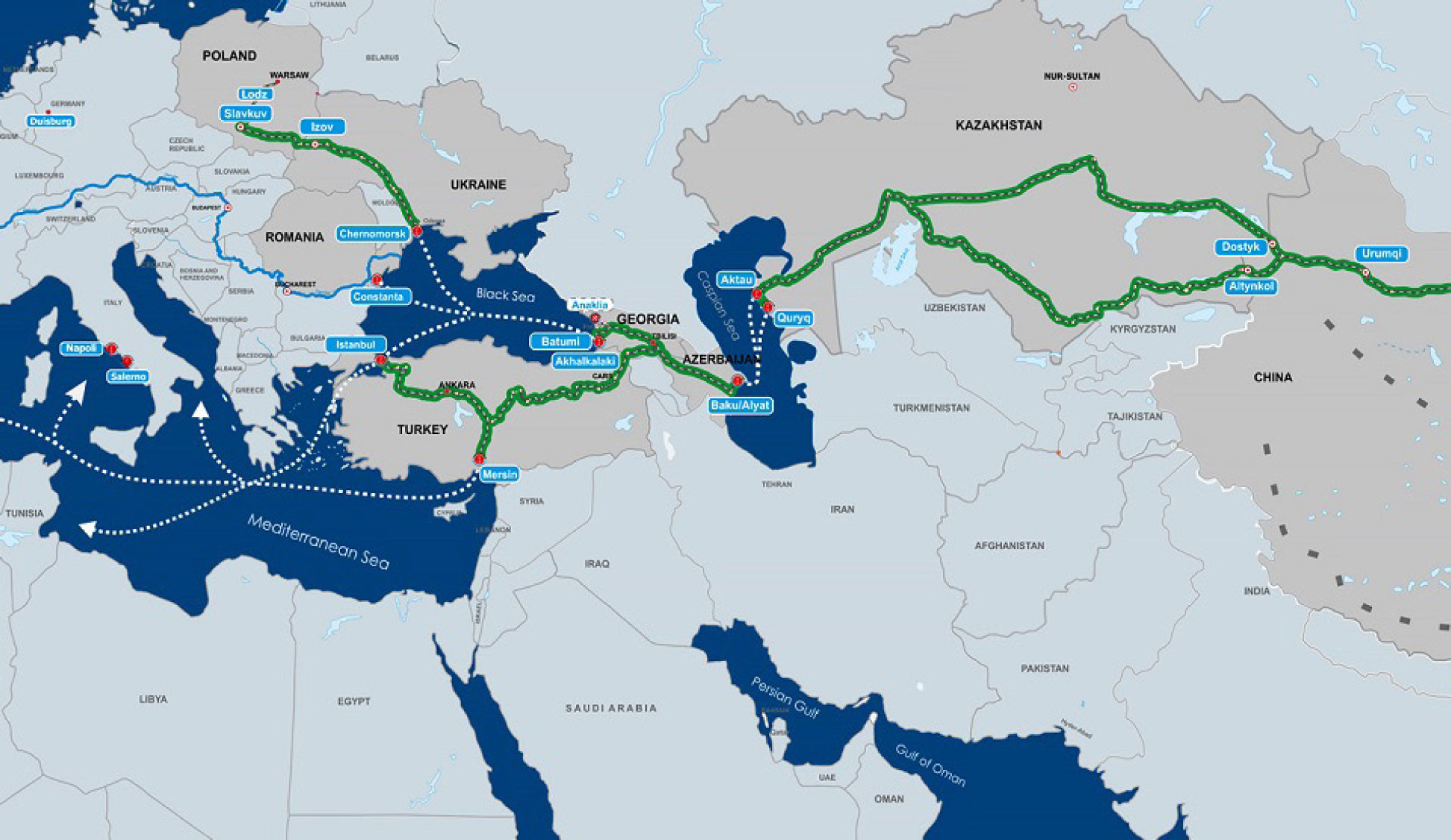
In this context, the Middle Corridor is emerging as one of the most strategic projects of the 21st century, connecting China and East Asia with Europe via Kazakhstan, Azerbaijan, the Caspian Sea, Georgia (and Armenia as a new alternative), and Turkey.
This corridor is not just an infrastructural alternative—it represents a new vision for international cooperation, diversification of regional economies, and the establishment of a more resilient global supply chain. At the center of this project stands Azerbaijan, which, thanks to its unique geographical position and balanced foreign policy, is playing the role of a vital bridge between East and West.
Azerbaijan’s Strategic Importance in the Middle Corridor
Azerbaijan has consistently invested in transportation, logistics, and energy infrastructure for over a decade. The Port of Alat, near Baku, has become one of the region’s most modern maritime hubs, with the capacity to handle millions of tons of cargo annually. Alongside the Baku–Tbilisi–Kars (BTK) railway line, which links the Caspian Sea with the Mediterranean, Azerbaijan has developed a transport system that significantly reduces the time and cost of shipments from Asia to Europe.
These developments have positioned Baku as an intercontinental logistics hub, aligning the interests of China (within the framework of the “Belt and Road Initiative”), the European Union, and Turkey. This multilateral cooperation has led to a steady increase in cargo traffic through Azerbaijan, strengthening its economic and geopolitical standing.
Over the past three years, cargo shipments along the Middle Corridor via Azerbaijan have grown by approximately 90%, while transit times have been significantly shortened. Projections suggest that by 2030, the corridor’s freight capacity will triple compared to 2021, with transit times expected to halve.
The Zangezur Corridor – The Golden Link in Regional Connectivity
A critical component of the Middle Corridor is the Zangezur Corridor, which connects mainland Azerbaijan with its exclave – the Nakhchivan Autonomous Republic – via Armenian territory. This corridor has the potential to establish a direct land connection between the Caspian Sea and the Mediterranean, ensuring seamless integration of Azerbaijan’s road and rail networks with those of Turkey and beyond to European markets.
In August 2025, this project gained unique international symbolism when it was designated as TRIPP (Trump Route for International Peace and Prosperity). This naming aims to emphasize the corridor’s significance as a tool for economic cooperation, peace, and stability in a historically tense region.
Economic Benefits of the Middle Corridor and TRIPP
From an economic standpoint, the Middle Corridor is a new trade artery with extraordinary potential. It could reduce international transport costs by 20–30% and shorten the delivery time for goods from China to Europe from 35 days to just 15. This dramatic improvement not only boosts logistical efficiency but also translates into billions of dollars in savings across global supply chains—while reducing dependence on maritime routes that pass through strategic choke points like the Suez Canal or the Strait of Malacca.
For Azerbaijan, this means a major step toward economic diversification beyond oil and gas. Investments in transport, logistics, warehousing, and supporting services are expected to significantly increase national GDP and generate new employment opportunities. At the same time, Azerbaijan is strengthening its ties with the European Union, which sees the Middle Corridor as a strategic alternative for the secure supply of goods and energy resources from Asia.
TRIPP will become the next vital segment of the Middle Corridor, serving as a key transportation line linking Asia and Europe, expanding transit capacity for international shipments, and contributing to regional prosperity and integration into global supply chains. TRIPP also holds significant potential for the future transport of energy resources, export of electricity—especially from renewable sources—and the installation of fiber-optic networks, helping transform the region into an international hub for trade and digital communications. Azerbaijan has taken all necessary measures to ensure the rapid realization of this strategic segment.
Energy Transport and Strategic Linkages
The Zangezur Corridor (TRIPP) opens up new routes for energy transport. Most notably, once a direct land connection is established between Azerbaijan and Turkey, Caspian energy resources will reach European markets more easily. For example, through the Southern Gas Corridor, Azerbaijan exported 12 billion cubic meters of natural gas to Europe in 2023; this figure is expected to reach 20 billion cubic meters by 2027. With Europe aiming to reduce its dependency on Russian energy, a direct land route between Azerbaijan and Turkey enhances their roles in the European energy supply chain. Forecasts suggest that with U.S.-supervised trade operations in the Middle Corridor, EU companies could reduce energy import costs by 10–15%.
Azerbaijan views both the Baku–Tbilisi–Kars railway and the planned Zangezur Corridor as core components of its long-term strategy for regional connectivity. The BTK line, completed in 2017 and recently expanded to accommodate 5 million tons of cargo annually, serves as the backbone of the Middle Corridor, linking the Caspian Sea to Turkey and Europe. At the same time, Baku sees the Zangezur Corridor as both an alternative route to BTK and a complementary transit pathway that can enhance East-West and North-South trade.
These corridors are being developed in tandem with other regional projects, such as the China–Kyrgyzstan–Uzbekistan–Turkmenistan railway, which will connect directly to the Caspian Sea and integrate into Azerbaijan’s trade networks. Together, they are expected to direct growing cargo flows to Azerbaijan’s Alat Port, which is currently expanding to handle up to 25 million tons annually. With an estimated 15 million tons capacity for the TRIPP segment alone, Azerbaijan aims to become the gateway to the Caspian Sea, where new continental routes converge before continuing westward through the South Caucasus to Europe.
Diplomatic and Geopolitical Dimensions
Beyond economic benefits, the Middle Corridor has a strong diplomatic dimension. Azerbaijan is using infrastructure projects as tools to promote regional peace and stability, fostering cooperation with its neighbors and avoiding entanglement in polarizing alliances.
Baku’s balancing role is vital for maintaining equilibrium among major powers—the EU, China, Russia, Turkey, and Iran—all of which have vested interests in the region. In this context, the TRIPP project is seen as a diplomatic platform for international cooperation, where physical infrastructure becomes a symbol of global dialogue and understanding.
The activation of the Middle Corridor has been made possible not only by Azerbaijan’s economic potential but also by the political stability and security environment prevailing in the country.
Strategically, the Middle Corridor diversifies communication routes and strengthens transport security. It offers a reliable new link between East and West, bypassing both Russia and Iran, acting as a flexible “lifeline” connecting Europe and Asia. As part of the Trans-Caspian route, the corridor links Central Asia with the South Caucasus and Turkey, minimizing risks posed by conflicts such as the Russia–Ukraine war or Western tensions with Iran.
Peace, Diplomacy, and Regional Transformation
The new corridor and the associated peace agreement are significantly reshaping the regional diplomatic landscape. Firstly, they mark real progress toward resolving the Azerbaijan–Armenia conflict—a U.S.-brokered agreement represents a major step toward normalizing relations. This deal also paves the way for a rapprochement between Armenia and Turkey.
With the launch of the Middle Corridor, the long-closed Armenia–Turkey border may reopen to transport, promoting political dialogue and trade exchanges. Turkish business circles have already shown interest in investing in Armenia’s post-war reconstruction and infrastructure projects, a process closely tied to Ankara–Yerevan normalization.
Azerbaijan is also enhancing its international profile. Within the framework of TRIPP, at the request of the United States, Baku has agreed to explore improving ties with Israel, potentially joining the Abraham Accords. As a result, diplomatic engagement around the Zangezur Corridor could lay the groundwork for a shift from conflict and instability to sustainable peace and true regional cooperation.
Conclusion
The Middle Corridor and TRIPP are more than just infrastructure projects—they are part of a global strategy for economic integration, stability, and intercontinental cooperation. Azerbaijan, with its role as a “golden gateway” between East and West, is transforming into a key player in the development of a more connected and sustainable world, built on the principles of good neighborliness and peaceful coexistence.
In an era when many nations are seeking new paths to prosperity and security, the Middle Corridor offers a new model of global cooperation—a route that, as its new name TRIPP suggests, leads to International Peace and Prosperity.
© 2025 Argumentum