














By Dr. Gurakuç Kuçi – Senior Researcher at Institute for Hybrid Warfare Studies “OCTOPUS” and professor at UNI College
The statements and actions of the Lavrov–Vučić–Vulin triad between October 24–27, 2025, escalated the threat against the Western security structure in Europe (including the Western Balkans), presenting the West with two alternatives: either allow the realization of Russian-Serbian interests under the Euro-Asian security framework, or face war.
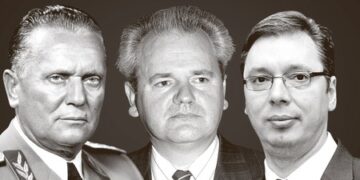
In just four days, three interlinked events revealed three levels of a single operation: Aleksandar Vučić articulated the political narrative (“Serbia toward the EU, but without recognizing Kosovo”); Aleksandar Vulin institutionalized Russian influence through the newly founded “historical” society; and Sergey Lavrov delivered the Euro-Asian geopolitical narrative to the international audience. This strategic coordination forms the foundation for implementing Aleksandr Dugin’s geopolitical doctrine.
“The Serbian World” as a Doctrinal Basis
The Russian Historical Society, inaugurated on October 26 in Belgrade, was presented as “a meeting point for all those who see Serbia as a state that will fight without any reservation for the peaceful creation of the Serbian world and to be a true ally of Russia and China.”
This statement by Aleksandar Vulin, former Minister of the Interior, former head of the Security and Intelligence Agency (BIA), and a figure sanctioned by the United States for corruption and ties to the Kremlin, is a strategic declaration aimed at institutionalizing the concept of the “Serbian world” as a metapolitical project under the Kremlin’s umbrella.
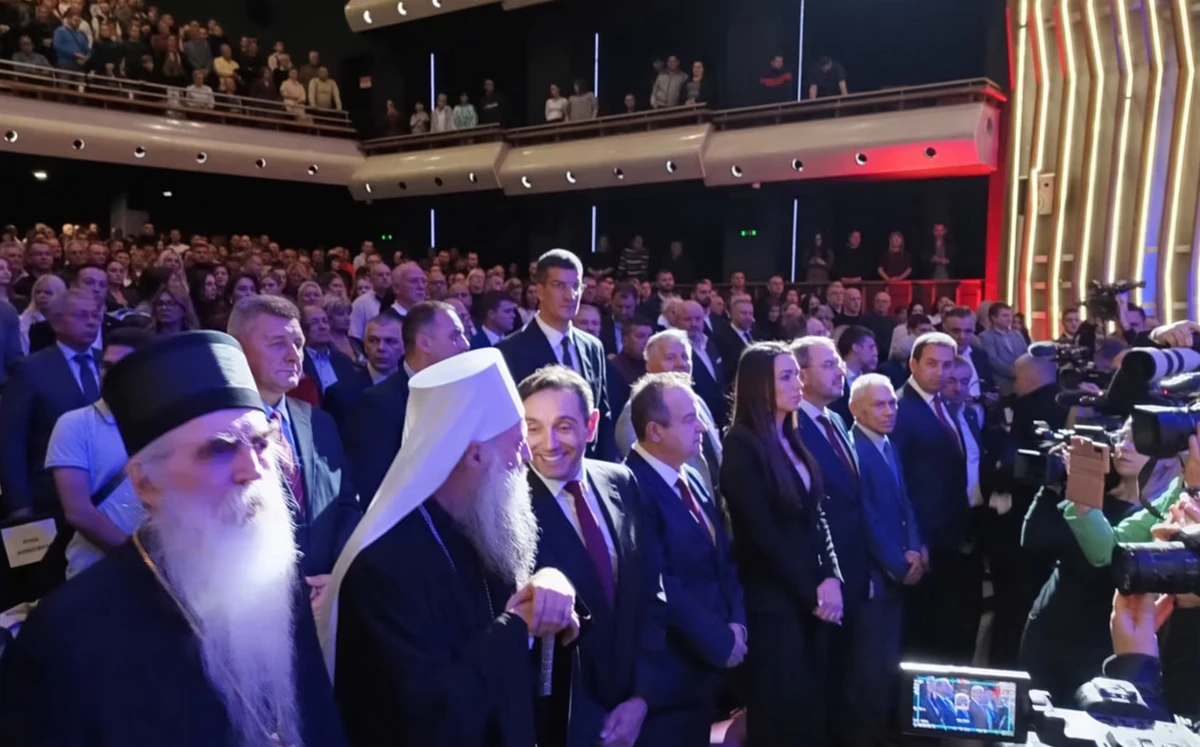
The event was attended by key figures from the Serbian state and the Serbian Orthodox Church: Patriarch Porfirije, Interior Minister Ivica Dačić, Russian Ambassador Aleksandr Bocan-Kharchenko, and representatives of the Russian Academy of Sciences. The national anthems of Russia, Serbia, and Republika Srpska were played as symbols of spiritual and political unity.
This political-religious ritual reinforces the fact that Serbia is no longer operating solely within the domain of classical diplomacy, but is constructing a hybrid ideological infrastructure, where history, religion, and security intertwine to produce a shared identity with Russia.
Naryshkin, Vulin, and the “Academization” of Influence
At the head of the Russian Historical Society stands Sergey Naryshkin, Director of the Foreign Intelligence Service of the Russian Federation (SVR), a fact that gives this institution an unmistakably intelligence-oriented character. Naryshkin introduced the society’s establishment through a video message, describing it as “a confirmation of the spiritual and historical connection between the Russian and Serbian peoples.” To an uninformed audience, this may sound like cultural rhetoric, but for security analysts, it signals a direct infiltration of the Russian influence apparatus into Serbia’s system of knowledge and culture.
In practice, this society will function as a platform for:
- rewriting regional history in line with the Russian narrative (“NATO as the aggressor,” “Serbia as the historical victim”);
- spreading cultural propaganda under the guise of “scientific cooperation”;
- and preparing the ground for infiltration into educational and media institutions.
Whereas Russian influence in Serbia once operated primarily through energy, media, and politics, it is now being capillarized into the fields of history and collective memory, the domains most difficult for Euro-Atlantic structures to neutralize.
Lavrov and the “New Security Architecture”: Rhetoric as a Cover
At the same time, in Minsk, Sergey Lavrov warned that “Europe is preparing for war,” but claimed that Russia “does not target any NATO or EU member state.” He proposed the creation of a “pan-continental structure of Euro-Asian security,” presenting Moscow as an alternative to the Western order based on NATO. This idea of a “new security architecture” is essentially a reformulation of Aleksandr Dugin’s doctrine of the Euro-Asian space, in which Russia positions itself as a spiritual and civilizational center opposing “Western degeneration.”
In practical terms, Lavrov used the same logic to delegitimize Kosovo’s independence, comparing it to the annexation of Ukrainian regions, a legally and politically false comparison. Kosovo declared independence following Serbian genocide and apartheid against Albanians, which ended only after NATO’s humanitarian intervention and a process supervised by the UN and the EU. In 2010, the International Court of Justice confirmed that Kosovo’s declaration of independence “did not violate international law.” Russian “referendums” in occupied territories, by contrast, are illegal acts under international humanitarian law.
This comparison shows that Russia does not seek genuine dialogue but rather aims to normalize its annexationist methods by relativizing historical facts. And this is precisely where the function of the Russian Historical Society comes into play: to make such narratives acceptable through so-called “historical reasoning.”
Vučić and the Double Game
Within this scheme, Vučić remains the figure of façade neutrality. While he declares to the domestic audience that he “will never recognize Kosovo, and if someone after him wishes to do so, they can do it themselves,” presenting himself as the sole defender of Kosovo, he simultaneously portrays himself to the European Union as a leader ready to integrate Serbia into the EU, but not with an independent Kosovo.
Through this stance, Vučić openly displays resistance to peace and security in Europe. This deliberate duality serves as a Russian tool to keep Serbia tied to Brussels while using it as a gateway for the strategic realization of Moscow’s interests.
Unlike all other EU candidate states, Serbia has not imposed sanctions on Russia and continues to engage in coordinated activities with the Russian propaganda apparatus, as demonstrated by the establishment of the Russian Historical Society.
The Splitting of the Euro-Asian Front and the Threat to Western Security
The Lavrov–Vučić–Vulin triad marks a clear partitioning of the Euro-Asian front and the creation of an ultimatum-style strategic line: either Russian-Serbian interests are accepted in Europe, or confrontation follows.
This strategy is a coordinated diplomatic threat that followed a series of drone provocations from Estonia to Kosovo, testing the response of the Western security line.
The events indicate hybrid preparations for a new conflict, where diplomacy, historical propaganda, and controlled military actions are combined to force a change in the European security order.
Vučić’s statements about a “change in the geopolitical circumstances” are directly linked to this plan, signaling readiness to act against Kosovo the moment the international balance weakens.
In this context, the Russian Historical Society in Serbia is not a cultural project but an ideological infrastructure of hybrid warfare, preparing the political and spiritual justification for the next phase of Russian-Serbian confrontation with the West.
© 2025 Argumentum