























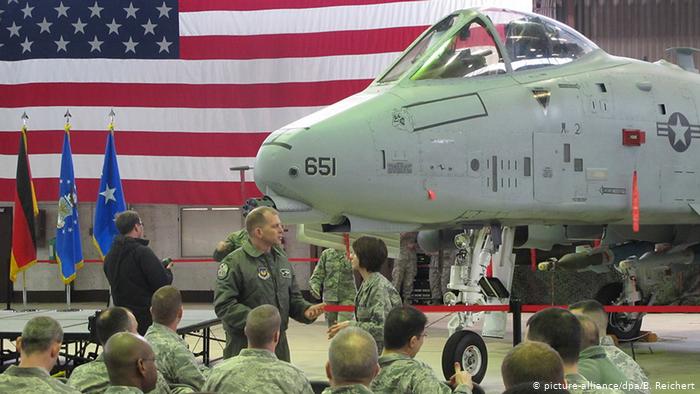
The US is to pull thousands of combat soldiers out of Germany back to America in a political blow by president Donald Trump.
Nearly 12,000 U.S. troops will pull out of Germany as soon as is feasible, the Pentagon announced on Wednesday, but the ones who will be stationed back in the U.S. may be called up for rotational deployments back to Europe.
Under the plan, troop levels in Germany would drop from 36,000 to just over 24,000, Defense Secretary Esper told reporters, with 5,600 of those re-positioned to other European countries and the remainder shifting to U.S. bases to be determined.
“I want to note that this plan is subject to, and likely will, change to some degree as it evolves over time,” he said in his opening remarks.
The plan would move at least two headquarters elements out of Stuttgart, Germany, and over to Mons, Belgium, according to U.S. European Command boss Air Force Gen. Tod Wolters, specifically EUCOM and Special Operations Command, Europe.
Africa Command, also based at Stuttgart, could also move out of Germany, officials said, though that decision will come with the completion of AFRICOM’s review.
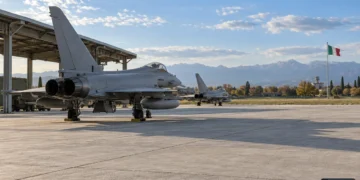
Elsewhere, an Air Force fighter squadron and support elements would move from Germany to Italy, while a group of 2,500 airmen who had been scheduled to shift from Royal Air Force Base Mildenhall, United Kingdom, to Germany will stay put, Esper said.
“Once Warsaw assigns a defense cooperation agreement and burden sharing deal as previously pledged, there are may be other opportunities as well to move additional forces into Poland and the Baltics,” Esper added.
In that way, he explained, troop presence in Europe will more closely mirror the new Eastern front. When the U.S. first began basing troops in Germany, to deter the Soviet Union, it was one of the farthest east allies to work with.
Now, with much of the former Soviet Union having joined NATO ― while still contending with Russian advances ― the U.S. has been spending more time working with troops in countries like Poland, Latvia, Lithuania, Bulgaria, Ukraine and more.
“These changes will achieve the core principles of enhancing U.S. and NATO deterrence of Russia, strengthening NATO, reassuring allies and improving us strategic flexibility and EUCOM operational flexibility,” he said.
That partner training has been done by a mix of Germany-based units moving east for weeks at a time, as well as U.S.-based Army brigade combat team rotating through.
Rotations allow the Army, for example, to save the logistics of moving entire families to Germany and then sending soldiers to the field for short stints.
“And I will say this much: the deployment rotational forces from the United States we have observed, whether it’s the [armored brigade combat teams] going from the United States to Korea with ABCT to Poland, or the bomber task force, we’re finding that they are deploying at a much higher level of readiness,” Esper said, citing other examples of rotational forces. “And while they are deployed, they are … able to sustain a much more fixed focus on their mission and their capabilities. And they can third, they can provide a more enduring presence.”
Trump: Germany is not paying their bills
As Pentagon leadership briefed reporters, President Donald Trump answered questions about Germany and NATO on the White House lawn.
“Germany is not paying their bills,” he said. “They’re delinquent. It’s simple.”
An non-mandatory target has NATO members paying 2 percent of their gross domestic product toward shared security costs by 2024, but few of those countries are meeting that benchmark. That includes Germany, at an estimated 1.38 percent in 2019, but also Italy and Belgium ― who paid an estimated 1.22 percent and 0.93, respectively, last year. Poland has reached that goal.
“Let’s be clear: I think Germany is the wealthiest country in Europe. Germany can and should pay more to its defense,” Esper said. “It should certainly meet the 2-percent standard, and I would argue go above and beyond that.”
The Pentagon’s plan was focused on maximizing readiness and reassuring allies, Esper said, while at the same time under pressure from the president, who has repeatedly targeted Germany.
While Esper had hinted at rejiggering Europe force structure last year, he said that Trump’s rhetoric “accelerated” the plan./compiled from wires- argumentum.al