























Pre-politicality, Cultural Wars and the Intellectual Insufficiency of Croatian Modernity
By Zlatko Kramarić* |ARGUMENTUM
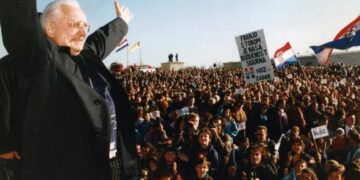
In one of the strongest and most far-reaching diagnoses of Croatian society, expressed in the spring of 1990, immediately after the first multi-party elections, Vlado Gotovac stated that Croats were a “neglected nation”. That assertion, spoken from the position of an intellectual who, after many years of dissident experience, suddenly found himself at the centre of the political process, sounded like a social alarm and a political warning. In that claim, Gotovac summarised the drama of a nation that had never lived political freedom in continuity, and which, when it finally achieved freedom, was left without the institutional, intellectual, and moral preparation for its use.
Even then it should have been clear that the statement about a “neglected nation” represented a serious diagnosis, because by “neglect” Gotovac meant something far more serious than social or cultural backwardness. He was alluding to the pre‑politicality of a nation/community that was only just freeing itself from the burden of a totalitarian, undemocratic system, and which knew almost nothing about what awaited it in the new political‑economic context.
That is precisely why Gotovac’s diagnosis is even more relevant today, in a time of Croatian pseudo‑cultural wars, ideological simulacra, and infantilised political debates. Today’s Croatian society, as if confirming his warning, often behaves as a political nation only in form, and as a pre‑political community in mentality. Democracy exists, but democratic culture remains fragile; pluralism has been established, but that still does not mean that a pluralistic consciousness exists.
1. Pre‑politicality as Croatia’s 20th‑century burden
Pre‑politicality — a term that can be traced in theory through the texts of H. Arendt and C. Lefort — denotes a condition in which a political system exists, but the political subject has not yet been formed. In such a condition, politics is conducted but not understood; institutions operate but are not experienced as one’s own; public debate continues, but is conducted not only without criteria, but without a basic understanding of the content of the debate itself.
For the Croatian case, the fragmentation of political memory is particularly important: each regime — Austro-Hungarian, royalist, the unfortunate and tragic NDH, communist, post-communist — introduced new loyalties and new traditions, while extinguishing and, for the most part, thoroughly delegitimising all previous ones. This is why Gotovac can say that the Croatian nation is “neglected”: not because it lacks talent, ethical sense, or culture, but because it lacks a long history of political responsibility and an awareness of its necessity.
Croatia entered democracy in the 1990s without a layer of mature political intelligence capable of moderating that traumatic transition. It is true that after 1990 Croatia freed itself relatively quickly from the totalitarian framework, but it developed the institutions of political culture slowly: debates, a critical public sphere, clear value orientations. During the war, this immaturity was concealed by existential necessity (the war temporarily homogenised and mobilised the moral energy of the nation), but after the war it returned in almost unchanged form. Even today, this immaturity is visible in our pervasive insecurity, cyclical pseudo-cultural wars, dependence on moralising poses… In such an atmosphere there is little need for more serious political argumentation that could offer adequate answers to problematic situations.
2. The double insufficiency of Croatian elites
Gotovac recognised very early what later proved true: Croatian intellectual elites, with a few exceptions, were not equal to the historical moment. In the post-Yugoslav period, these weaknesses take on a double form.
A. The post-Yugoslav moralistic elite
Among the authors and activists who built their political legitimacy primarily on a moral reading of the Yugoslav collapse are, for example, Boris Buden, Miljenko Jergović, Velimir Visković, Igor Mandić, Predrag Matvejević, Slavenka Drakulić, Dubravka Ugrešić, Slobodan Šnajder, Branimir Johnny Štulić, Rade Šerbedžija, Dejan Jović… This narrative is also systematically promoted within a large part of the academic community. It is present in mainstream media and on public television as well. In other words, this is an elite that controls most of the symbolic capital.
This approach is problematic not because of its critical distance toward nationalism — that in itself is not questionable; on the contrary, it is necessary — but because of the transformation of moral discourse into dogma, into a hermetically closed hermeneutical framework that prevents real political thinking.
Their cultural pessimism has grown into moral superiority, and moral superiority into political negation. In doing so, they have unconsciously reproduced one form of pre-politicality — the inability to think about one’s own political community outside the Yugoslav/Serbian framework.
B. The right-wing elite without theoretical substance
On the other hand, the right-wing in all these years has not been theoretically convincing. It has remained ideologically fragmented, with much rhetorical energy but little real conceptual strength. In the 1990s it won elections (presidential, parliamentary…) relatively easily and almost automatically, with an obvious consequence: victory soon became a substitute for politics. Opening toward Europe, NATO, and modernisation processes often proceeded by inertia rather than through a considered strategy and clear political projections.
C. Outcome
Thus, a stable pattern was established: one side offers moralistic criticism without a political programme; the other offers political power without intellectual foundation.
Between these two poles, Gotovac remains one of the few advocates of freedom, responsibility, and political integrity.
In the last decade, a new group of quasi-liberals/activists has also emerged — loud, dominant in the media, but intellectually short of memory. This group usually advocates standard European values, but without real knowledge of European (and national) political and cultural history. Because of this, their messages often sound more like appealing slogans than serious arguments. As such, these messages not only remain within the framework of superior “political correctness”, but for reasons difficult to understand, they uncritically adopt the narratives of minority (Serbian) politics, without at all considering the possible problematic or manipulative aspects of that narrative.
The result of all this is what Gotovac called “neglect”: a lack of memory, self-defensive sensitivity, and a permanent unpreparedness for political conversation.
3. Cultural wars as a simulacrum of politics
Today’s Croatian “cultural wars” — disputes over history, identity, monuments, curricula, gender policies — in most cases are not a sign of a mature democracy, but proof of the emptiness of political content. They function as a substitute for political debate about real issues: economic models, education, institutions, reforms. Thus, in one of his speeches in Parliament, Gotovac stated that “a people who have long been neglected can hardly distinguish freedom from noise”!
Cultural wars are noise: they mobilise emotions, but do not produce strong and independent institutions; they appear to bring political victories, but do not create binding standards of political thought and behavior.
4. Gotovac vs. Camus: a moral vertical without political infrastructure
To understand the political thought of Vlado Gotovac, it is useful to read the texts of Albert Camus. Both men, almost against their own will, became political symbols. Camus, in the French and colonial context, insisted on the “double truth”: the criticism of violence regardless of its source and the defence of the humiliated without ideological conditions. Gotovac did the same in the Croatian context: he defended Croatia’s right to freedom, but also the individual’s right to freedom from his own state.
However, Camus operated within a politically stable republic, while Gotovac operated within a politically unfinished nation that was still searching for a stable republic. That is why Gotovac possesses the moral stature of a Camus, but without the possibility for his ethics to become a generally accepted social practice.
He stands between a moral vision and a pre-political reality — like a bridge that Croatian society has not yet learned to cross.
5. The German “dialectic of guilt” and Croatian moral labyrinths
To further understand the Croatian case, it is useful to recall the German intellectual debates of the 1970s and 1980s, especially those opened by the director Hans Jürgen Syberberg. Syberberg spoke of the “dialectic of guilt”: a condition in which post-war German politics turned into a ritual of repentance, an endless repetition of moral formulas that ceased to be historical responsibility and became a political blockade.
Such a culture, he argued, produced a reactive anger among the young, who fought against moral pedagogy with provocations and destruction. They did not deny guilt — they rejected morality as the sole identity.
When today, without any ideological prejudice, one looks at the confused Croatian youth — shouting what it shouts in our stadiums, streets, and squares, and who tomorrow may concretise that “noise and fury” in some other, destructive way — it becomes clear that this youth, sometimes banal, sometimes truly vulgar, does not act for itself or for a political party, but for something much more noble: it is a symptom of an unfinished catharsis! This youth is the real victim of certain undefined political, social, and economic conditions, of all those “sedimentary” experiences, constant suppressions… It is, as Syberberg accurately defined it, “merely a function of our post-war democracy: the persecuted Erinyes are never beautiful or loved.” Ultimately, every political act takes place on the stage of the historically unconscious.
Similar motifs appear in the dramas and films of Rainer W. Fassbinder, who consistently demonstrated how moral rigidity produces social hypocrisy, and in the texts of Peter Sloterdijk, whose critique of “sentimental moralism” is particularly relevant: morality, he argues, becomes a currency that replaces political arguments, creating an inflation of moral appeals. Camus also warned that politics turned into moral absolutism inevitably collapses into violence or cynical resignation.
We witness today in Croatia how right these authors were. Croatian youth reacts (too) violently to moralising and ideological lecturing with noise, irony, radicalisation, and nihilism. The problem is not only in their behaviour; the problem is that some elites encourage, justify, or use such behaviour as an instrument in their own cultural battles. This is, in fact, a symptom of pre-politicality: instead of political education — moral incitement; instead of argument — identity slogan.
Some in Croatia still believe that every social debate must first be moralised, and only then understood. For them, the problem is not that Dejan Medaković actively participated in writing the SANU Memorandum and in defending war criminals — the problem, in their view, are those who point out these uncomfortable facts! The problem is not that Serbian state television broadcasts a series of programmes on “Serbian Dalmatia”, that at some cultural events of the Serbian community in Croatia songs are sung about “Serbian Dubrovnik”, or that, in the meantime, in the Serbian imaginary, Vlaho Bukovac has become a “great Serbian painter”. No — for them, the real problem are those who refuse to believe that Dalmatia or Dubrovnik are Serbian territory, those who do not accept the new national attribution of Vlaho Bukovac. Therefore, in their eyes, some Croatian reactions to these deliberate provocations appear “slightly exaggerated”.
However, any serious politics should deal with causes, not “moralise” about the consequences to which those causes lead. Such politics is not authentic politics. Such behaviour belongs to village taverns, where every intellectual effort fails to cross the threshold of “café hermeneutics”.
For that reason, it should be clear to all of us that in today’s Croatia it is not possible to reduce the “Yugoslav/Serbian legacy” to a benign aesthetic fact, as one of the organisers of Serbian cultural events in Croatia naively believes. And when we are, rightly, asked to confront our own past, then it should not be considered a political sin if the same is asked of the Serbian community in Croatia. It is unacceptable that representatives of the Serbian minority elite (Milorad Pupovac, Dejan Jović, Čedo Višnjić, much of the editorial staff of Novosti, the SNV weekly…) become moral arbiters of Croatian history, given that they still behave as if they can apply old Yugoslav political models in which the Serbian community in Croatia, after the Second World War, was exempt from the obligation to face its own past, especially its “darker episodes”. The same formula should apply to them: without serious work on memory, there is no lasting change of status in Croatian society.
In the Croatian case, therefore, we are dealing with an inverted but structurally similar phenomenon: instead of a culture of guilt, we have a culture of victimhood. But the consequences are identical: political thinking is replaced by moral discourse. The young respond with anger, irony, provocation. The elite often does not calm this anger — sometimes it even legitimises it — because it suits them in the simulated arena of cultural wars.
Gotovac’s phrase about a “neglected nation” captures precisely this paradox: a nation without a political tradition will easily replace politics with morality — either the morality of the victim, or the morality of accusation. For Gotovac, political maturity meant a balance between moral feeling and political responsibility. He shared that intuition: he believed that a nation must have a moral foundation, but that morality must not become a substitute for politics.
Gotovac’s statement that we are a “neglected nation” is, in fact, the Croatian equivalent of Camus’s formula about “a rebellion that knows its limits”. Croatia has never learned to rebel politically — only morally — and therefore continually returns to a pre-political state. The “culture of political maturity”, Camus would say, does not arise from moral gestures, but from developed institutions, the habit of dialogue, and the capacity to assume responsibility. Ultimately, freedom cannot be maintained by morality alone — freedom is safeguarded by institutions and political maturity. If we still remain “neglected”, then this is not a question of the nation’s talent, but of the insufficient responsibility of the elites — those who always choose the moral or moralising stage instead of true political debate.
6. Conclusion: the exit from pre-politicality still awaits us
Today, thirty-five years after the first democratic elections, the Croatian political scene still seems to hover between moral lecturing and political improvisation. Therefore, we repeatedly return to the same cultural wars, the same symbolic conflicts, and the same historical fears.
Gotovac warned us that a political community cannot live permanently in a pre-political space. If our social life remains contaminated solely by moral imperatives for too long, then there is a real danger that our society will be forced to confront both the rage of an uncontrolled mass and intellectual cynicism. Taking all this into account, it seems that Gotovac was not speaking only about the moment of 1990, but about a structural constant of Croatian modernity.
Pre-politicality persists — in cultural wars, in fragmented elites, in the absence of long-term policies, in tribal media discourse, in the deficit of institutional memory.
Gotovac shows us the way: it is not enough to have democracy — one must also have a democratic culture. It is not enough to have institutions — one must also have an institutional mentality. It is not enough to have pluralism — one must also have a pluralistic consciousness.
For the citizens of Croatia to truly become a political nation, they must move from the pre-political to the political phase of thinking, acting, and behaving. However, this transition requires more than elections and laws: it requires work on collective culture, memory, responsibility, and the sincere adoption and practice of serious standards.
*Zlatko Kramarić is a Croatian publicist, author, and diplomat, currently serving as Ambassador to Albania. Formerly a university professor and politician, he is known for his work in literature, cultural studies, and regional history.
© 2025 Argumentum