




'/%3E%3C/svg%3E)
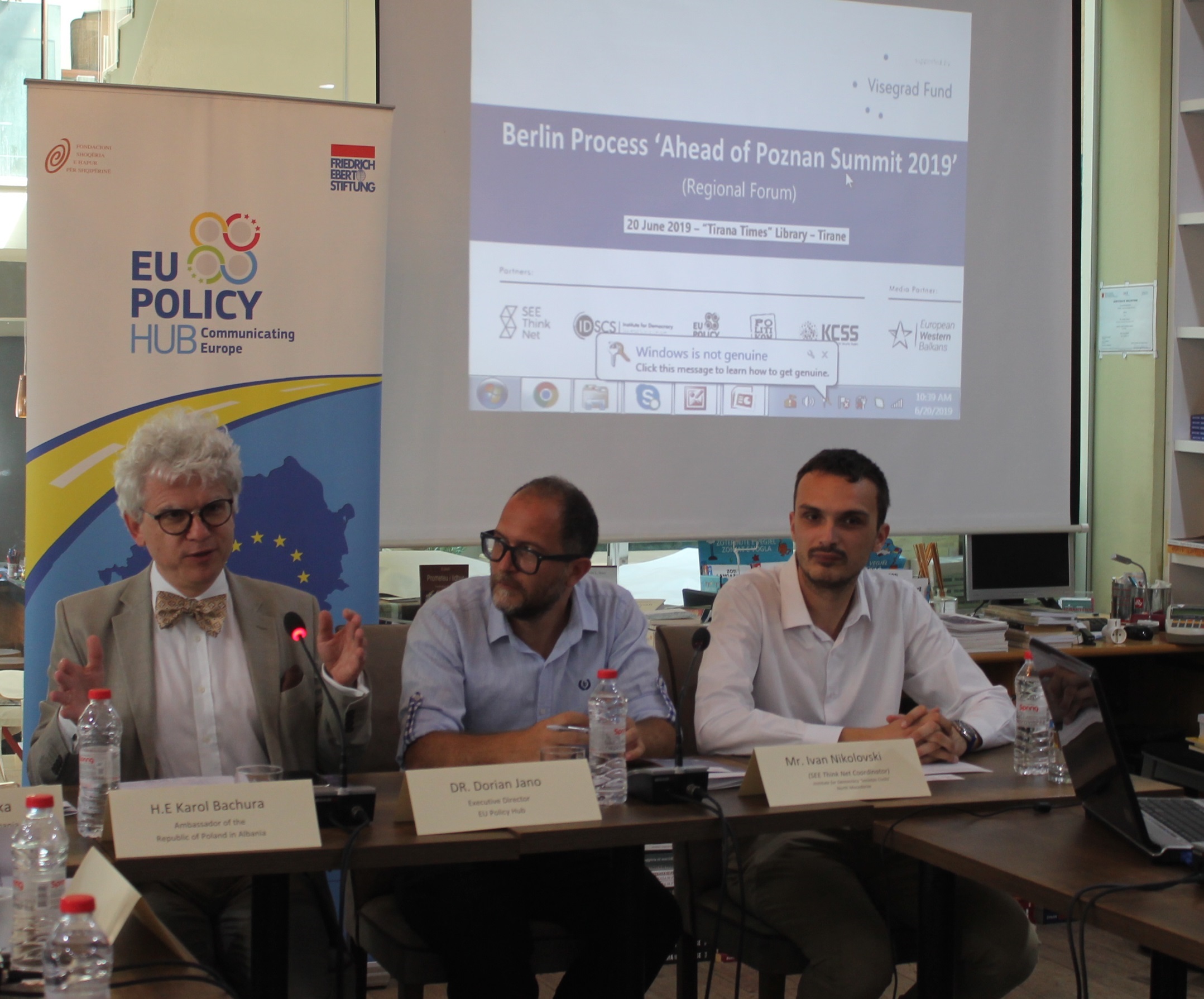
“Berlin Process ‘Ahead of Poznan Summit 2019′” Forum in Tirana
“We stick to four pillars which are the priorities of our Presidency Program: economy, connectivity, civil society (comprising youth and culture), and security,” explained Ambassador Karol Bachura. “ We intend to make economy, business and connectivity the main focus of the Poznan summit. Support for small and medium enterprises, innovation, implementation of the Regional Economic Area, energy and transport connectivity will be prominently included on the agenda of the ministerial meeting and/or accompanying events”
By Genc Mlloja
Senior Diplomatic Editor
“Poland is very satisfied to have joined the ‘Berlin Process’ and to organize the Western Balkans Summit in Poznan in July 2019. For Poland the ‘Berlin Process’ is neither an alternative to the enlargement policy, nor its duplication, but a format which complements the activity of the European Commission and supports reforms contributing to Western Balkans’ progress on the European path. Supporting enlargement, the Berlin Process can provide additional political momentum and vision, and is an opportunity to connect with entrepreneurs, civil society, and youth,” has said the Polish Ambassador to Albania, Karol Bachura.
The Ambassador made that comment on June 20 at the Regional Forum “Berlin Process ‘Ahead of Poznan Summit 2019′” organized in Tirana by the EU Policy Hub in the framework of SEE THINK NET, which gathered representatives from the Albanian government, international community, academia and experts in the field, in an open discussion about the future of the Western Balkans in EU and how the ‘Berlin Process’ can contribute to this path. During this event the partner organizations presented two recent policy briefs that provide important analysis on the development of the Rule of Law and Security Cooperation in the Western Balkans.
SEE Think Net Network was established in mid-march 2018 with the goal to produce and contribute significant policy inputs and provide policy recommendations on topics that derive from the ‘Berlin Process’, and as such its activities are devised in order to closely monitor this Initiative and the policy areas the process encompasses.
Poznan Summit, strong signal to new EC for continuation
In his address, Ambassador Bachura reiterated the fundamental role that civil society has in this process of EU Integration while stressing the importance of the Poznan Summit which will be held on 4-5 July 2019, the 6th meeting since 2014. He stated that Poland has a great interest for the integration of Western Balkans in EU and is currently working hard for a productive Summit of Poznan 2019. He mentioned that the future of the Western Balkans has only one path: the EU. “The future of the Western Balkans is called European Union.”
The ‘Berlin Process’ has never been replacing formal Enlargement process of the EU but is a platform where all interested parties can share their experiences and efforts towards the integration with the Union, said Mr. Bachura.
The ‘Berlin Process’ was launched by German Chancellor Angela Merkel in 2014 and initially there were speculations that the Initiative would be an alternative to accession in EU of the WB countries something which has been strongly refuted.
“The ‘Berlin Process’ is an informal process. It is expected that it will continue, however the future of it depends on the will of the Western Balkans countries and the evaluation of the Initiative by the members of the EU,” said Warsaw’s top envoy to Tirana in his remarks in the Forum. In addition he noted that the cooperation between governments and third sector is one of the principles of the EU – the closer it is, the better is the understanding of implemented policies in the society as well as its commitment to necessary reforms.
Mr. Bachura highlighted the importance of dialogue in the region saying that it is the answer to many questions. “Polish Presidency to the ‘Berlin Process’ has an intention to provide space and time for such a dialogue – there is an ongoing process of consultations with NGOs in WB, already summed-up in May in Skopje and finally concluded at Civil Society Forum in Poznan during the Summit. CSO were asked to prepare policy-papers so decision-makers will be informed about the expectations and various discussions are to be organized in such a way that governments and non-governments will have a chance not only to meet, but to talk and what is most important to listen to each other.”
In September and November last year Plenipotentiary of the Polish Government, the Secretary of State, Szymon Szynkowski visited all the WB countries to learn about their expectations concerning the WB summit and Polish Presidency in the ‘Berlin Process’. Visits included meetings with the civil society and think tanks in all the six regional countries, including Albania. Poland authorities were keen on getting to know the expectations of both governments and NGOs from WB6 before starting to draft the Polish program.
“We coordinate closely with the United Kingdom, so that there is a follow-up between the summits,” said the Ambassador.
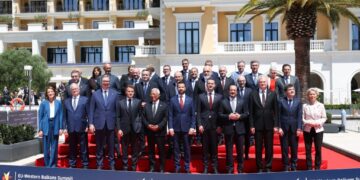
On 10 July 2018 the UK hosted the Western Balkans Summit in London which was considered as a demonstration of its longstanding commitment to the region and to European security despite the fact that it was held against the backdrop of the ‘Brexit’. Heads of Government of the Western Balkans 6, Albania, Bosnia and Herzegovina, Kosovo, Macedonia, Montenegro and Serbia, attended the Summit, and also representatives of Austria, Croatia, France, Germany, Italy, Poland and Slovenia, as well as Bulgaria and Greece and the EU institutions. The Summit was the fifth to take place under the ‘Berlin Process’ after Berlin (2014), Vienna (2015), Paris (2016) and Trieste (2017. That Summit focused on 3 areas, namely increasing economic stability with a view to improving the business environment, encouraging entrepreneurship, addressing youth unemployment, and promoting regional inter-connectivity; strengthening regional security cooperation to help tackle common threats, including corruption, serious and organized crime, trafficking of people, drugs and firearms, terrorism and violent extremism and facilitating political cooperation to help the region resolve bilateral disputes and overcome legacy issues stemming from the conflicts of the 1990s and strengthen democracy.
In his remarks in Tirana Ambassador Bachura noted that the EC’s Western Balkans strategy and Six Flagship initiatives provide a framework for crucial reforms and initiatives needed for region’s progress. “ As the summit in Poznan is going to take place shortly after the EP elections, it will be an excellent opportunity to send a strong signal to the new EC to continue the positive dynamics brought about President Juncker’s State of the Union in 2017,” he said.
WB countries eager for concrete results
The Albanian Deputy Minister of Justice, Fjoralba Caka emphasized in her statement how the ‘Berlin Process’ is strongly connected with the three main columns as defined by the Copenhagen Criteria: Political, Economic, and Acquis Communitaire. In this framework all the Western Balkan countries have a clear road map in achieving such criteria, Mrs. Caka said confirming the Albanian government’s commitment to work with a rapid step in this regard in order to have concrete and tangible results.
Mr. Ivan Nikolovski, presented the initiative of 9 organizations from the Balkan countries united under the name SEE Think Net as the first regional network composed of CSOs to monitor the topics related to the Berlin Process. He stressed the successful engagement and results of the Network members in the supporting and contributing in the efforts and policies towards EU accession.
Ms. Jovana Marovic, Executive Director of Politikon Network, one of the most active CSOs in Montenegro in the field of EU integration, presented the Policy Document “How to foster the Rule of Law in the Western Balkans: 10 notes for the Decision-Makers” focusing on addressing the gaps in the rule of law such as improvement of regulations, change of socio-political culture, improving regional cooperation and transparency. She voiced some of the main concerns that relate mainly to CSO’s approach to access official documents and contribute in the related national policies. “…accessibility of office documents would make governance more transparent and increase citizens’ credibility in policy making”, Ms. Marovic said.
Ms. Donika Emini, representing the Network member, Kosovo Center for Security Studies, presented the Policy Brief: “Regional Security in the Western Balkans: The Role of the Berlin Process” shared with the audience some key observations in regard to regional security cooperation in the Western Balkans. Ms. Emini noted that it is very important to develop closer ties and boost the cooperation among the countries of the region to ensure dissemination of information among law enforcement institutions so that security is conceived at the regional level.
The floor was opened to questions and opinions from the participants who touched different aspects of the Berlin Process and shared their views on the boosting but also the hindering factors concerning the EU integration of the Western Balkans.
In a comment in the event Genc Mlloja, Senior Diplomatic Editor of Albanian Daily News, said he was impressed by the enthusiasm and hard work of Polish authorities to make the Summit a success. Together with some other journalists from WB countries Mr. Mlloja visited the venue where the Summit will be held in Poznan as the first leg of a work tour taking them from Poznan to Gdansk, Sopot and Warsaw from 9 to 15 of June this year.
The coordinators of the Summit told the journalists, who had the opportunity to visit all the sites of the venue on June 10 which was the first leg of their tour in Poland lasting until June 15, that intensive efforts were being made to get everything ready for the event. “We are working day and night to get everything according to the highest level in every aspect for the progress of the events,” the Summit coordinator, Wieslaw Tarka, said, while leading the journalists to see all the facilities which will be available for the Summit. According to him, given the speed of work and the time of the Summit he expected that everything will be ready to host the participants in the events.
As for the program Mlloja quoted State Secretary Szymon Szynkowski as saying among others in an exclusive interview with Albanian Daily News: “We would like that the most important element of this event to be the Civil Society. I believe that the integration of the Western Balkans countries and their people with the EU has to come and grow with the learning and understanding and it has to be a bottom up process. And only then the political agenda can meet what is to be done on the ground.”
ADN’s Mlloja said that the program and preparations being made as well as expectations from the officials of the host country and others be them of EU or WB countries the impression has been created that there will be an ‘After Poznan Berlin Process’.
In a wrap up of the Polish tour in general Mlloja said that given the high rate of development of Poland, its achievements in all fields, particularly after EU membership 15 years ago, and what WB journalists saw and heard, if is spoken of a genuine success story that could be called ‘Polish Success Story’.
Poznan Summit’s Agenda
The Western Balkans summit will take place on 4-5 July, 2019 and the location is going to be Poznan. “The meeting of Leaders will be held on 5th of July while Ministers of Foreign Ministers will gather on 4th of July. The first meeting of ministers of foreign affairs took place in April in order to provide their own visibility and agenda distinctive from the leaders’ one. Focus will be bilateral issues and future of Europe,” said Mr. Bachura while providing some details of the agenda of the Summit.
“We stick to four pillars which are the priorities of our Presidency Program: economy, connectivity, civil society (comprising youth and culture), and security,” he said. “ We intend to make economy, business and connectivity the main focus of the Poznan summit. Support for small and medium enterprises, innovation, implementation of the Regional Economic Area, energy and transport connectivity will be prominently included on the agenda of the ministerial meeting and/or accompanying events.”
In the meantime the EU-WB Business Forum will be organized on the 4th of July and according to the Ambassador it is going to have a strong focus on digital agenda, start-ups, young entrepreneurs. In addition the Interior/security ministers format is going to be continued. In the light of Plenipotentiary’s consultations with the WB, there is value added, especially regarding law enforcement cooperation.
In his address Mr. Bachura also focused on the reconciliation of the Balkan societies as a key element of the Berlin Process. “ A success of the Berlin Process is supporting regional cooperation and good neighborly relations, as well as youth and civil society cooperation. RYCO is one of the most significant achievements of the ‘Berlin Process’. Tackling the legacy of the past and work on the bilateral issues is an important dimension of the Initiative,” he said. In the meantime, Mr. Bachura announced that the Civil Society Forum will be held on July 4 while a Think Tank Forum will gather on July 3. “We plan to engage the civil society, think tanks and youth organizations, and organize cultural events accompanying the summit (e.g. exhibitions, concerts). We would like to bring EU and WB societies closer together through culture,” said the Ambassador.
Prior events before Poznan Summit
Polish Chairmanship in the Berlin Process is considered more than just the Western Balkans Summit. There were other events: meetings, workshops, seminars and conferences, implementing priorities of the Polish Presidency. Some of them included the following:
February 15th: WB Ministers for European Affairs and European Commission (EC) meeti
February 25th: roundtable with the civil society, Tirana
February 26th: roundtable with the civil society, Podgorica
February 28th: roundtable with the civil society, Sarajevo
March 6th: PL, UK and Global Initiative against Organized Crime seminar on anti-corruption, Warsaw
April 11th to 12th: Berlin Process Ministers of Foreign Affairs meeting
April 24th to 25th: roundtable with the civil society, Pristina
April 24th to 25th: WB and PL Statistical Offices conference, Warsaw
May 9th: Balkan Dinner, Poznan
May 10th to 18th: WB Cultural Week, Poznan
May 13th to 14th: WB Think-Tank Forum Reinforcing the European Integration of the Western Balkans, Skopje
May 21st to 26th: 21-26: Balkan Film Fest, Poznan
May 29th: Conference Western Balkans: Infrastructure and Energy from a Geopolitical Perspective, Warsaw
May 29th to 31st: Seminar Digital Youth Work and Innovation, Warsaw
June 4th to 6th: Forum of Cities and Regions Investing in Western Balkans – Investing in Europe, Rzeszow