








































'/%3E%3C/svg%3E)

By Dr. Ermir I. Hajdini
Legal Analyst & University Lecturer
When European Commission President Ursula von der Leyen issued her latest warning regarding the European Union’s trade gap with China—a deficit that has expanded to nearly €1 billion a day[^1]—she articulated a symptom while misdiagnosing the disease. Facing a €103 billion quarterly goods deficit in mid-2026[^2], Brussels’ response has mirrored Washington’s reactionary playbook: threatening trade-defence instruments, countervailing duties, and regulatory barriers designed to force “rebalancing.”
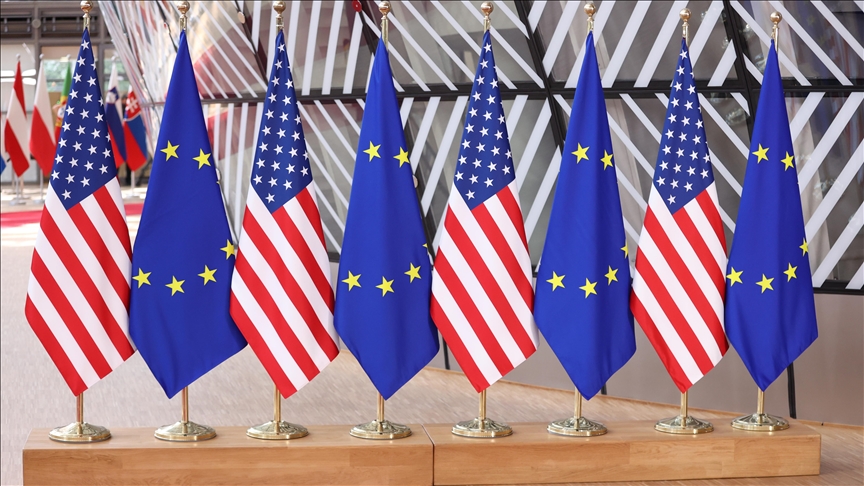
Yet across the Atlantic, the paradigm is structurally identical. Whether framed in Donald Trump’s aggressive tariff unilateralism or von der Leyen’s bureaucratic “de-risking” apparatus, both transatlantic powers have retreated into defensive trade policy. This convergence exposes a fundamental misunderstanding of global economic realpolitik. In client-oriented, consumption-driven economies that have spent decades offloading energy intensity and manufacturing infrastructure, trade restrictions are not a instrument of leverage—they are a late, costly, and structurally ineffective attempt to reverse lost competitiveness.
The Flawed Mechanics of Defensive Trade Instruments
Defensive trade policy operates on an obsolete premise: that foreign state-backed producers will simply absorb cost increases, and domestic industries will spontaneously re-emerge behind tariff walls. In reality, state-subsidized economies adapt dynamically. As demonstrated in extensive empirical literature on global trade flows and state interventions, targeted industrial subsidies in raw materials and energy create a compounding price advantage for downstream advanced manufacturing[^3]. Defensive tariffs applied at the final assembly level do not erase these upstream structural disparities; they merely redirect trade through third-party intermediaries or force foreign firms to absorb margins to maintain market dominance.
“Trade restrictions cannot fabricate manufacturing capacity by decree. Protective tariffs applied to an economy burdened by high energy costs, capital fragmentation, and regulatory overreach serve only as a tax on domestic consumers and downstream industries.”
Furthermore, deploying tariffs in consumer-oriented economies creates severe self-inflicted distortions. When a nation lacking domestic manufacturing scale imposes restrictions on cheap foreign inputs, it raises input costs for its own remaining industrial base. The outcome is not industrial renaissance, but systemic inflation, reduced profit margins, and accelerated capital flight toward lower-cost jurisdictions.
The Structural Roots of the Transatlantic Gap
The core vulnerability of both the EU and the US is not unfair foreign practice, but internal structural decay. As noted in critical evaluations of European economic performance—and echoed in European Central Bank President Christine Lagarde’s warnings regarding the erosion of Europe’s economic pillars[^4]—the West suffers from a self-inflicted “delayed awakening.”[^5]
For Europe, decades of relying on cheap piped energy, underinvesting in frontier technologies, and enforcing heavy precautionary regulations (such as the EU Artificial Intelligence Act) have systematically eroded its manufacturing engine. Capital continuously flees the continent, seeking higher returns and lower operational costs in foreign markets[^6]. For the United States, while financialization and domestic consumption have sustained GDP growth figures, the physical infrastructure, supply chain depth, and skilled labor force required for large-scale advanced manufacturing have severely atrophied.
| Economic Paradigm | Reactive Trade Policy (Current US / EU) | Structural Competitiveness (Required) |
| Primary Focus | Tariffs, anti-subsidy duties, export controls | Supply-side transformation & energy security |
| Industrial Effect | Protects inefficient incumbents; inflates costs | Fosters scale, capital intensity, & rapid execution |
| Energy Strategy | Short-term subsidies & regulatory mandates | Securing abundant, cheap, base-load power |
| Capital Deployment | Fragmented national subsidies (subsidy wars) | Deep capital market union & focused execution |
Beyond the Subsidy Fallacy: The Need for Structural Realignment
Attempting to counter Beijing’s industrial strategy by engaging in a domestic “subsidy war” or erecting high trade barriers is financially ruinous for debt-laden Western states. As the International Monetary Fund has consistently pointed out, responding to foreign industrial policies with uncoordinated national subsidies creates fiscal drag without building real market competitiveness[^7].
If Brussels and Washington wish to halt their structural decline, they must abandon the illusion that defensive trade tools can substitute for industrial capability. True economic power in a multipolar world relies on real output, supply chain resilience, and technological execution. Without deep structural reforms—re-anchoring affordable energy, slashing administrative friction, unifying capital markets, and restoring physical manufacturing capacity—von der Leyen’s €1 billion-a-day trade gap will not remain merely a statistic. It will stand as the permanent metric of Western strategic stagnation.
References & Notes
[^1]: Eurostat Press Office, “EU Trade in Goods with China: Q2 2026 Statistical Update,” European Commission, August 2026.
[^2]: Euronews Business, “EU Trade Deficit with China Nears €1 Billion a Day as Von der Leyen Demands Action,” August 27, 2026.
[^3]: International Monetary Fund (IMF), “Trade Implications of Industrial Subsidies: Macroeconomic Effects and Spillover Channels,” IMF Policy Paper, 2024.
[^4]: Christine Lagarde, “The Changing Geopolitical Landscape and European Competitiveness,” Keynote Address by the President of the ECB at the World Economic Forum’s International Business Council, Geneva, November 2026.
[^5]: Dr. Ermir I. Hajdini, “The Delayed Awakening: Realpolitik and the Structural Causes of European Stagnation,” Argumentum, Tirana, 2026.
[^6]: European Central Bank, “Capital Outflows and Investment Trends in the Euro Area,” Occasional Paper Series, No. 312, 2025.
[^7]: International Monetary Fund (IMF), “Industrial Policy and Global Trade: Fiscal Risks in Advanced Economies,” IMF World Economic Outlook Analytical Chapters, 2025.
© 2026 Argumentum