






By Dr. Zlatko Kramarić| ARGUMENTUM
Ambassador of Croatia to Albania
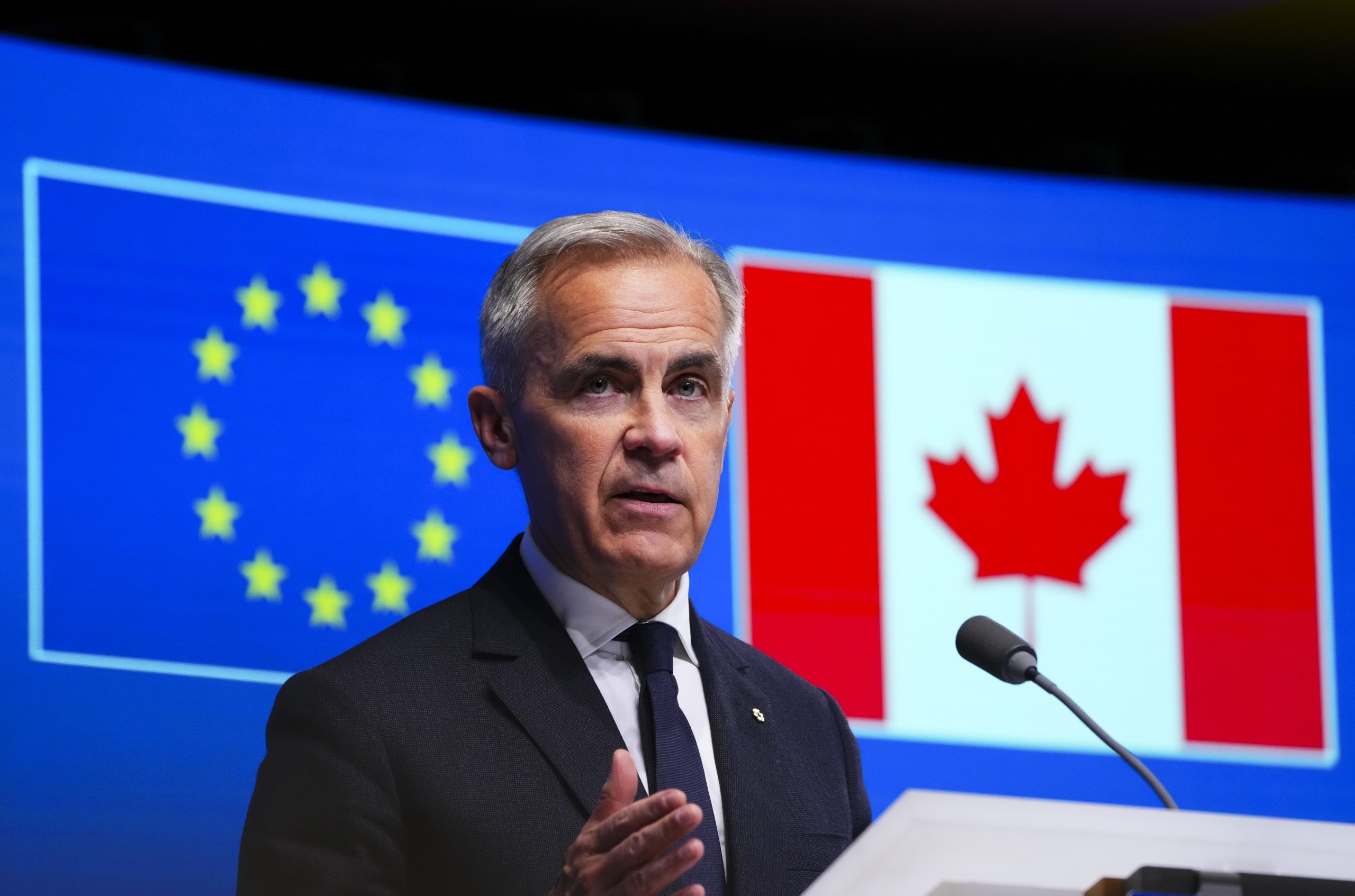
In the speech delivered by the Canadian Prime Minister in Davos, I do not see merely a brilliant political commentary on the time we live in. Rather, it is a speech that precisely identifies most of the symptoms of the profound changes in the global constellation. From the European perspective, but also from our own, that speech functions as a kind of external mirror of Europe. Not because it reveals anything new, but because it articulates what Europe has known for a long time yet, for reasons difficult to understand, has avoided expressing: the world has returned to power politics, while Europe still speaks the language of post-political self-confidence. This fact undeniably testifies to Europe’s spiritual powerlessness, to its fatigue. It is therefore worth keeping in mind that those who are tired, old, and powerless are not capable of carrying out any political or other changes.
Canada, which sees itself as a middle power without imperial ambitions, demonstrates an enviable level of normative lucidity. It is aware of the end of liberal illusions, yet despite this awareness it does not abandon liberal values. Europe, paradoxically, does the opposite: it retains all those values as a rhetorical framework, but in the meantime has lost faith in their historical effectiveness. In my view, this is the very core of today’s European crisis, which is by no means the result of institutional weakness. This crisis has emerged primarily because of a complete spiritual insufficiency—an inability to provide adequate, that is, timely answers to existing political and other relations in the world.
It is precisely for this reason that the speech of the Canadian Prime Minister appears almost subversive to a European audience. Not because it offers solutions, but because it shows that it is still possible to speak about democracy without irony and without defeatism. Canada acknowledges the reality of a multipolar world, but does not relativise values; Europe, paradoxically, often relativises its own values precisely because it considers them “self-evident”. Unfortunately, European leaders have evidently not read carefully the texts of K. Marx, who said that “all that is solid melts into air”! And it is precisely this generation of Europeans that is witnessing that transformation of the “solid” into “air” — the very idea that America under Trump might side with Russia in the Ukrainian crisis erases many of the assumptions on which the world of most Europeans was based.
Depoliticised Europe and the Illusion of Governance
In his recent interventions, Ivan Krastev does not speak of Europe as a failed project, but as a project that has lost its narrative of the future. His diagnosis of a depressive public mood is particularly important: today, the European citizen fears not only war, migration, or economic problems, but also historical return — the feeling that Europe is returning to 1914, 1938, or 1989, but without a clear awareness of the real reasons for those returns, and into a worse past. Ultimately, war, the collapse of empires, and authoritarianism are all painful European experiences. However, it would be wrong to reduce the problem exclusively to negative memories. Doing so would oversimplify it. The real problem lies in the absence of the future. There is no doubt that (bad) memories prevail in the European consciousness, while expectations and hope have been reduced to a minimum.
This is precisely the point of convergence between our views and those of I. Krastev: the European spirit has not disappeared because it was challenged from outside, but because it has ceased to be the subject of internal debate. European politics speaks a technical language of regulations, funds, and procedures, while the public sphere remains without an elementary philosophical and cultural horizon that might, at least partially, justify these ad hoc policies.
In my texts on the European spirit, I have repeatedly emphasised that Europe did not emerge as a project of stability, but as a project of (self-)critique. From the Enlightenment onwards, European identity was shaped through a permanent conflict of ideas, through doubt, through constant questioning of its own foundations. Today, however, we are witnessing what I would — following the fundamental premises of critical theory — call the structural depoliticisation of Europe, in which the “political” has been replaced by the managerial. Conflict has been replaced by procedure (and we often have the impression that these procedural actions are mostly meaningless, unnecessary, and boring). Vision has been replaced by crisis management. In this context, the European citizen does not so much feel repression as suffer from the feeling of living in a world devoid of all meaning. It is, therefore not surprising that Ivan Krastev quite rightly speaks of a depressive state of European public opinion, where this depression does not represent an emotional problem or condition, but is par excellence a political fact.
“The next ten years will have two important characteristics. The first is that, psychologically, they will be extremely intense. Everything will revolve around how you feel, so even great powers will have their teenage five minutes. We have entered a period in which they are all searching for new geopolitical identities.”
Depression, nostalgia, and melancholy here are categories and derivatives of critical theory. They denote states in which the subject no longer sees itself as an actor of history, but as an object of processes that it not only fails to understand but is also incapable of controlling. Europe today suffers precisely from this: from the feeling that history has “happened to others”, while it has remained trapped in its own normative self-understanding. It would therefore be more than desirable for Europe finally to understand that alliance with America is not an eternal category — especially not now, when D. Trump is the President of the United States for whom Venezuela is evidently more important than Ukraine.
Critically speaking, this is a paradox of late liberalism: societies that are institutionally the most stable are simultaneously the most existentially insecure. In this sense, Europe no longer produces political ideas, but political reactions. It merely responds, while initiating almost nothing. This is precisely why the speech of the Canadian Prime Minister sounds like an external warning — a reminder that it is still possible to speak about democracy without irony, but also without naivety.
The European Spirit as a Lost Practice
For me, the European spirit has always been a practice, not a dogma. Not a set of “values”, but a way of thinking. Today, these values are often repeated mechanically, as if their validity were independent of political and social context. Critical theory, however, teaches us the opposite: values that are not lived and not questioned turn into mere ideology.
In this sense, today’s Europe is not cynical, but conformist. It does not reject its own ideals, but it no longer questions them — and it was precisely this (self-)critical attitude that formed the foundation of its historical strength. The European spirit was never a mere set of values, but a constant process of self-questioning — from Augustine and Erasmus, through Kant and Husserl, to Krleža, Miłosz, and Kundera. European thought has always emerged through a constant confrontation between ideals and (harsh) reality. Today, this process has almost entirely been replaced by a managerial logic, which produces political stability without spiritual legitimacy. We should always bear in mind that every relativisation is a sure path towards complete intellectual emptiness.
Instead of a Conclusion
From my perspective, the current geopolitical situation is not merely a test of European institutions, but a test of European self-awareness. If Europe wishes to remain a historical subject, it must relearn how to think itself. And this thinking must take place within new theoretical paradigms. We must say goodbye to all melancholic moods that lead Europe to perceive itself as being in a much worse position than it actually is (I. Krastev).
Otherwise, Europe will not be defeated from the outside. It will slowly but surely disintegrate from within, in the silence of irrational administrative efficiency and public indifference. And that would, paradoxically, be its most non-European end. Therefore, we must by no means allow pessimism to become the dominant sentiment in European societies. “Now we risk becoming victims of excessive pessimism. That reminds me of a man who wants to kill himself out of fear of death.” Europe needs mobilisation — in all segments of society. From “competitive decadence”, in which we console ourselves by noting that others are worse off than us, there is little benefit. For between pessimism and optimism, one should always choose HOPE.
© 2026 Argumentum